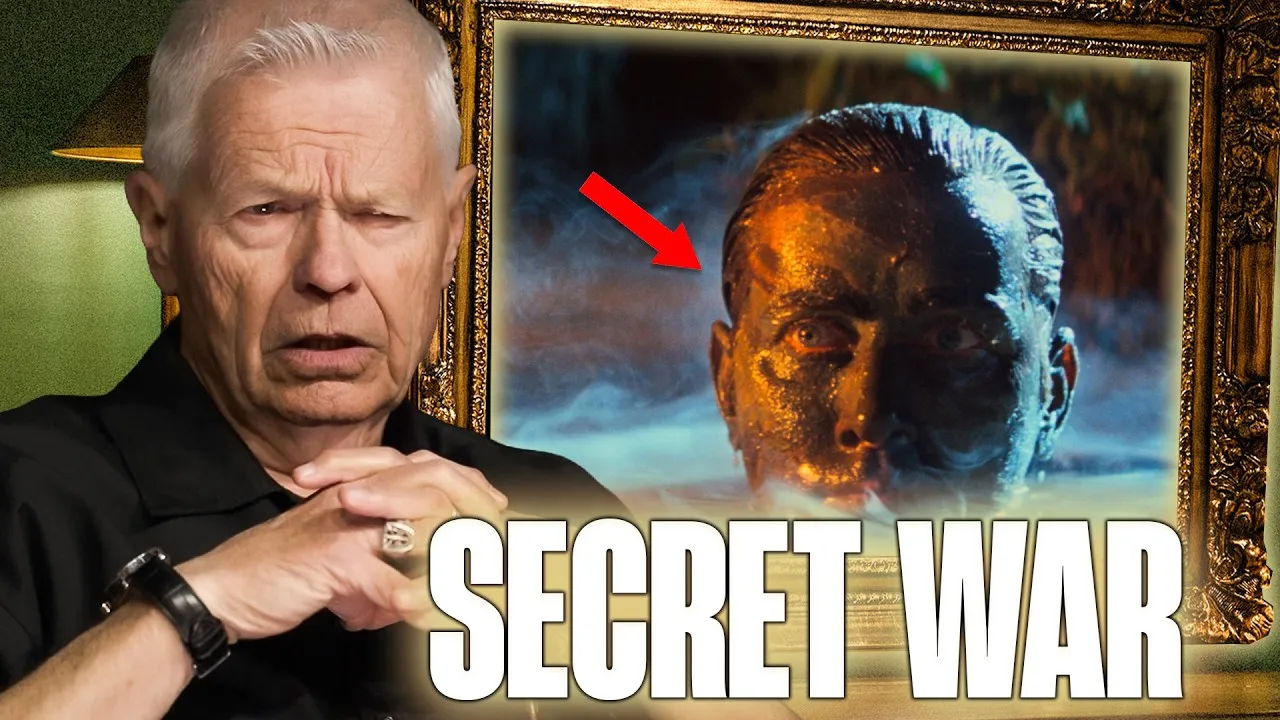
John Stryker Meyer says MACV-SOG reports went directly to the White House and he could not talk for 20 years
The Vietnam veteran’s account of the secret war is less a war story than a lesson in how a country hides a war from itself.
Listen on YouTube · Spotify · Apple Podcasts
 WATCH NOW↓
 John Stryker Meyer’s version of the secret war begins with paperwork, which is about as American as it gets. Before the maps, before the helicopters, before the bomb crater, the future MACV-SOG operator says he was handed an NDA that told him he could not discuss what he was about to do for 20 years, and that his reports would go “directly to the White House.”
That is the claim that makes this Shawn Ryan Show clip more than another veteran’s campfire story with better microphones. Meyer is describing a military assignment that sounds less like a job posting than an invitation to disappear into a footnote: sign here, stop talking, go into Laos and Cambodia, maybe come back.
Oh, you can’t talk about it for 20 years. If you talk about anything or take any pictures, you could be prosecuted federally.
Meyer, better known as Tilt, is not some guy retrofitting his youth into a Tom Clancy paperback. He was a Green Beret in the Military Assistance Command, Vietnam, Studies and Observations Group, the covert unit whose job was to do the thing polite briefings often pretended was not happening: cross the fence into Laos and Cambodia during the Vietnam War. The phrase “secret war” gets abused now by everyone with a Substack and a ring light. Here, it meant actual target boxes on maps, actual classified briefings, and actual Americans operating in countries that made Washington’s public story much more complicated.
Welcome to the secret war. This is top secret. And your reports go directly to the White House.
The NDA is the least cinematic part, which is why it sticks
The temptation is to treat the White House line like a grenade pin pulled on camera. Did every report Meyer wrote land on a presidential desk next to the breakfast toast? Almost certainly not in that literal, cinematic way. Military reporting moves through channels, and “to the White House” can mean into the national security machinery rather than into the president’s own hand. But that caveat does not deflate the story. It actually makes it more chilling.
What Meyer is describing is the psychology of compartmentalized war. The sergeant major does not need to explain geopolitics. He needs the room to understand two things: the mission is illegal-looking enough to require silence, and important enough that the men in power want the paperwork. That is a very specific kind of fear. Not the fear of being shot. The fear of surviving and still not being allowed to tell anyone what happened.
On that front, Meyer’s story is convincing. His details have the ugly texture of memory rather than the smoothness of legend: the curtains over the map, the pens being put away, the South Vietnamese H-34 Kingbee helicopter with the pilot above them, the new guy seeing another recon team climb aboard and vanish from his life almost immediately. War stories often inflate toward glory. This one keeps shrinking the room.
They take off, never heard from again. Welcome to the secret war.
The secret war had no onboarding period
The most brutal part of Meyer’s account is how quickly the abstract becomes physical. One minute, he is the new man at FOB 1. The next, Spike Team Idaho is gone. Then Spike Team Oregon goes in after them, following tracks, trying to read the grass like a crime scene. They see a checkpoint. They realize the enemy is not surprised.
But bottom line, the NVA knew they were there.
That sentence is doing the work of a whole memorial wall. The North Vietnamese Army knew. The insertion was compromised. The rescue force became the target. Meyer’s description of the firefight that follows is grisly and matter-of-fact: a bomb crater, hand grenades thrown in, American grenades coming back at Americans, jungle boots blown off by the blast. Shawn Ryan mostly stays out of the way here, which is the right move. You do not improve a story like this by adding podcast-host awe noises around it.
The claim to take seriously is not just that John Stryker Meyer signed a 20-year NDA. It is that the NDA was the front door to a form of war that depended on official silence and personal memory. The government could classify the mission. It could not classify the blast, the missing team, or the guy who spent two decades carrying a sentence he was not allowed to say out loud.
If Meyer is right, the listener’s stake is simple and uncomfortable: some of the most consequential stories of the Vietnam War were not hidden because no one lived to tell them. They were hidden because the men who lived were ordered not to.
- What did John Stryker Meyer say the MACV-SOG NDA required?
- Meyer says the document barred operators from talking about the missions for 20 years and threatened federal prosecution, prison terms, and fines for disclosure or photos. The rule, as he tells it, was absolute: not family, not girlfriends, not anyone outside the unit.
- Did MACV-SOG really operate in Laos and Cambodia?
- Yes. Meyer describes being briefed on target boxes across the fence in Laos and Cambodia, which matches MACV-SOG’s known role in covert cross-border operations during the Vietnam War. The political point is the key: these were missions in places the public war was not supposed to fully admit.
- What happened to Spike Team Idaho?
- Meyer says he watched Spike Team Idaho board a helicopter after he arrived at FOB 1, and the team was never heard from again. A follow-up team, Spike Team Oregon, went looking and quickly discovered the North Vietnamese Army knew they were there.
Johnnie Clark says he got his Silver Star 30 years late because a Marine wanted a Purple Heart license plate
On The Shawn Ryan Show, the Vietnam Marine ties one of his highest honors to a surreal chain of bureaucracy, destroyed records, and a war story that wrecked him decades later.
Jim Capers says his Operation Bulwark Silver Star may be upgraded to the Medal of Honor
The Vietnam veteran frames the possible Medal of Honor upgrade less as vindication than as a cruelly late receipt for men who never came home.
Brian Keating says UFO disclosure is “bread and saucers” distraction, not alien evidence
The physicist’s best point isn’t that aliens are fake. It’s that teasing civilization-shaking secrets while showing no data is a cheap trick with a saucer on it.
Shawn Ryan says he went through four exorcisms after a psychedelic vision of hell
The former Navy SEAL and podcast host frames his recent supernatural experiences as a reason to push harder into Christianity, while Bishop Joseph Strickland calls it spiritual warfare.
The circuit, read weekly. No noise.