Pete Holmes Retells the Prodigal Son and Somehow Makes It Funnier Than His Standup
The comedian and podcaster walks a live audience through evangelical upbringing, mushrooms at Bonnaroo, and why awareness is the only God worth arguing about.
Listen on YouTube
 WATCH NOW↓
 Pete Holmes opens a meditation event by saying the word ‘diarrhea.’ His wife hears this and thinks: that’s my man. This is, somehow, the least surprising thing you learn about him in ninety minutes. Holmes is a comedian who has been slowly, publicly, and very entertainingly converting himself into a mystic for about fifteen years, and the appeal of watching him do it is that he never quite stops being the guy who opened with diarrhea.
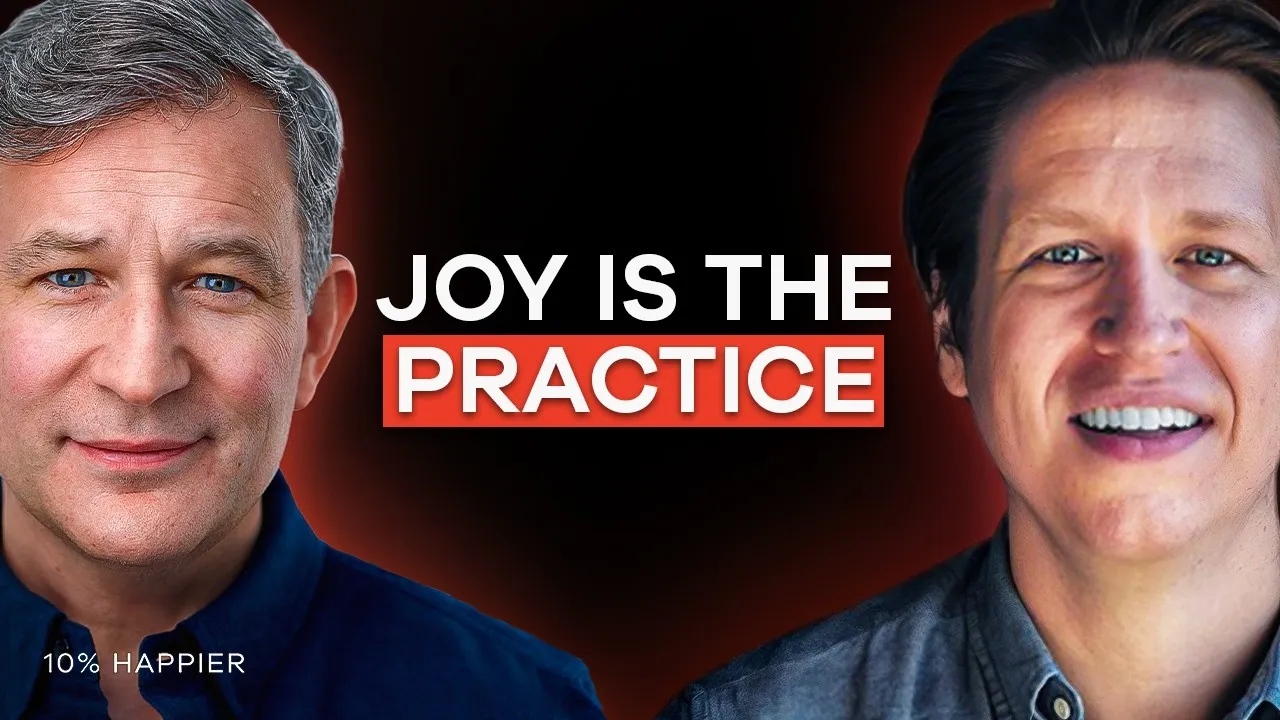
This episode of 10% Happier is a live recording with Dan Harris, taped in front of an audience Harris keeps calling ‘the restless leg folks.’ Holmes grew up evangelical in Lexington, Massachusetts, which Harris finds genuinely shocking, went to Gordon College, got married at 22 specifically because he wanted to have sex, had his wife leave him at 28 for someone else, found atheism briefly comforting, took mushrooms at Bonnaroo, and then spent the next decade reverse-engineering what happened to him on that field back into language. That’s the arc. The thing is, he’s really good at it.
The Best Preacher in Comedy
Harris tells Holmes he has a preacher’s style, which Holmes accepts without embarrassment because, obviously, he does. The man spent twenty minutes retelling the Prodigal Son from memory and it landed. His reading of it strips out the atonement theology entirely. No intermediary Jesus figure, no vengeful father who needs someone’s head to roll. Just a kid who blows his inheritance, ends up working with pigs, and then remembers his father is loving. Holmes’s gloss: ‘You can’t become what you already are.’ The father was never going to turn him away. He just forgot.
Jesus didn’t die to change God’s mind about you. He died to change our mind about God. That he’s in it with us. God suffers in and through and with and as you.
He’s citing Richard Rohr here, as he does roughly every eight minutes. He also name-checks Rupert Spira, Ram Dass, Joseph Campbell, and Father Greg Boyle in a single conversation, wearing his influences without embarrassment the way he wears everything. The eclecticism isn’t sloppiness. Holmes has clearly read these people. He just also happens to think all of them are pointing at the same thing, which is the background awareness that doesn’t stand out from anything because it’s what everything else stands out from. Rupert Spira’s formulation, which Holmes quotes repeatedly: what is, but doesn’t exist. Meaning it can’t be located, can’t be separated out. It’s the screen, not the movie.
Affirmation Junkie, Enlightened Background
Here’s the actual tension of the episode. Holmes has built a philosophy around the idea that the witnessing presence behind all experience is inherently peaceful, fulfilled, complete. He also admits that after doing a town hall on Friday, the high is gone by Saturday morning. He will, upon waking at four in the morning, replay every embarrassing thing he said at dinner. He will stand in a deplaning row and make deliberate, shaming eye contact with the person in the row behind him who tried to leave first. He will hold their gaze while slowly removing his bag from the overhead bin.
I’ll stand and face them to shame them and then take my bag down while making eye contact with them and then deliberately leave slowly.
He knows this is funny. He also knows it’s real. The therapy language he reaches for is IFS, Internal Family Systems, and his self-diagnosis is that getting laughs meant less fighting and more safety when he was a kid. Golden Boy as survival strategy. ‘Broken Pete,’ he says, is actually one of his favorites, because broken Pete needs people, and needing people is how you get close to them. The affirmation addiction and the mystical philosophy aren’t in conflict, exactly. They’re just the wave going out and the wave coming back.
If we were fine, we’d be at home.
Yes. Thank You.
Holmes ends with his actual practice, a two-word mantra he calls ‘Yes. Thank you.’ Say it to the flight delay. Say it to the four-in-the-morning shame spiral. Say it to the advance copy of your own book that came back with the word ‘flappy’ scattered throughout as a placeholder for sections you never finished. His claim is not that it resolves anything. It’s that it stops the basketball-held-underwater dynamic, the energy you’re pouring into resistance. You say yes to the thing and the brain, briefly, has nowhere to go with it.
If you can just say yes to what is, that’s all you need. Yes. Thank you. It just shortcircuits your brain. That’s been one of the most powerful things in my life.
There’s a version of this episode that’s frustrating, because Holmes is always three sentences away from a concept he can’t quite land, and Harris keeps asking clarifying questions that Holmes answers with Michael Jordan appearing in the field of knowing. But the frustrating version misses what’s actually happening, which is two guys on a live stage trying to talk about something that resists being talked about, and occasionally succeeding, and laughing when they don’t. Ram Dass said if you think you’re enlightened, go spend a week with your parents. Holmes has tried. His mother has his number. She breaks the spell every time.
Pete Holmes Went to Ayahuasca, Neal Brennan Is Scared of His Dog
Two comedians closing in on 20 years of friendship talk God, plant medicine, body dysmorphia, and whether love is just a dog following a turkey leg.

Pete Holmes Teaches Bobby Lee the Way of the Whites
Baking soda in the freezer, gas before the light comes on, and other mysteries of white American life, as explained to two men who never learned.

Pete Holmes on Silly Silly Fun Boy, Carousel Guilt, and the Case for Paying for Your Porn
The comedian stops by Whiskey Ginger to workshop new material, defend OnlyFans on philosophical grounds, and explain why mushrooms change your walk.

John Lennox says transhumanists are too late because Jesus already solved death
The Oxford mathematician and Christian apologist turns Silicon Valley’s dream of defeating death into a setup for Easter.
The circuit, read weekly. No noise.