Tina Fey Tells Amy Poehler She Has to Kill Every Time
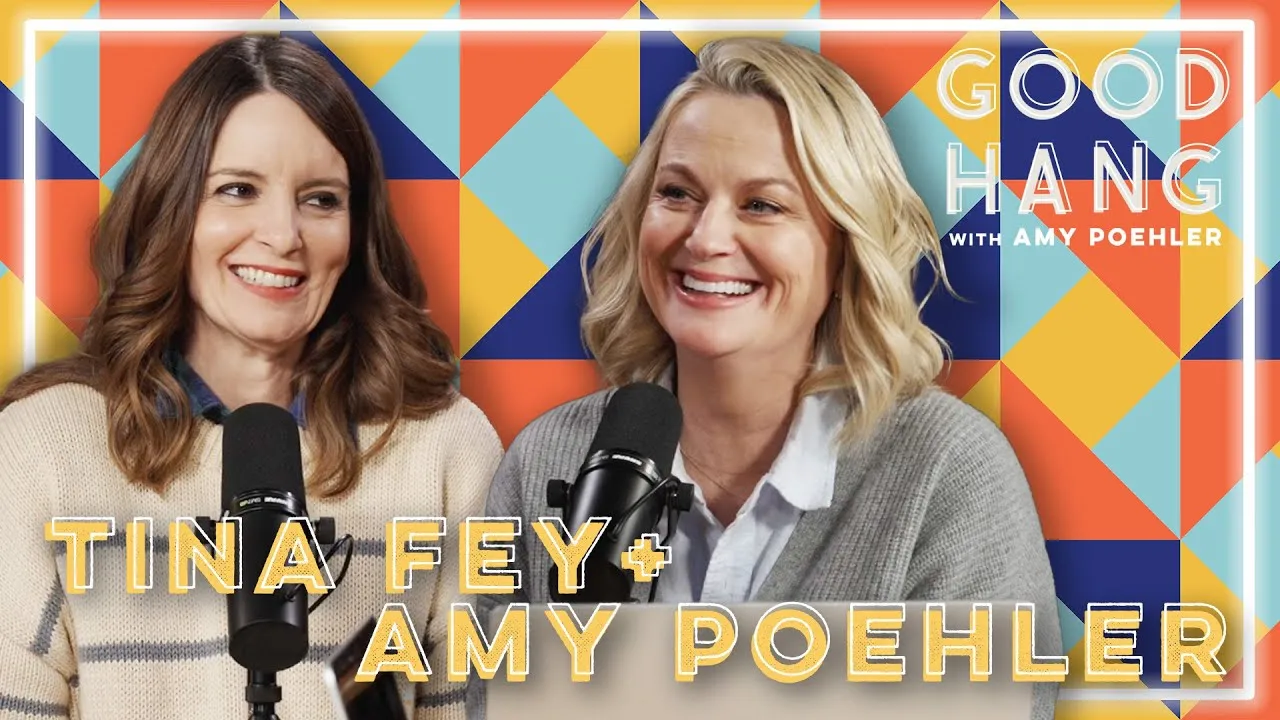
The first episode of Good Hang is less a podcast debut than a reunion special where the guest happens to be the host's comedy wife.
Listen on YouTube · Spotify · Apple Podcasts
 WATCH NOW↓
 Amy Poehler opens her first podcast by announcing she does not care if you get any better. No advice, no growth arc, no worksheet to download. Just her, a microphone, and the stated intention to make you laugh while you hide from your kids in the basement next to the Bow Flex. It is, as podcast pitches go, the most honest one in recent memory. And then Tina Fey shows up and the whole thing stops being a podcast and becomes something closer to eavesdropping.
Before Fey even appears, there is a pre-game segment where Seth Meyers, Fred Armisen, Rachel Dratch, and Zarna Garg pile onto a Zoom call to suggest questions. Dratch’s headphones are tangled like Christmas lights, her doorbell rings mid-recording, her dog starts barking because she ordered food, and she nearly strangles herself with the cord. Poehler, watching all of this, sounds like a woman who has been watching Dratch do exactly this for twenty-five years and finds it no less funny. The chaos is the content. By the time Fey actually joins, the bar for professional podcast behavior is somewhere underground.
The Carriage Horse and the 36 Hours
The real material is Fey talking about work, which she does with the resigned clarity of someone who has finally been able to name the thing that has been running her life. She describes herself as a carriage horse, the kind of animal that needs to pull something or it goes insane. But she says something more interesting alongside it: that she has only recently discovered what the absence of work actually feels like, and that the window of genuine peace lasts exactly thirty-six hours after she turns something in. After that, the anxiety creeps back. Notes are coming. She should already be ahead on the next thing.
the only the closest I can get to joy and peace is like the 36 hours after I’ve turned something in cuz that’s the only time when you’re like I did it I really I don’t have any homework
This is delivered without any performance of self-awareness. No laugh after it to soften the admission. It just sits there. Poehler, to her credit, does not rush to fill the space with a relatable aside. She asks a follow-up. It is, as Seth Meyers told her in the pre-show, exactly what she is good at: standing on the cliff of her own opinion without jumping off, which pulls other people forward.
Fey also talks about her new Netflix show The Four Seasons, directed by Coleman Domingo, and what she is proudest of is not the performances or the writing but the fact that she built the set deliberately around good people. She was, she says, extremely purposeful about bringing together people who I believed were good people who would not make any trouble for me. It sounds almost paranoid until she explains what the alternative looks like, which is movies: poorly behaved crazy people being indulged by various parties, with one or two people trying to harvest a series of photographs that can be assembled into a film. SNL gets named as another place where insecurity turns people feral. The show is too polite to name names. It does not need to.
Steve Martin’s Maxim and the Bite-and-Smile Circuit
The best story in the episode is Fey’s, about meeting Steve Martin backstage at SNL after she had complimented him on a Letterman appearance. He looked at her and said, matter-of-factly, that you have to kill every time. She has been haunted by it since. The point is not that the standard is impossible. The point is that it only applies to comedy people. A beautiful actress from, Fey says, melrose’s place, can go on a talk show and say she went to the store once. A comedy person cannot.
if you’re a comedy person you have to kill every time
This leads into a string of early-career audition stories from Chicago, where both women were doing Second City and trying to book commercials to pay rent. Fey went out for what the industry called bite-and-smile spots, which involved pretending to bite into a hamburger and then beaming at the camera. She knew immediately her teeth disqualified her. There was also a McDonald’s drive-through commercial she traveled forty-five minutes to audition for before realizing, upon arrival, that the concept required a close-up of someone pulling up to a window. She had a scar on the left side of her face. She did the audition anyway. Then she left. The way she tells it, the refusal to be rejected first is not bitterness. It is self-preservation with good comic timing.
Pat Battle, Bobby Moynihan, and the Algorithm
Fey’s answer to what makes her laugh lands in two places that have almost nothing to do with each other. The first is Bobby Moynihan watching his old SNL audition tape in a documentary and seeing something beyond inappropriate, and responding by quietly saying, oh Bobby. Fey wants that audio trademarked. She thinks it should be the universal sound for acknowledging past comedic sins, a gentle self-correction that skips the press release entirely.
oh no and then he goes oh Bobby and the way he says oh Bobby the way he calls himself by name is so gentle
The second thing is her weekend local news. NBC4, Pat Battle, Gus Rosendale, a segment called Produce Pete where a nice old Italian man tells you what is in season. She has invited Pat Battle to events multiple times. Pat Battle has attended. Pat Battle also appeared as herself in a 30 Rock episode about a women in media luncheon where Andrea Martin’s character has a breakdown and says she put a sweater on a body pillow and took it for a canoe ride. Fey delivers this information with the same tone as someone describing a beloved documentary.
Poehler, for her part, brings genuine warmth to a format she is clearly figuring out in real time. The charm of this first episode is that it does not feel performed. The chaos with Dratch, the lip balm break, the tangent about Colin Jost being a narc at Harvard, all of it moves the way a conversation between old friends actually moves, which is sideways and fast and occasionally somewhere you did not expect. Fey is right that Poehler asks real questions. It is not a small thing.
Steve Carell and Amy Poehler Compare Notes on Bombing, Boston, and the Baritone Horn
Two Second City survivors swap war stories, and the most revealing thing either of them says is about failure.

Tina Fey on Las Culturistas: Great Americans, Mozzarella Stick Math, and the Danger of Having Opinions
The woman who wrote Mean Girls shows up, delivers a masterclass in institutional wisdom, and tells Bowen Yang his podcast career has maybe one year left.

Tina Fey on Athletes, Almonds, and Why She Can't Get Her Kids to Watch 30 Rock
The Kelce brothers haul in Tina Fey and Nate Bargatze for an episode that somehow covers manspreading at MSG, a Cleveland Guardians ownership stake, and the origin of Nashville hot chicken.

Tina Fey Has No Beef with Timothée Chalamet, and God Is Fair
The 30 Rock creator stops by New Heights to settle the great Knicks game manspreading controversy once and for all.
The circuit, read weekly. No noise.