Adam Sandler on Bombing, Kevin Meany, and Why He Said Yes to the Netflix Special
Two hours and forty minutes of comedians talking about comedy, and almost none of it is boring.
Listen on YouTube · Spotify · Apple Podcasts
 WATCH NOW↓
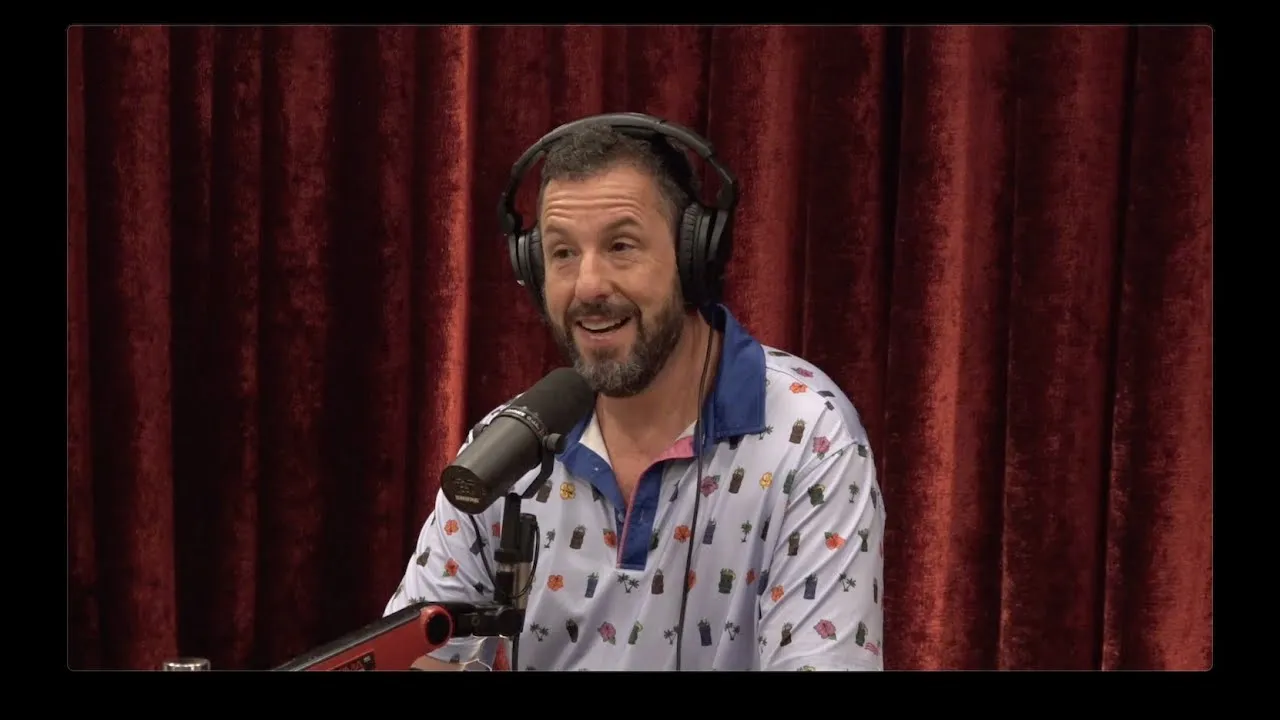
 Adam Sandler told his friends in high school he was going to be famous. Then he went to Boston’s Comedy Connection at 17, bombed with his dad in the crowd, and walked off stage while the MC stopped him to say ‘Class Clown’ to the laughing room. He nodded, went to the dressing room to hide, and Kevin Meany found him there and said something nice. Sandler remembered it for forty years. That is the whole story of early standup in one anecdote: humiliation, witnesses, and one generous stranger who keeps you from quitting.
Rogan and Sandler have known each other since at least the Zookeeper era, which they are both horrified to learn was fourteen years ago, and the whole conversation has the loose, digressive energy of two people who already like each other and have nowhere to be. They talk about Kevin Hart’s McDonald’s order, David Lee Roth living in Japan to train Kendo, the Rolling Stones doing two shows a week at eighty, Will Smith, Aerosmith, the Boston comedy scene, News Radio, Milton Berle’s hog. It is a lot. But the throughline, the thing they keep pulling back to, is the specific terror and specific joy of standup. Neither of them can stop talking about it.
The Delusional Years
Both of them bombed constantly and both of them somehow believed they were great anyway. Sandler’s version is especially good. He would eat it in front of a crowd, drive to a pay phone, call his boys back in New Hampshire, and report that he killed. ‘I told the boys I was like going to be great and then when I would check in with them I remember being on pay phones calling after even eating it at catch a rising star I call him up did good tonight B.’ He laughs telling it. The lie wasn’t even convincing. It was just necessary.
I dug a hole for myself like I’m doing great Robin Williams said I was fantastic Robin Williams I remember one night saw me eat it I was just like oh man I ate it in front of Robin Williams but I changed the story of like yeah he liked that
Rogan’s version of the same delusion involves watching other comics bomb at open mics and thinking he could do better, then bombing himself. Both of them are describing the same psychological trick: you need the confidence before you have earned the skill, because the skill takes years, and nobody survives years of failure on an accurate self-assessment. The delusion is structural. It is not a character flaw. It is the thing.
Why He Did the Netflix Live Special
Sandler said no first. His manager called, he said no, he hung up. Then he was driving home and started arguing with himself.
I was driving home I was like thinking and then I when I got home I called her back I go don’t say no yet I go let me think about it
The next day he said yes specifically because he was scared of it. Which is either very wise or the way every comedian justifies the decision after they have already made it. Probably both. What followed was three weeks of doing the same set in order, no deviation, every night, writing all the bits out by hand, listening to recordings, watching videos, preparing for five hours the day of the show. For a guy whose whole persona is loose and silly and kind of shambolic on stage, the preparation was monastic. That contrast is probably the point. The looseness is manufactured. The spontaneity is rehearsed. Everyone at the top of this knows that.
I beat myself into the ground I overprepared right right right so that when I got up there there was no what is next what is next
Kinison, Meany, and the Guys Who Blew Out the Room
The conversation keeps returning to comedians who had a peak so extreme it almost seemed unfair. Kevin Meany at Catch a Rising Star, Cambridge, absolute peak, everyone in the room in physical pain from laughing. Sam Kinison in 1986, maybe one of the greatest comedians who ever lived, and then the bandana years arrived and something left and never came back. Sandler and Rogan are genuinely trying to understand what happens when that much talent meets that much cocaine and fame, and they do not fully solve it, but they sit with it seriously. The Kinison section alone is worth the runtime.
Sandler’s own career maps weirdly onto these cautionary examples, except he survived. He took twenty years off from standup, came back, now does two-hour shows and has more material than he can use. His critics have been wrong about him for thirty years. His Rotten Tomatoes scores are catastrophic. His audience doesn’t care. During the pandemic, Rogan’s family watched basically every film he made. That’s not a redemption arc. That’s just the actual record.
Adam Sandler on Happy Gilmore 2, Bobby Boucher's NFL Career, and Why He Still Gets Nervous Around Taylor Swift
The Sandman shows up on New Heights and turns a sports podcast into a forty-minute masterclass in being exactly yourself.
Daniel Rodriguez says he became a Mexican citizen to get out of jail after an ounce of weed
The UFC welterweight told Joe Rogan that a border mistake after the Kevin Holland fight turned into eight months in a Tijuana jail, a citizenship workaround, and a very expensive lesson.

The Circuit: the week the tidy story kept losing
Across nine conversations this week, some of the biggest names on the podcast circuit spent their time roughing up the clean version of events, the plague that supposedly ended Rome, the aliens in the government freezer, the trophy that counts as a World Cup. What kept surfacing was a preference for the smaller, stranger, less quotable truth.
Bill Burr and Garrett Morris Reminisce About Carnegie Hall, Cocaine, and Getting Shot
Two comics from different eras swap stories on Tom Green's web show, and somehow it works.
The circuit, read weekly. No noise.