Amy Goodman Has Been Right About Everything for Thirty Years and Nobody Paid Her For It
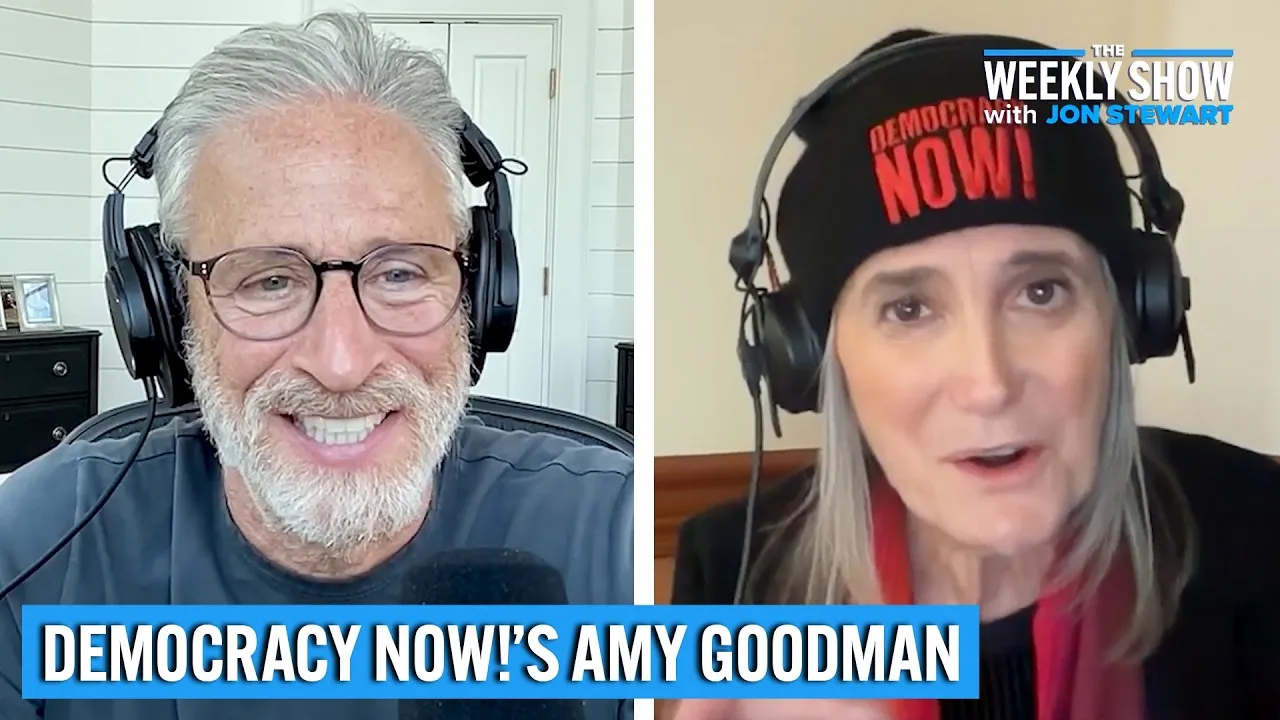
The Democracy Now founder joins Jon Stewart to talk about what journalism actually costs, and what the corporate press gave away for free.
Listen on YouTube
 WATCH NOW↓
 Amy Goodman once kept Bill Clinton on the phone for half an hour. He called her. She asked him about welfare cuts, corporate power, Leonard Peltier, and sanctions on Iraq. He told her she was hostile, combative, and at times disrespectful. The White House later threatened to ban her from the briefing room. Her response, delivered on air three decades later with the same flat certainty she brings to everything: ‘He’s the leader of the free world. He could hang up if he wants to.’
That is the whole argument. That is the entire philosophy of Democracy Now compressed into one sentence. Stewart, who has spent twenty-five years being very funny about the same problems Goodman has spent thirty years actually covering, understood this immediately. He spent most of the interview doing what he does best: asking smart questions and then getting out of the way.
The Access of Evil
Goodman has a name for the deal that mainstream journalists make with power. She calls it ‘the access of evil.’ The premise is simple and damning: you get the seat at the briefing, the background calls, the on-background scoops, and in exchange you ask the questions that guarantee you keep getting invited back. Nobody says this out loud. Nobody has to. The incentive structure says it for them.
Trading truth for access is not worth it. The questions you’re going to ask for that access, those softball questions.
Stewart pushes her on why good journalists end up inside this machine anyway. Her answer is generous but clear: they learn how to rise in it. You stop asking to cover the protest. You go to the White House briefing. You ask a question designed to get you called on again tomorrow. The ambition is real. The calling is real. And then one day you’re Katie Couric at the 2008 Republican National Convention telling Amy Goodman, who is getting arrested outside, that you’d love to cover it but there are so many speeches.
Stewart’s staff, talking after Goodman signs off, can barely contain themselves. Lauren Walker, his lead producer and a former national security reporter, describes writing a story ten years ago about the American Psychological Association banning members from participating in national security interrogations, a story that got no clicks and disappeared, and then finding it cited in Goodman’s twentieth anniversary book. The pipeline from invisible to record is exactly what Democracy Now exists to be.
What It Actually Costs
The Indonesia section of this conversation is hard to sit with. Goodman went to East Timor in November 1991 with her colleague Allan Nairn. They were there when Indonesian soldiers, armed with US M16s, marched into a crowd of peaceful protesters at a cemetery and opened fire. Over 270 Timorese were killed. Goodman and Nairn were beaten with those same rifles. Nairn had his skull fractured.
They marched around the corner without hesitation, without provocation, without warning. They swept past us and they just opened fire on the crowd.
The soldiers kept shouting ‘Australia, Australia.’ They wanted to know if the journalists were Australian. Goodman and Nairn understood exactly what that meant: Australian journalists had been executed during the original 1975 invasion, and Australia had barely protested. Goodman threw her passport at the soldiers. They stopped when they saw ‘United States of America.’ Her read on why is cold and precise: they would have had to pay a price for killing Americans that they never had to pay for killing Timorese.
Stewart, to his credit, does not treat this as a heroism anecdote. He treats it as evidence. Evidence of what corporate access journalism gives up. You don’t get to Standing Rock, you don’t get to the Niger Delta, you don’t stand in front of bulldozers on sacred burial land, if your continued employment depends on not making anyone powerful uncomfortable. The Chevron segment drives this home: Goodman walked into Chevron’s Nigerian headquarters and asked a spokesperson who authorized flying military helicopters to shoot protesters. The spokesman just told her. Chevron’s management, he said. On tape.
I consider an exclusive a failure. Like, if no one picks it up, that’s really a problem.
The Silenced Majority
Goodman’s framing of who Democracy Now serves is the most quotable thing she says, and it’s the thing the corporate press most needs to hear. She rejects the word ‘mainstream’ for cable news. The people who care about climate, about inequality, about war, about reproductive rights, about the immigrant crackdown, she argues those people are not fringe. They are not even a silent majority.
Not even a silent majority, but the silenced majority, silenced by the corporate media, which is why we have to take it back.
Democracy Now’s thirtieth anniversary celebration at Riverside Church, the same church where Martin Luther King gave his 1967 speech against the Vietnam War, ended with Bruce Springsteen appearing unannounced from the audience and singing ‘The Streets of Philadelphia.’ Then everyone got up and sang Patti Smith’s ‘People Have the Power.’ This either sounds like the most earnest thing you’ve ever heard or it sounds like the only honest version of what a press freedom celebration should look like. Goodman doesn’t seem to think there’s a difference. She’s probably right.
Stewart closes by asking whether there’s a future for independent media, maybe a Bezos figure but for the good guys. Goodman doesn’t hesitate. It comes from community. It always has. Democracy Now runs on listener and viewer support, started on Pacifica Radio, grew because a Ku Klux Klan bombing of a Houston station couldn’t keep it off the air. The Grand Dragon, or possibly the Exalted Cyclops, Goodman says she always confuses the titles, called it his proudest act. He understood, she says, exactly how dangerous a radio station that lets people speak for themselves actually is. Thirty years later, that assessment holds.
Graham Platner Wants to Be the Oyster Farmer Who Fixes the Senate
A Marine combat vet from Sullivan, Maine showed up on Jon Stewart's podcast and spent an hour saying the quiet parts loud about why Democrats keep losing.
Ben Rhodes Told You So: The JCPOA Was Right, the Iran War Was Dumb, and Everyone Knew It
The former Obama deputy national security advisor walks Jon Stewart through a decade of foreign policy failure, and the argument is depressingly airtight.
The circuit, read weekly. No noise.