Chris Williamson says too much self-awareness can make you a coward
The Modern Wisdom host turns Hamlet into a diagnosis of the modern overthinker, and he is more right than a Shakespeare scholar would enjoy admitting.
Listen on YouTube
 WATCH NOW↓
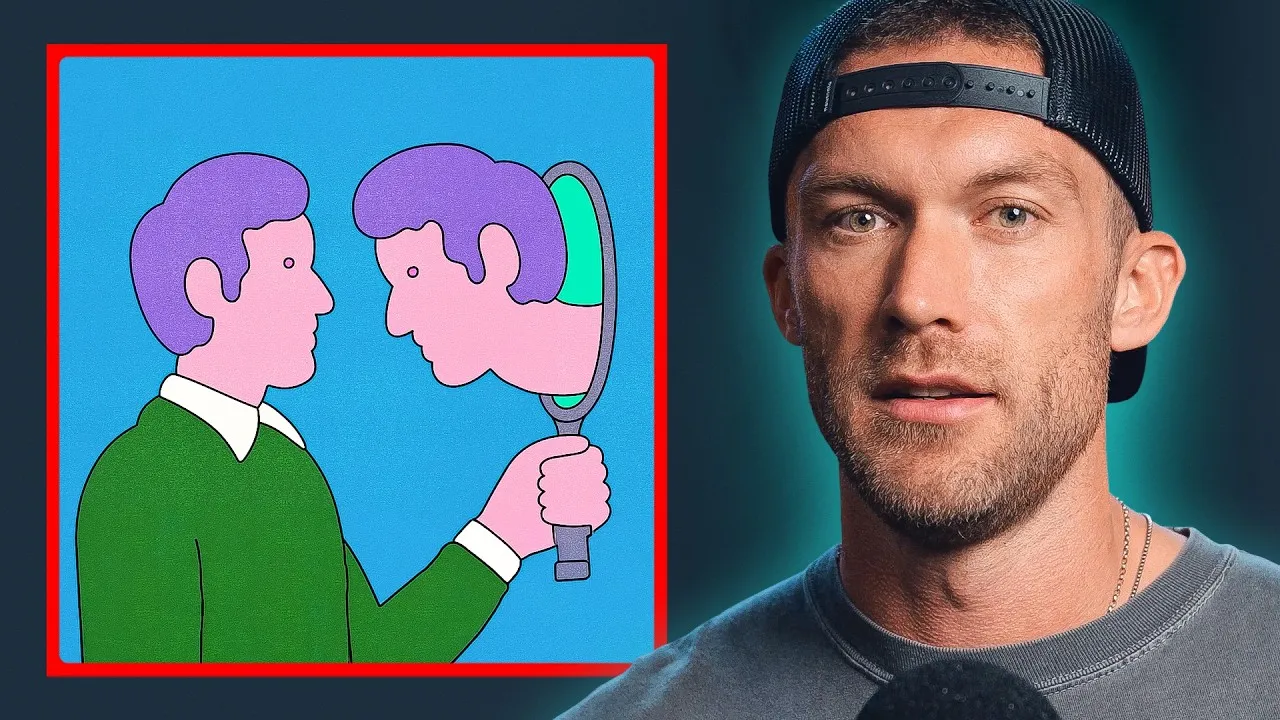
 Chris Williamson’s Hamlet take is that your inner philosopher might be running a tiny coward factory. On Modern Wisdom, Williamson argues that too much self-awareness can make overthinkers less brave, not more wise, because they simulate disaster so vividly that doing nothing starts to feel like the sane option.
This is not exactly Harold Bloom. Williamson admits, with charmingly little academic camouflage, that he basically did not read Shakespeare and is reverse-engineering a line from Hamlet like a man finding personal development advice carved into a cathedral. Still, the read has teeth. His version of “Thus conscience does make cowards of us all” is not about morality making people soft. It is about consciousness making people stuck.
Shakespeare isn’t attacking goodness. He’s pointing at self-awareness and naming its cost.
That is the claim worth pulling out of the clip: not the Instagram-poster version of courage, not another speech about escaping your comfort zone, but a sharper diagnosis of the overthinker’s disease. The mind does not merely warn you that failure may happen. It screens the director’s cut. Embarrassment, rejection, reputational ruin, the weird look from the person in the cafeteria, all playing in IMAX before you’ve done a thing.
So, courage isn’t defeated by fear. It’s defeated by simulation.
The cowardice of the well-considered life
Williamson’s best move is separating two kinds of failure. There are commission errors, the loud ones. You said the wrong thing. You launched the bad business. You asked and got rejected. Then there are omission errors, the ghost failures. You never asked. You never launched. You never quit. You never found out. Nobody claps for the disaster you avoided, and nobody sends flowers for the life you quietly failed to begin.
People make commission errors if they don’t think enough. People make omission errors if they think too much.
That distinction is the strongest part of the argument. Self-help culture usually treats action as an unqualified good and thinking as either noble or neurotic depending on the lighting. Williamson gives the overthinker a better accounting system. The cost of acting is visible. The cost of not acting is often invisible until it becomes your personality.
He is also careful, briefly, to avoid turning this into a license for impulsive behavior. Most people, he says, probably need to be more thoughtful. The target here is narrower: the person whose mind creates so many possible futures that the actual future never gets a vote.
Self-awareness is not a pure good. Right? Beyond a certain point, self-awareness actually inhibits agency. Less reflection can mean more peace. Less certainty can mean more movement. Less conscience can sometimes mean more life.
A useful overstatement
Is the claim true? Mostly, yes, with a giant asterisk wearing noise-canceling headphones. Calling overthinkers cowards is theatrically harsh, which is probably why it works. But the mechanism Williamson describes is real enough in ordinary life: rumination can mimic preparation while quietly eating the possibility of action. The brain calls it prudence. The calendar calls it five years.
His Tony Robbins detour helps explain the prescription. Williamson talks about front-loading the pain of not changing, forcing yourself to feel the future cost of staying put. That is not elegant. It sounds like motivational dentistry. But the logic is clean: if your brain naturally magnifies the pain of visible failure, you have to deliberately magnify the pain of invisible avoidance.
The concrete stake is almost insultingly small. Do the open mic. Ask the person out. Start the business badly enough to learn whether it should exist. Close the loop before your imagination turns it into a museum exhibit. A life can be deeply examined and still have no pulse.
- Is Chris Williamson saying self-awareness is bad?
- No. He says most people probably need to be more thoughtful, but there is a specific group of overthinkers who turn reflection into paralysis. For them, self-awareness becomes less like moral clarity and more like a very expensive security system that keeps them locked inside.
- What does Hamlet have to do with overthinking?
- Williamson reads Hamlet's line about conscience making cowards of us all as a line about consciousness, not just morality. In his version, Hamlet is diagnosing the human ability to simulate bad outcomes before acting, which can make inaction feel safer than change.
- What are omission errors in Williamson's argument?
- Omission errors are the mistakes you make by not acting, not asking, not starting, not leaving, not trying. Williamson's point is that these errors are harder to feel than public failures, which is why people can lose years to them without ever getting a clean bruise to point at.
George Mack says Belgium’s driving theory test raised the death rate for new drivers by 32%
On Modern Wisdom, Mack turns Belgian road safety into a brutal little parable about false confidence, bad incentives, and the danger of thinking you know what you’re doing.

Angela Duckworth says successful people don’t use willpower
The author of Grit has not disowned effort, but she is now arguing that white-knuckle discipline is the worst way to build a life.

Tim Urban says the black hole era lasts so long you would need 1.4 billion observable universes packed with timeline ribbon to measure it
The Wait But Why writer turned far-future cosmology into a craft-store nightmare, and the math is mostly the point.
Zac Efron says eating too much salmon during The Iron Claw prep gave him mercury poisoning
Efron says the 6,000-calorie bulk for The Iron Claw pushed him from a 29 waist to a 34, up to 205 pounds, and into a fish problem.
The circuit, read weekly. No noise.