George Mack says Belgium’s driving theory test raised the death rate for new drivers by 32%
On Modern Wisdom, Mack turns Belgian road safety into a brutal little parable about false confidence, bad incentives, and the danger of thinking you know what you’re doing.
Listen on YouTube
 WATCH NOW↓
 A driving test is supposed to keep teenagers from turning a roundabout into Darwin’s waiting room. George Mack says Belgium managed the opposite: after the country introduced a mandatory driving theory test in 1969, the death rate among theory-tested drivers went up by 32 percent.
That is the kind of claim that sounds like it escaped from a Freakonomics paperback and then got hit by a Peugeot. It’s also the best idea in this episode of Modern Wisdom, because it takes the show’s stated subject, overthinking, and puts it behind the wheel. The problem isn’t thinking. The problem is thinking that passes for competence.
So Belgium had no driving test policies at all.
Mack frames old Belgium as a libertarian driving simulator with actual funerals. Turn 18, get taken to the dealership, show your date of birth, buy the car, and try to make it home. His phrase for it is the “18th birthday party gift,” which is very cute until you remember the gift is a ton of metal and a teenager who has never merged.
The test can become the hazard
So the death rate went up by 32% with the theory test drivers.
The number is the hook, but the explanation is the meat. Mack’s theory is not that road signs kill people. It’s that a little formal knowledge can produce a stupid amount of confidence. A kid who knows he can’t drive may at least behave like a frightened mammal. A kid who has passed a theory test may behave like he’s unlocked Belgium Pro Mode.
One theory is that they have this kind of false sense of confidence going into the roads that at least the ones that knew they couldn’t drive didn’t have.
Do I fully buy the claim as delivered? Not yet. Mack doesn’t give the source, the denominator, the period measured, or whether the new theory-tested cohort differed in some boring but crucial way from the pre-test drivers. The phrase “death rate went up by 32 percent” is doing real work, and without the table behind it, you shouldn’t tattoo it on your anti-bureaucracy forearm.
But as a parable, it’s disgustingly useful. Modern life is full of little Belgian theory tests. Compliance trainings. Productivity systems. AI-generated meal plans. Reading six books about negotiation instead of having the conversation. The credential arrives before the capability, and suddenly the worst person you know has a Notion dashboard and a sense of destiny.
This is the overthinking point hiding in the traffic pileup
Mack’s cleaner psychological framework comes later, when he separates rumination from useful thought. He argues that bad thinking is repetitive, unhelpful, and often false. Good thinking is new, useful, and true. That’s simple enough to sound like a fridge magnet, but it’s actually a pretty sharp diagnostic. If the thought doesn’t move you closer to action or clarity, it may just be cud.
Most of our thoughts that we think aren’t even true.
That is where the Belgium story earns its place. A theory test is thinking, but not necessarily skill. Journaling is thinking, but not necessarily progress. Research is thinking, but not necessarily courage. The show keeps circling the same uncomfortable lesson: advice does not land evenly. The reckless ignore caution. The anxious turn caution into a prison. The already overprepared become better decorated statues.
Mack’s 32 percent claim needs a citation before it becomes a fact you can throw at a dinner party without getting deservedly cross-examined. Still, the warning is strong enough to survive the missing footnote. If your preparation makes you calmer, clearer, and safer, great. If it only makes you braver at the exact wrong speed, congratulations, you’ve passed the Belgian theory test.
- What did George Mack claim about Belgium’s driving test?
- Mack claims Belgium once allowed 18-year-olds to buy a car and simply drive away without a driving test, then introduced a mandatory theory test in 1969. According to him, the death rate among theory-tested drivers rose by 32 percent, possibly because the test gave new drivers confidence without giving them actual skill.
- Is the Belgium driving test story definitely true?
- Mack presents it as “traffic data,” but he doesn’t name the study, dataset, or time window in the episode. The claim is specific enough to be checked and vivid enough to remember, but the podcast version should be treated as an unsourced anecdote with a plausible mechanism, not a settled finding.
- Why does a driving test story fit an episode about overthinking?
- Because the story attacks the lazy idea that more thinking automatically improves outcomes. Mack’s broader point is that knowledge has to move you toward better action. Otherwise it can become theater, like a teenager passing a quiz and then driving into traffic with the confidence of a Formula 1 reserve driver.

George Mack says Spanish chicken farmer Juan Pujol was one of D-Day's three most important people
The Juan Pujol García story is real, absurd, and slightly overpolished in the telling, which is exactly why it works.
Chris Williamson says too much self-awareness can make you a coward
The Modern Wisdom host turns Hamlet into a diagnosis of the modern overthinker, and he is more right than a Shakespeare scholar would enjoy admitting.

Zac Efron says eating too much salmon during The Iron Claw prep gave him mercury poisoning
Efron says the 6,000-calorie bulk for The Iron Claw pushed him from a 29 waist to a 34, up to 205 pounds, and into a fish problem.
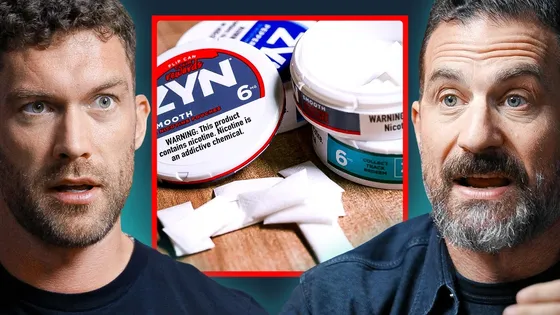
Andrew Huberman says daily nicotine pouches don't boost your brain, they just fix withdrawal
Huberman's rule is brutally unfashionable in the pouch era: if you want nicotine to help performance, don't make it a habit.
The circuit, read weekly. No noise.