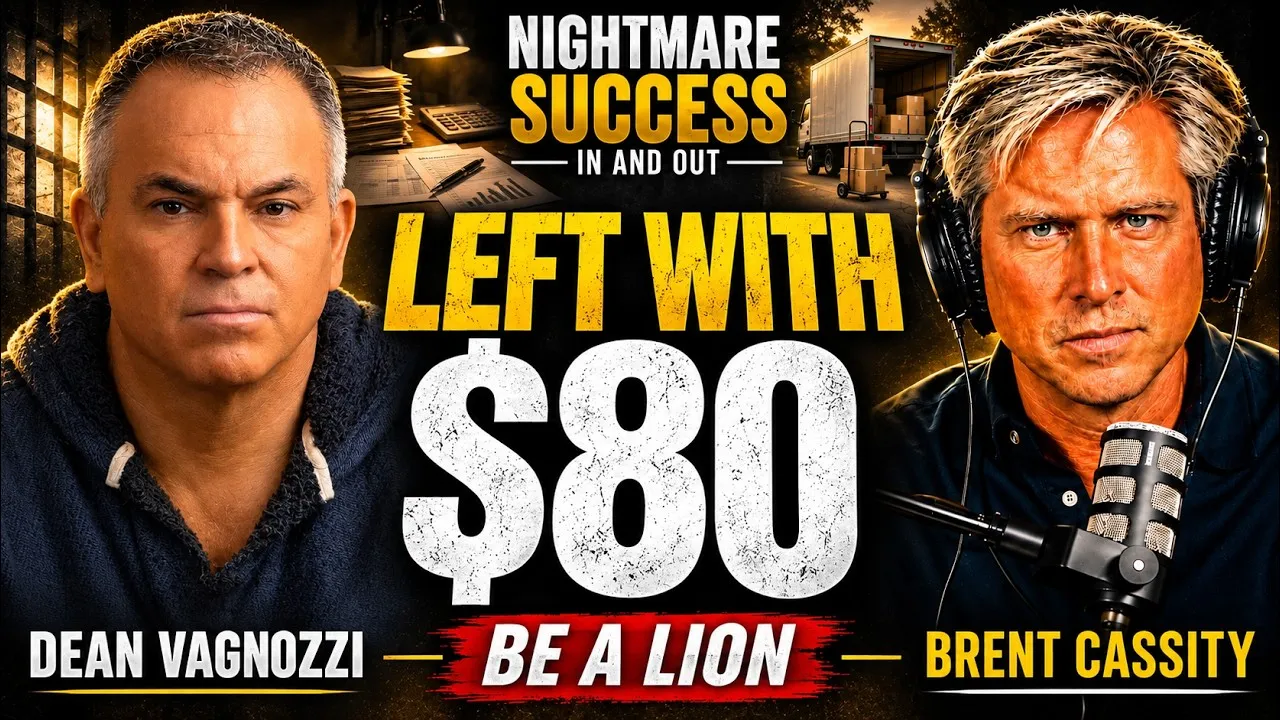
Dean Vagnozzi says the SEC froze his accounts and left him with $80 before trial
The financial salesman tells Nightmare Success that a civil SEC case blew up his business, his bank accounts, and his reputation in 72 hours.
Listen on Nightmare Success · YouTube
 WATCH NOW↓
Dean Vagnozzi said on Nightmare Success that the SEC froze his accounts after suing him in the Par Funding case, leaving him with only $80 in his pocket before any trial. Dean Vagnozzi says the government seized control of his business, locked up his money, and detonated his reputation in 72 hours.
That is the podcast version of stepping on a rake, except the rake is federal civil enforcement and the handle is your mortgage. Vagnozzi tells it like a man still blinking from the flashbang. One day, he says, he had a financial firm with 15 employees and plans to explore going public. Then a lawyer walked into his office with a court order and a lawsuit from the Securities and Exchange Commission.
Mr. Vagnozzi, your business is now in our possession. Gather your employees, you know, you’ve been sued by the government. We have a court order to take poss- possession of your business.
Vagnozzi’s version is not small. He says he raised about $125 million for a merchant cash advance business, had roughly 600 to 650 investors in it, and believed his lawyers had vetted the whole thing. The SEC, as he describes it, saw something much uglier, an unregistered securities scheme tied to Par Funding, with money allegedly siphoned off and Vagnozzi treated as part of the machine.
The $80 detail is the whole movie
The sticky detail here is not that a successful guy lost status. Podcasts are full of men discovering humility right after discovering consequences. The sticky detail is the freeze. Vagnozzi says his wife found out when her debit card failed at the grocery store. He called the bank. He called brokerage accounts. Frozen, frozen, frozen.
I had four 20s on me. I had $80.
His outrage is easy to understand and also self interested, which doesn’t make it false. Asset freezes are real weapons in civil enforcement. The government argues they preserve money for victims. The target experiences them as a trap door, because the same order that protects funds can also make it harder to pay lawyers, keep the lights on, or even buy groceries without help. Vagnozzi’s line is blunt.
And and they they literally treated me like a terrorist. You I mean, this is what they do to terrorists.
That comparison is heated, but the feeling behind it is the point of the episode. Vagnozzi says there was no knockdown argument in a courtroom before the freeze hit him. There was a court order, a civil complaint, and then the machinery. He says the SEC later lifted restrictions enough that he can speak freely, and he now claims, flat out, that every allegation against him was wrong. The podcast doesn’t test that claim against the government’s case, so don’t treat this as a verdict from the heavens. Treat it as testimony from the guy under the boot.
The rebuild is ugly in useful ways
The better part of Vagnozzi’s story is that he doesn’t pretend the rebuild was cinematic. No swelling music. No instant comeback. He says he DoorDashed far enough from home to avoid being recognized, driving his daughter’s Chevy Volt and delivering food while the headlines still had teeth.
I’m making millions of dollars a year or week earlier, and I’m I’m driving my daughter’s Chevy Volt, driving delivering chicken wings.
Then came the FedEx route. An old college friend, Matt Asplundh, wrote the check, according to Vagnozzi. Vagnozzi ran the operation. It wasn’t glamour. It was warehouse mornings, drivers, cold, sweat, and having somewhere to be before the dark thoughts got a vote.
So, I went from suit and tie to to managing 15, 25 FedEx drivers.
This is where the episode earns its Be a Lion branding without turning completely into airport bookstore incense. Vagnozzi’s mantra is macho, sure. But his actual survival strategy is humble as hell. Cut the cable. Cancel the lawn service. Leave the country club. Sell a car. Let a friend help. Let your wife be the rock. Go do the unsexy job.
My read, based only on what this episode gives us, is that the $80 claim is credible as a personal account of the freeze, while Vagnozzi’s bigger claim of total innocence remains his argument, not a settled fact here. He says he settled with the SEC, lost $5.5 million, then sued his law firm and later sued the SEC. That is not a clean exoneration arc. It is messier, more American, and probably more useful, a man insisting he was wronged while also admitting he had to eat losses he hated.
If Vagnozzi is right about the freeze, the concrete lesson isn’t motivational. It’s financial and brutal. In a serious civil case, your money may not wait politely for the trial.
- What did Dean Vagnozzi say about the SEC freezing his money?
- Dean Vagnozzi said the SEC sued him in connection with the Par Funding case and obtained a court order that froze his accounts, leaving him with $80 in cash. He framed the freeze as a crushing pretrial tactic, saying he had not yet had a chance to fight the allegations when his money, business, and access to records were cut off.
- What was Vagnozzi accused of in the Par Funding case?
- Vagnozzi said the SEC alleged Par Funding was selling an unregistered security and siphoning investor money, and that he was part of it because he had raised a large amount of money for the company. His position on the podcast is that he was deceived by Par Funding and that the government wrongly assumed he was in on the misconduct.
- How did Dean Vagnozzi make money after the SEC case hit?
- He said he started DoorDashing in his daughter's Chevy Volt and later ran a FedEx Ground route that an old college friend funded for him. That part of the story is less finance bro redemption than pure triage, a guy trying to keep food in the house while lawyers circled.

Judith Negron says she survived a 35-year prison sentence by not thinking about the 35 years
The Nightmare Success guest turns a brutal sentence into a story about presence, advocacy, and the weird modern clemency pipeline that can run through Alice Marie Johnson and Kim Kardashian.
Jennifer Michelle Helms says she went from HGTV interior designer to a four-year federal prison sentence
The Nightmare Success episode frames Helms’s fall as a brutal reversal: a designer who once visited her father in prison later ended up serving time herself.
Lathan Word says a witness admitted lying and he was freed 30 minutes later after 12 years in prison
The Nightmare Success episode sells Word’s case on one brutal contrast: 12 years to get back into court, 30 minutes to walk out.
Bill Noguera says he helped solve cold cases from San Quentin's death row
The Nightmare Success pitch is wild enough to sell itself, but the clip gives us the legend before it gives us the proof.
The circuit, read weekly. No noise.