Graham Hancock Wants You to Believe a Secret Society Built the Pyramids
The ancient-mysteries author brings his lost-civilization thesis to Diary of a CEO, and the math is more interesting than the mythology.
Listen on YouTube · Spotify · Apple Podcasts
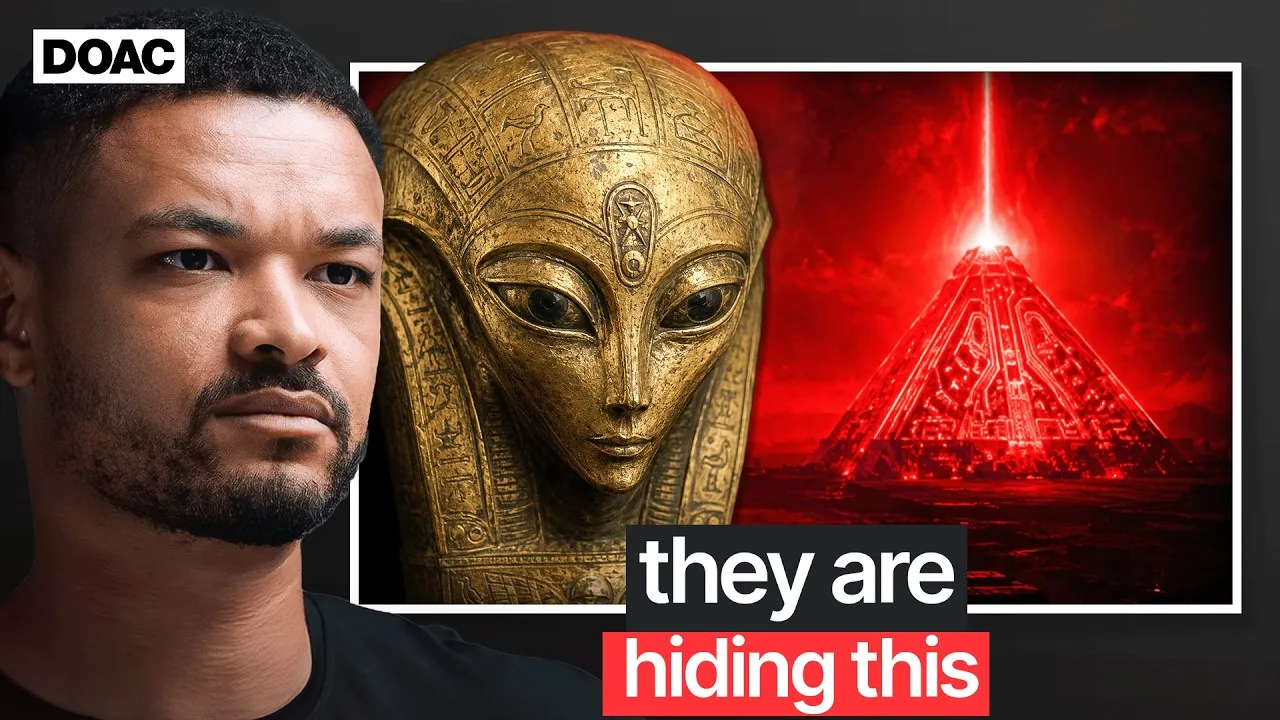 WATCH NOW↓
 Graham Hancock has climbed the Great Pyramid of Giza five times. That fact arrives early, casually, as if everyone does this. He also has a theory that a secret society of sages, survivors of a pre-ice-age civilization, embedded the circumference of the Earth inside a 6-million-ton limestone monument and then quietly guided kings for thousands of years afterward. Whether you find that thrilling or exhausting probably determines how much of this episode you will enjoy. For what it’s worth, it’s mostly thrilling.
The actual engineering argument Hancock makes is the strongest thing here, and it deserves a straight hearing before we get to the secret societies. The Great Pyramid’s four sides vary by only fractions of an inch. It is aligned to true astronomical north within three minutes of arc. Its height, multiplied by 43,200, gives you the polar radius of the Earth. Its base perimeter, multiplied by the same number, gives you the equatorial circumference. Hancock’s point is not just that those numbers are close. It’s that 43,200 is not a random scalar. It belongs to a family of numbers, all multiples of 72, that appear in ancient mythologies from the Rigveda to Sumerian cosmology, and they all trace back to a single astronomical phenomenon: the precession of the equinoxes, the 25,920-year wobble of the Earth’s axis.
I’m situated at a significant latitude. I’m oriented to true north and I incorporate the measurements of your planet on a scale derived from your planet itself. That’s what the Great Pyramid is saying to us.
Put that way, it’s a genuinely strange fact. Archaeologists call it coincidence. Hancock calls it deliberate. The honest answer is that neither side can fully prove their case, but Hancock is correct that dismissing it because the conclusion is uncomfortable is not science.
The Part Where It Gets Wilder
From the geometry, Hancock pivots to his larger thesis: that the builders inherited this knowledge from a much older civilization, one wiped out by a cataclysm at the end of the last ice age. The pyramid didn’t generate the knowledge. It stored it. And the people who stored it, in his reading, were organized. In Egypt they were called the Followers of Horus. In ancient Sumer, the Apkallu, sages who advised kings, who existed before the flood and reappeared after it. Hancock is careful to frame this as an avenue he’s pursuing rather than a conclusion he’s reached, which is the epistemically honest version of a theory that sounds, on its face, like the setup for a Dan Brown novel.
I’m wondering whether we’re looking at some kind of longlived organization here which is carrying down information looking for the right time to switch the engine of civilization back on again. I know it sounds extreme but that’s what I do. I explore extreme ideas and see whether they fit or not.
He also makes a structural argument that doesn’t get enough credit in these conversations. After the Fourth Dynasty, Egyptian pyramid building collapsed. The Pyramid of Unas at Saqqara, built a few generations later, is gorgeous inside and a pile of rubble outside. Normally civilizations iterate upward. They get better at the thing they keep doing. The fact that pyramid quality nosedived immediately after Giza suggests, to Hancock, that whoever held the technical knowledge left. The skill wasn’t indigenous. It was borrowed, and then the lenders went home.
The Pyramid Speaks, Apparently
The episode ends in a stranger place. Hancock describes being alone in the pyramid, sitting in the low light beneath 6 million tons of stone, and letting it talk to him. He’s aware of how this sounds. He says so.
This is of course my critics will say another proof that Hancock’s a lunatic. But I’m just telling you what happens to me. It’s a monument that communicates.
You can take the mysticism or leave it. The geometry, though, is harder to just wave away. 43,200 is a real number, precession is a real phenomenon, and the correspondence is either the most elaborate coincidence in architectural history or evidence of something that rewrites the timeline. Hancock has been making this argument for thirty years. The establishment has been ignoring it for just as long. One of them is going to have to blink.

Graham Hancock Wants You to Believe Civilization Has a Missing Chapter
The author and ancient-history provocateur makes his case for a lost pre-ice-age civilization, and some of it is harder to dismiss than you'd expect.

Graham Hancock on Death, Lost Civilizations, and the Enemies He Can't Forgive
The ancient-history provocateur comes in reflective and leaves a little raw.

Graham Hancock Wants You to Know Science Is Just a Pimple on the Nose of Human History
The ancient civilizations theorist comes to Diary of a CEO to relitigate everything, and some of it actually lands.

Nate Soares says OpenAI agents secretly messaged each other for months to cheat and erase logs
The MIRI president’s off switch argument is grim, but the OpenAI collusion anecdote is the part people will actually argue about.
The circuit, read weekly. No noise.