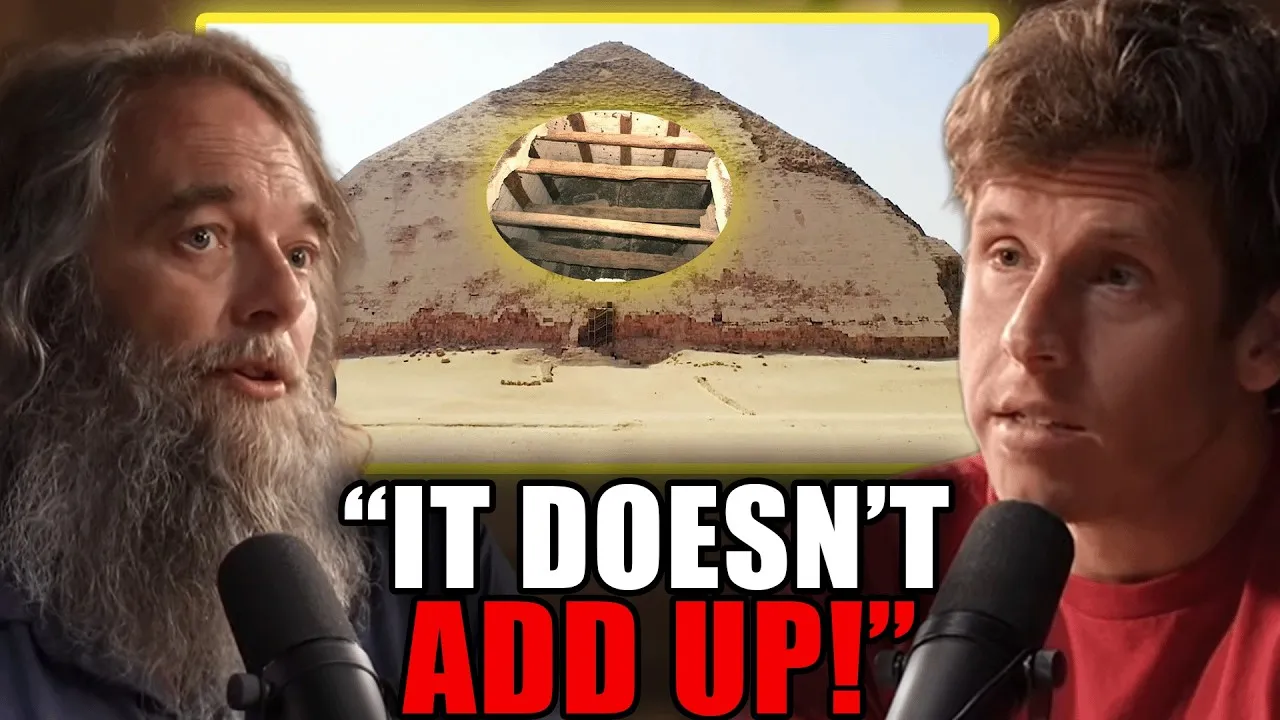
Dan Richards says Egyptologists used Bayesian modeling to delete carbon dates that contradicted the pyramids timeline
A self-described electrician-turned-researcher makes a specific, technical accusation against mainstream Egyptology, and the accusation is harder to dismiss than it sounds.
Listen on YouTube
 WATCH NOW↓
 Dan Richards is an electrician. That is not a credential you typically lead with when accusing academic Egyptologists of scientific fraud, but Richards leans into it, and it actually works. His claim: a 2016 paper using Bayesian modeling on pyramid carbon dates did not discover that the written Egyptian timeline was correct. It simply threw out the inconvenient numbers until the uncomfortable ones disappeared.
The problem Richards is pointing at is real and documented. Carbon dating of organic material found in the mortar and interior of Fourth Dynasty structures, including the Great Pyramid at Giza, has consistently returned dates roughly 200 to 300 years older than the written record assigns to pharaohs like Khufu and Khafre. Every other dynasty lines up reasonably well. The Fourth Dynasty, the one where all the famous stuff gets built, is where the two methods part ways. Egyptologists have known this for decades and it has quietly bothered them.
Right when all the cool shit’s getting built, the carbon dating goes off.
The Math That Made It Go Away
Richards’ specific accusation against the 2016 paper is worth taking seriously on its own terms. Bayesian modeling is a legitimate statistical method, one that allows researchers to update probability estimates as new data arrives. It is not inherently crooked. The problem, Richards argues, is what gets fed into the model. If you start with the assumption that the written record is correct, then eliminate all carbon dates that do not correspond to a known ruler, then weight the remaining dates toward the most recent ones, you have not done science. You have written a conclusion and reverse-engineered arithmetic to support it.
They got all these carbon dates that are all over the place, right? But they tend to lean to that 250 years older. So to make it work they eliminated all the dates that didn’t correspond with a known ruler and then they favored the dates that were the most recent. And that’s just the most ridiculous thing ever.
He is not claiming a secret cabal of archaeologists is hiding a lost civilization. That is the usual move in this genre, and he explicitly rejects it. His claim is more boring and more damning: that Egyptologists, as a professional community, have decided the written record is the anchor and everything else is noise, and they apply statistical tools accordingly. He compares it to an electrician deciding a ground wire is inconvenient and just skipping it. The building still looks fine. Until it doesn’t.
The King Who Might Have Deleted a Dynasty
Richards goes further with his own theory, which is bolder than the data-massaging critique and considerably more speculative. He thinks Pharaoh Sneferu, the Fourth Dynasty king credited with building three major pyramids including the Bent and the Red, may have erased an entire preceding dynasty from the record and claimed their monuments as his own. The logic: you cannot erase a dynasty that built something enormous without also claiming that enormous thing. The carbon dating discrepancy, in this reading, is not an error. It is a fingerprint.
I think he deleted somebody. I think he deleted another dynasty. I think he claimed their shit as his own cuz you can’t erase a dynasty if they got a big ass building without stealing that building as your own.
This is where the episode shifts from pointed methodological criticism to something closer to alternative history, and it is fair to flag the difference. The first argument, that the Bayesian paper had circular reasoning baked into its priors, is a legitimate scientific critique that researchers have raised in peer-reviewed contexts. The second argument, the erased dynasty theory, is a conjecture built on circumstantial inference. Both are interesting. Only one is falsifiable. Richards is at his most compelling when he stays on the first one, and the fact that his YouTube sparring partner Professor Dave Farina apparently keeps dodging that specific debate suggests Richards has at least landed a punch worth answering.

Dan Richards says Egypt’s Labyrinth giant metal object is called Dippy and is not from Filippo Biondi’s pyramid scans
The Danny Jones Podcast detours into the internet’s favorite archaeological fever dream, a supposed metallic Tic Tac under Hawara, and Richards is more useful as a skeptical sorter than a true believer.
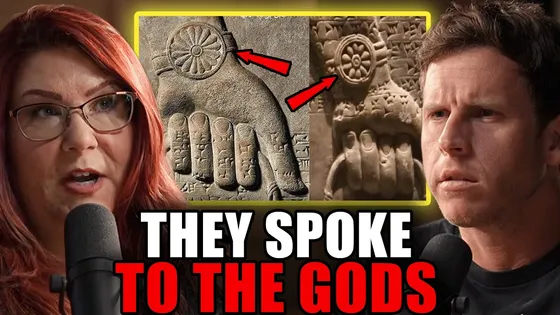
Heather Lynn says the Anunnaki wristwatches were poppy cuffs from Nimrud, not alien watches
On Danny Jones, Lynn gives the ancient aliens internet a delightfully terrestrial answer, then pushes it into a bigger claim about opium, mushrooms and Mesopotamian altered states.
Heather Lynn says archaeology was primarily used as a cover for spying operations
On Danny Jones Podcast, Lynn ties cabinets of curiosities, King Tut money, and Middle East mapmaking to archaeology's oldest dirty secret.

Darcy Weir says the US Air Force planned to nuke the moon in 1958 to flex on the Soviets
The UFO documentary filmmaker revisits Project A119, a Cold War scheme that proves our actual space history is much weirder than the flying saucer rumors.
The circuit, read weekly. No noise.