Maureen Callahan says JFK Jr.'s plane crash was a murder-suicide mission
Callahan makes the hardest possible case against the Kennedy myth, but her evidence proves recklessness more cleanly than intent.
Listen on YouTube · Spotify · Apple Podcasts
 WATCH NOW↓
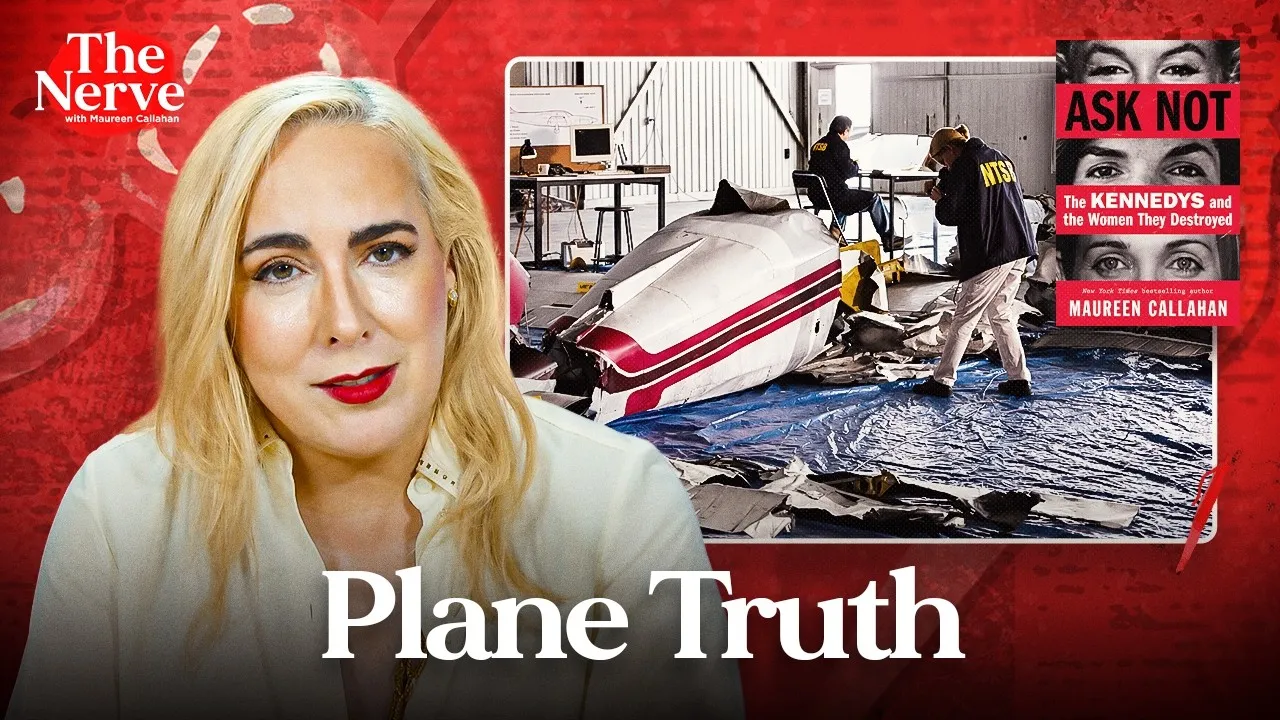
 Maureen Callahan says John F. Kennedy Jr.’s 1999 plane crash was not really an accident, but a “murder-suicide mission.” That is the kind of sentence that arrives wearing steel-toed boots, especially when the dead include Kennedy’s wife, Carolyn Bessette-Kennedy, and her sister, Lauren Bessette.
Callahan is not interested in the gauzy, candlelit version of the John F. Kennedy Jr. story, the one where golden-boy tragedy gets converted into national wallpaper. On The Megyn Kelly Show, using material from her book Ask Not, she frames the crash as an act of extreme selfishness by a pilot who had no business taking off. The romance gets tossed overboard first.
we are hell-bent on making sure that the true story of this suicidal homicidal act is the one that is memorialized in the history books for successive generations.
The reckless-pilot case is brutal enough
The aviation case Callahan lays out is grim. She says four other pilots had been unable to land at Essex County Airport that evening without instruments, the haze was thick, visibility was only about four miles, and one pilot’s friends refused to get into his plane. Kennedy, meanwhile, was still recovering from an injury and moving around the Piper Saratoga on crutches. This is not Top Gun. This is a man trying to force destiny through bad weather in a small plane.
John did not know how to use his instruments.
She also cites the NTSB investigation to say Kennedy failed to file a flight plan and cut off communication with air traffic control. Then comes the detail that feels like it belongs in a courtroom drama too broad for network television, an American Airlines plane with 128 passengers and six crew members had to avoid him as he climbed above his assigned airspace. The airline’s destination, Callahan notes, was John F. Kennedy Airport. The symbolism is almost tacky. Real life often is.
Here is the important split. Callahan’s recklessness charge is persuasive. Her intent charge is not proved by the material she presents. The established account of the crash already gives us a damning story about poor judgment, night flying, haze, and a pilot losing control. Calling that “murder-suicide” requires evidence of state of mind. What Callahan has, at least here, is a mountain of irresponsibility. That’s not nothing. It’s also not the same thing as proof of a murder plot against his passengers.
The uglier claim is what happened after
Callahan’s attack on the Kennedy family does not stop at the crash. She says Ted Kennedy moved quickly to manage the aftermath, with autopsies, sealed reports and photos, cremation, and family positioning over the remains. The nastiest material she reads comes from Robert F. Kennedy Jr.’s diary, where he describes the Bessette family’s treatment as cold, strategic, and cruel.
He bullied, bullied, bullied the shattered, grieving mother.
That is the part of Callahan’s case that lands without needing the most explosive label. A grieving mother had lost two daughters. A powerful family was trying to control the public meaning of a disaster. Even if you reject the murder-suicide language, the afterimage here is ugly, power arranging the flowers before the bodies are cold.
Still, Callahan’s choice of phrase matters. “Murder-suicide” is not just a harsher synonym for negligent flying. It implies motive, or at least a self-destructive drive so extreme that it swallowed two innocent passengers. If the phrase becomes searchable, shareable, and cable-ready, it should also be challenged at the same volume. Reckless is supported. Fatal arrogance is supported. Murder-suicide is Callahan’s prosecution, not the case file.
I actually do believe that whether he was dialed into it or not, he was on a murder-suicide mission.
- What exactly did Maureen Callahan say about JFK Jr.'s plane crash?
- Callahan said John F. Kennedy Jr. did not merely make a tragic mistake. She called the crash a 'suicidal homicidal act' and later said she believed he was on a 'murder-suicide mission,' even while allowing that he may not have been fully conscious of that intent.
- What evidence did Callahan use for that claim?
- She cited poor flying conditions, his inability to use instruments, his failure to file a flight plan, his decision to cut off communication with air traffic control, and a near miss with an American Airlines plane. Those details support a harsh negligence argument. They do not, on their own, prove intent.
- Is Callahan's murder-suicide claim the official finding?
- No. The official account of the crash centers on pilot error, including spatial disorientation during a night flight in difficult visibility. Callahan is making a moral and interpretive argument, not repeating an official finding of suicide or murder.

Maureen Callahan says Jack Schlossberg’s Caroline Kennedy campaign video proves the Kennedy brand is tarnished
The jab is brutal, and a little too pleased with itself, but the central point is sharp: dynastic glamour can look desperate when the heir starts losing.

Maureen Callahan says David Sedaris’ New York Times home interview was extremely obnoxious because his husband flew to London to check on their other homes
Callahan’s target wasn’t just Sedaris’ money, it was the museum foyer, the expensive Christmas sculpture, and the breezy little phrase “their other homes.”

David Sedaris says he bought a $2.5 million New York penthouse for his Picasso
Maureen Callahan uses Sedaris's New York Times real estate profile as Exhibit A in the case that America's beloved literary crank has become a museum-grade rich guy.

Maureen Callahan says Lena Dunham unloaded on Bruce Springsteen about Jack Antonoff in a Mayfair nightclub
Callahan’s read of Fame Sick is that Dunham protects Taylor Swift, punishes Jack Antonoff, and saves the wildest therapy session for Bruce Springsteen.
The circuit, read weekly. No noise.