Professor Jiang says he is not really a professor and does not have a PhD
Theo Von's geopolitics guest built an anti-expert case on prediction, then admitted the title is not an academic credential.
Listen on YouTube · Spotify · Apple Podcasts
 WATCH NOW↓
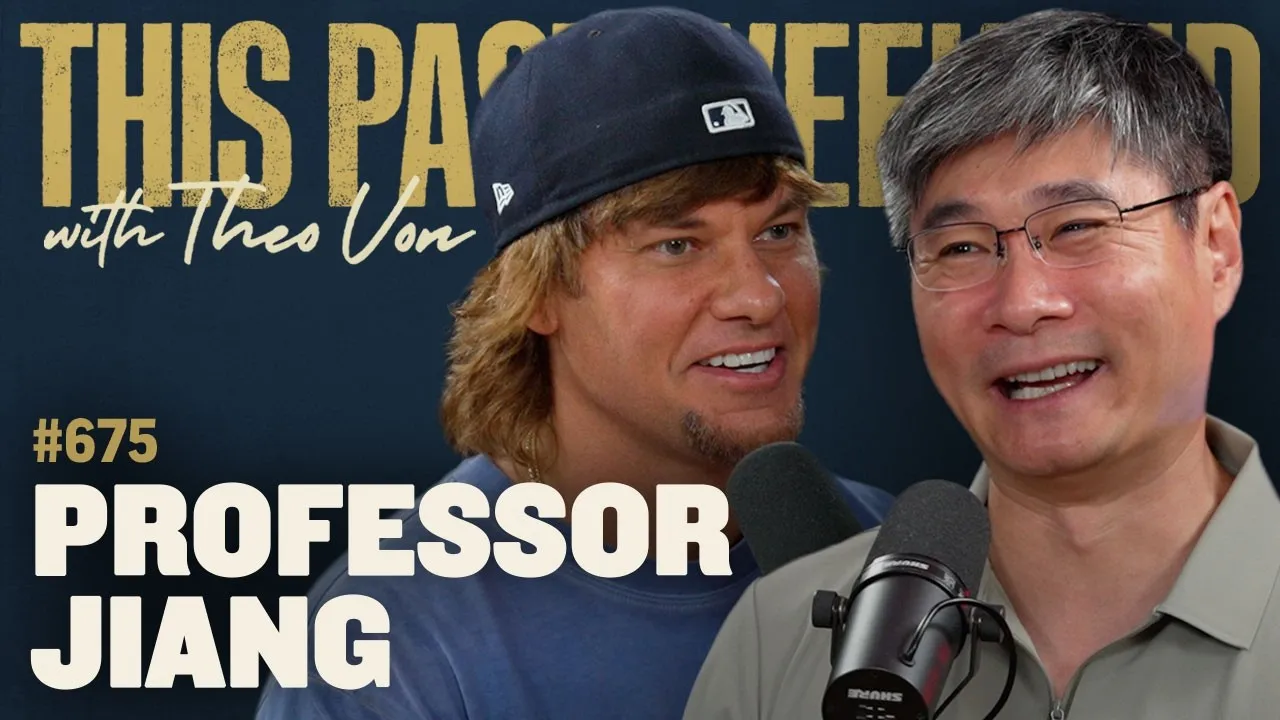
 Professor Jiang, the geopolitics YouTuber Theo Von introduced as a teacher and expert, says he is not really a professor and does not have a PhD. That admission lands after nearly two hours of Iran war scenarios, Clean Break memo theorizing, Illuminati talk, and Theo’s vision of heaven as a Jersey Mike’s staffed by your dead relatives.
I’m not really a professor, right? I I not I’m not a professor.
That is not a footnote. It is the operating system of the whole This Past Weekend episode. Jiang is not hiding the ball, exactly. Early on, he says he teaches high school. Later, he says the quiet part cleanly: the professor title is not an academic rank. It is a YouTube costume, a classroom vibe, a little tweed jacket for the algorithm.
The funny thing is that his case against credentialism is not stupid. Plenty of very credentialed people have been wrong in public, loudly, expensively, and with better lighting. Jiang’s pitch is that prediction should be the new credential. Do not show me the diploma. Show me the hit rate.
And what I try to do is with my with my analysis, I try to make predictions and that’s a really um good way to engage students as well as to test my own worldview, my own hypothesis.
The anti-expert bargain
Jiang says he predicted Trump would win in 2024, that Trump would launch a war against Iran, and that America would lose it. That is the candy shell of his project: geopolitics as a scoreboard. Theo, to his credit, keeps asking the questions that make the whiteboard sweat. What is game theory? Why the Strait of Hormuz? How does Israel benefit? Wait, which war are we talking about?
The bargain Jiang offers is seductive. Experts, he says, are protected by gatekeeping. Outsiders, by contrast, can be tested in the open. There is something democratic in that. There is also a giant trapdoor underneath it. If predictions are vague enough, if the theory expands after every contradiction, if every bad fact becomes proof that the hidden system is even more hidden, then the scoreboard is fake.
I don’t have a PhD, right? So, so just for um yeah, just be for honesty. Okay, but that’s just gatekeeping like where where you know if you’re not a college professor, you don’t you don’t have a PhD, you’re not a specialist, you’re not you don’t get get to be called a professor.
This is where the episode gets both fascinating and woozy. Jiang points to real things, like the Clean Break report and Wesley Clark’s famous remarks about a post-9/11 plan to target multiple countries. Then he stacks those pieces into a mega-claim: American policy in the Middle East is following an Israeli strategy, Iran is the final boss, and the deeper force is not merely state interest but secret eschatological networks. The leap is Olympic. No warm-up, no spotter.
A whiteboard is not a source
By the time Jiang is talking about the Illuminati, Jeffrey Epstein being above Mossad, and Gaza as a pilot for a surveillance state, the professor question starts to matter less as snobbery and more as consumer protection. Credentials do not guarantee truth. Fine. But a lack of credentials does not magically turn speculation into courage.
secret societies rule the world. Okay. So let me explain why that’s the case.
The strongest version of Jiang is the teacher who wants arguments to make predictions and survive contact with reality. The weakest version is the guy who can explain every event by expanding the circle of invisible control. That second version is not analysis. It is a Roomba trapped in a conspiracy closet.
Theo is a useful host for this because he is allergic to fake smoothness. He interrupts with the kind of questions a cable anchor would be too embarrassed to ask, then wanders into heaven lore, then comes back with, basically, hold on, are you saying Netanyahu is the crazy brother? The result is messy, funny, and weirdly clarifying. Theo does not make Jiang prove everything. He does make him say the thing plainly.
So yes, Professor Jiang says he is not actually a professor. The more important test is whether listeners treat that as the end of the story or the beginning of better media literacy. If the degree does not decide who gets believed, the receipt has to. Dates. Definitions. Failed predictions. Corrections. The whole annoying pile.
I might be a Chinese spy but I’m not the but I’m not the antichrist.
- Is Professor Jiang actually a professor?
- No, by his own account. He says he is a high school teacher, not a college professor, and that he does not have a PhD. That does not automatically make him wrong, but it does make the title feel more like a media identity than an academic credential.
- Why does Professor Jiang think predictions matter more than credentials?
- His argument is that experts should be judged by whether their models predict events, not by where they work or what degrees they hold. That is a useful challenge to credential worship, but only if the predictions are specific, dated, and checked with the same force as the claims he makes about war and secret power.
- Did Theo Von challenge Professor Jiang's claims?
- Theo pushed for definitions, asked basic follow-ups, and had producers check some factual claims in real time. He also let Jiang range far into claims about the Clean Break memo, secret societies, Israel, Iran, and the Illuminati. The episode works best when Theo is asking the simple question everyone else is thinking.
Professor Jiang says Xi Jinping is a frontman for red nobility families who run China from overseas
On the Danny Jones Podcast, Professor Jiang offers a spicy theory of Chinese power, useful as a provocation, weaker as a full explanation.
Professor Jiang says Texas red heifers are already in Israel for a Third Temple sacrifice
The Danny Jones guest turns a strange but real prophecy story into a much bigger claim about Jerusalem, Al-Aqsa, and end-times politics.
Joey Diaz says 19 years off cocaine gave him more than his first 44 years
Diaz turned a filthy, funny hang with Theo Von into a blunt sermon on sobriety, regret, and what finally showed up after the bag left.
Theo Von says he has 46 days sober after falling out of his AA program
A solo episode that begins with haircut shame turns into a blunt recovery check-in from Theo Von.
The circuit, read weekly. No noise.