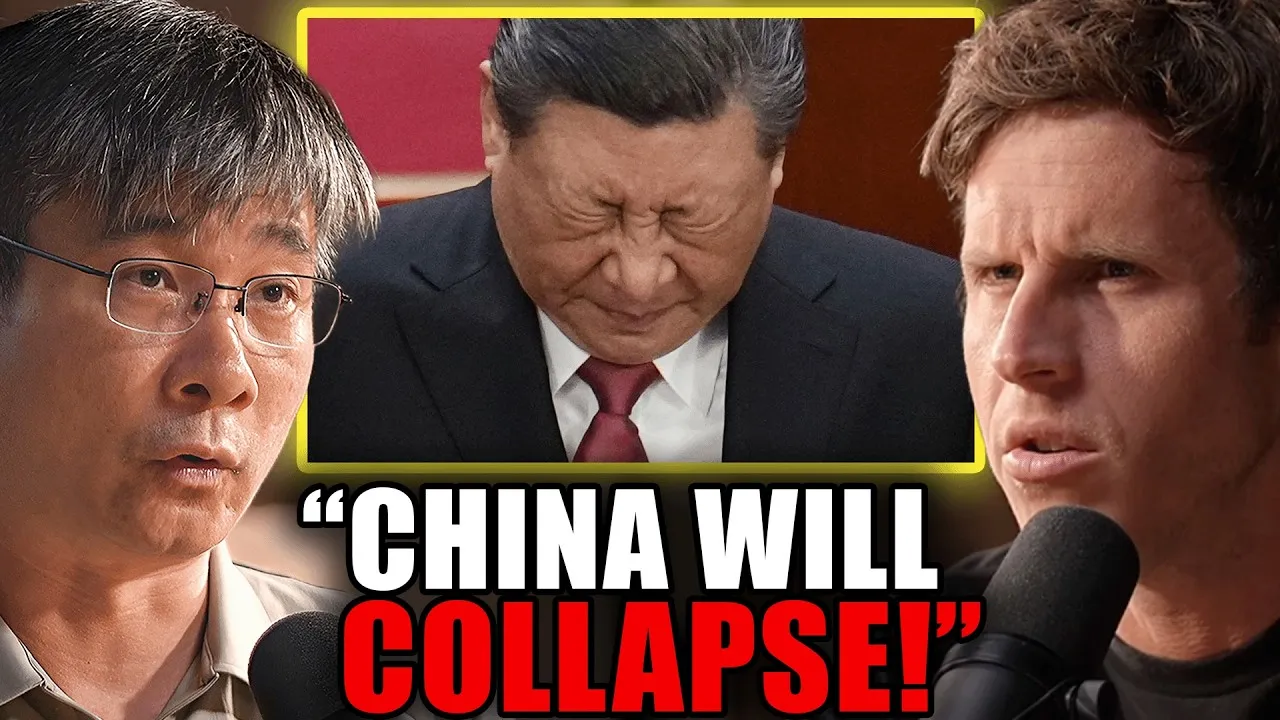
Professor Jiang says Xi Jinping is a frontman for red nobility families who run China from overseas
On the Danny Jones Podcast, Professor Jiang offers a spicy theory of Chinese power, useful as a provocation, weaker as a full explanation.
Listen on YouTube
 WATCH NOW↓
 The spicy version of the China take is not that Xi Jinping is all powerful. It is that he is the guy on the poster, while the real owners are revolutionary families cashing checks from a system they do not even have to physically inhabit.
That is the argument Professor Jiang brings to the Danny Jones Podcast, and it is much more fun than the usual Bond villain reading of Xi Jinping. In Jiang’s telling, Xi is not the master switch of China. He is the acceptable strongman, the face that keeps the factions from admitting the machine is run by families, networks, and old revolutionary ownership claims.
So the people who run China are not actually in China. They’re actually in the United States and they are inconspicuous. You don’t know who they are.
That is a hell of a sentence. It sounds like a Reddit thread that drank three espressos and got into archival land reform documents. Jiang’s phrase for this ruling class is “red nobility,” the descendants and networks of revolutionary power who control the guns, the assets, and the boring stuff that actually matters, hospitals, power plants, telecommunications, infrastructure. His ugliest metaphor is also his clearest one, China as a “plantation economy,” built to extract value upward rather than liberate creativity below.
The anti-innovation theory of Xi
Jiang’s case depends on a clean split, innovation versus control. The technocratic era after Deng Xiaoping, he argues, created a middle class that could interface with global capital. Wall Street wanted access to Chinese household savings. Chinese professionals wanted education, mobility, and the cosmopolitan life. That produces growth, but also corruption, inequality, capital flight anxiety, and the terrifying possibility of people like Jack Ma becoming more culturally powerful than the party’s old families.
This is where Jiang turns Xi into a political instrument. Xi was “brought into power,” he says, to shut down the drift toward liberalization and bring the economy back under control. The claim is not that Xi hates money. It is sharper than that. Jiang says the ruling class preferred a smaller, more obedient China to a richer China full of people creative enough to ask why the same families always win.
Did you want innovation or did you want control? And they said, “No, we prefer control.”
As a theory of authoritarian capitalism, this is punchy and useful. As a total theory of modern China, it is too neat. China’s state can crush billionaires, steer banks, censor memory, and still pursue electric vehicles, AI, industrial policy, and hard science. Authoritarian systems are not allergic to innovation. They are allergic to innovation they cannot domesticate.
COVID as the smoking crater
Jiang’s best evidence is COVID-19, which he treats as the moment China abandoned the old legitimacy bargain of growth at any cost. Entrepreneurs could not reach factories. Factories closed. Real estate cratered. The economy, in his version, was not merely damaged by a public health panic. It was sacrificed to prove who owned the room.
Why would they intentionally implode the Chinese economy, right? And the answer is they wanted control, not innovation.
That word “intentionally” is the load bearing beam. Jiang is not saying Beijing made bad policy under uncertainty, which every government on Earth managed to do in its own national flavor. He is saying the economic pain was acceptable because it disciplined the middle class and reset the hierarchy. That is a darker argument, and also harder to prove from the outside.
COVID is probably the most sensitive topic right now in China still to this day.
He is on firmer ground when he talks about memory. Authoritarian states curate the past because an uncontrolled past becomes an uncontrolled politics. COVID deaths, origins, lockdown decisions, and the sudden lifting of restrictions are not just policy questions. They are ownership questions. Who gets to say what happened? Who gets blamed? Who gets erased?
Xi, the emperor with a costume department
The headline claim arrives when Jiang separates the image of authoritarian unity from the mess underneath. He says Chinese factions need a strongman because the performance of singular authority keeps the system legible. Xi is indispensable as symbol, but not sovereign in the fairy tale sense.
So he is really the frontman, the strong man for the system. But the problem with this is he has actually very little control over China. He’s an emperor of no clothes.
Here is the rub. Xi has spent years looking very much like a man with control, consolidating offices, punishing rivals, ending the expectation of orderly succession, and turning personal loyalty into a governing requirement. You do not have to buy the comic book version of Xi as omnipotent to see that “very little control” is an overcorrection.
Still, Jiang’s frame punctures a lazy habit in Western China talk. We love one-man explanations because they are tidy. Xi wants this. Xi fears that. Xi decides. Jiang’s answer is messier and more aristocratic, a party state as family business, a strongman as brand manager, a country as asset.
If that is true, the question is not just what Xi wants. It is what the people behind him can afford to lose.
- What does Professor Jiang mean by red nobility?
- He means the elite families that came to power through the Chinese revolution and kept control of key state assets, military power, infrastructure, hospitals, power plants, and telecommunications. In his frame, they are not just rich insiders. They are the shareholder class of the Chinese system.
- Did Professor Jiang really say the people who run China live in the United States?
- Yes. He says many members of the ruling elite’s families moved overseas, especially to the United States, and that the State Department tracks them. The stronger version of his claim is that China functions like an extraction machine for these families, wherever they personally live.
- Is the claim that Xi Jinping has very little control believable?
- Partly. It is credible that Chinese politics includes elite factions, family networks, and interests far deeper than one man. But saying Xi has “very little control” overshoots the evidence, since Xi has also centralized power, broken succession norms, and used purges and policy campaigns with real force.

Professor Jiang says Texas red heifers are already in Israel for a Third Temple sacrifice
The Danny Jones guest turns a strange but real prophecy story into a much bigger claim about Jerusalem, Al-Aqsa, and end-times politics.
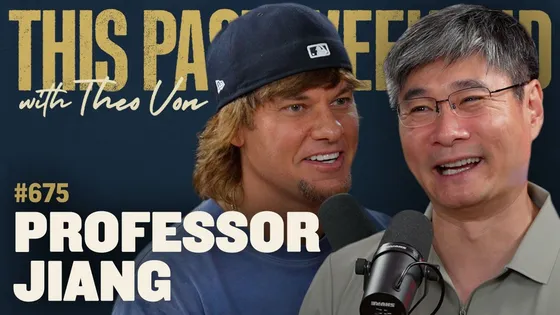
Professor Jiang says he is not really a professor and does not have a PhD
Theo Von's geopolitics guest built an anti-expert case on prediction, then admitted the title is not an academic credential.

Matt Ehret says cosmic rays, not human CO2, are the real causes of climate change
On the Danny Jones Podcast, Ehret revives the Henrik Svensmark cosmic-ray theory and says the scientist was professionally punished for challenging the CO2 consensus.

Daniel Whiteson says the Princeton simulation evidence is a cosmic-ray glitch thought experiment, not proof
The physicist likes the sci-fi of it, but he treats the viral simulation claim less like a smoking gun than a very nerdy stress test for reality.
The circuit, read weekly. No noise.