Robert MacLean says the Germanwings Rule makes flying less safe, and the U.S. is the only country still using it
The former air marshal argues that a post-Germanwings cockpit rule meant to stop suicidal pilots may actually create the hijacking window everyone is trying to close.
Listen on YouTube
 WATCH NOW↓
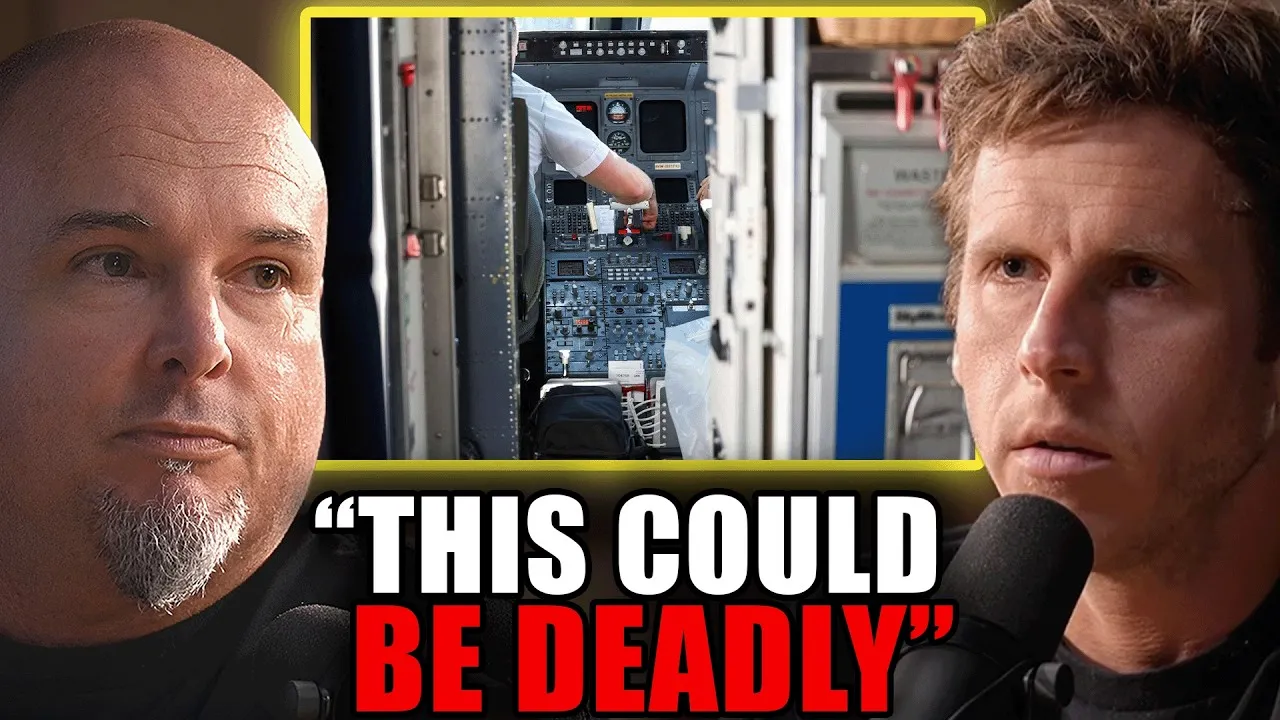
Robert MacLean told the Danny Jones Podcast that the Germanwings Rule makes flying less safe because it keeps the cockpit door open longer, and that the United States is the only country he knows still using it. Robert MacLean, a former Federal Air Marshal and TSA whistleblower, said Europe, Asia, and Australia dumped the rule because it “created more vulnerabilities.”
This is the kind of aviation-security argument that sounds insane for about two seconds, then starts to feel annoyingly plausible. The rule is supposed to solve the nightmare scenario from Germanwings, a pilot alone behind a locked door. MacLean’s objection is that the cure creates a different nightmare, a cockpit door cracked open long enough for the wrong person to rush it. Airport security loves rituals. Shoes off. Liquids in a tiny bag. Everyone solemnly performing safety theater under fluorescent lighting. MacLean is saying this one is not just silly. It may be backwards.
And here’s another thing I blew the whistle on. It’s called the German Wings Rule. And the United States right now is the only one that does the German Wings Rule.
The mechanics are grimly simple. If a pilot leaves, a flight attendant enters the cockpit. That is supposed to mean no pilot is alone. But MacLean asks the obvious rude question: what exactly is a flight attendant going to do if the person at the controls wants to crash the plane? Meanwhile, the door has to unlock, open, admit one person, release another, then close again. In aviation security, that is not a detail. That is the whole ballgame.
So, tell me, what what is what is How is a flight attendant going to stop a guy in the controls, or gal, who wants to crash the plane?
The door is the danger
MacLean’s strongest point is not emotional. It is spatial. Airplane cockpits are tiny, doorways are bottlenecks, and seconds matter. He says the door can remain open “six times longer” under the two-person swap than it would if the pilot simply exited and the door immediately closed. The moment the door cracks open, the reinforced cockpit door stops being a symbol and becomes an opening.
That puppy cracks open, all I have to That is the That is the That’s the worst vulnerability of all of them.
Is MacLean overstating it? Maybe around the edges. His claim that the United States is alone comes with some caveats in the transcript, including uncertainty about South America and a rumor that one U.S. airline may have stopped the practice. But the core critique is not a conspiracy theory. It is a design problem: a rule created to prevent one rare catastrophe may increase exposure to another.
His alternative is almost comically modest. Not a new airplane. Not a sealed luxury cockpit pod with a pilot-only bathroom and a little Nespresso machine. A secondary barrier. Something that buys a few seconds while the cockpit door is open.
You don’t need a robust one. You just need 5 seconds.
First class versus five seconds
Then MacLean takes the argument from cockpit geometry to airline economics. He says an unpublished TSA report, later published because of his disclosure, showed then-TSA administrator David Pekoske opposing stronger secondary barriers because airlines did not want to sacrifice high-revenue seats. That is the episode’s nastiest little detail: the alleged tradeoff is not safety versus feasibility. It is safety versus first class.
MacLean’s outrage has a familiar whistleblower shape. The agency says weight and space are problems. He points at seatback screens, wiring, alcohol service, and all the other things airlines seem perfectly willing to carry when there is money attached. It is not proof by itself, but as a piece of bureaucratic satire, it bites. Nothing says national security like refusing a barrier because it might inconvenience the people drinking champagne before takeoff.
The most eyebrow-raising wrinkle involves the Federal Air Marshals. MacLean says new secondary barriers have slats because air marshals wanted the ability to shoot through them if a flight attendant failed to check the lavatory before a pilot came out. He calls that logic absurd and suggests motion or weight sensors would solve the problem without weakening the barrier. He also floats a more cynical theory: once cockpit barriers truly work, the air marshal program has less to justify.
That last part is the least provable and most MacLean-ish claim, the kind of institutional self-preservation argument that sounds paranoid until you remember institutions do, in fact, preserve themselves. The cleaner, stronger case is narrower: if the safest cockpit door is a closed cockpit door, then a rule that opens it longer deserves a brutal audit.
For passengers, the stake is concrete. If MacLean is right, the thing meant to reassure everyone after Germanwings is another airport-security ritual that survives because it looks like action. The real question is smaller and scarier: when the cockpit door opens, who is the system actually protecting?
- What did Robert MacLean say about the Germanwings Rule?
- Robert MacLean said the Germanwings Rule makes flying less safe because it requires the cockpit door to stay open longer while a flight attendant swaps in for a pilot. He argued that the United States is the only country he knows of that still uses the rule, while Europe, Asia, and Australia dropped it after deciding it created more vulnerabilities.
- What is the Germanwings Rule?
- MacLean describes it as a two-person cockpit rule adopted after the Germanwings crash: if one pilot leaves the cockpit, a flight attendant goes inside so two people remain up front. The idea is to prevent a lone suicidal pilot scenario, but MacLean says the procedure opens the cockpit to a different danger.
- What cockpit safety change does MacLean think would work better?
- MacLean favors secondary cockpit barriers that buy a few seconds when the main cockpit door opens. In his view, the answer is not a huge redesign or a pilot-only bathroom, but a simple barrier that delays an attacker long enough to close the vulnerable window.
Bret Weinstein says he fears powerful pro-Israel forces could kill him for criticizing Israel
The evolutionary biologist frames his criticism of Israel as a patriotic risk, but his evidence for a physical threat is much thinner than his alarm.
Carl Hayden Smith says DMTX risks humans colonizing entity space
On the Danny Jones Podcast, Smith treats extended DMT less like a trip hack and more like a diplomatic incident.
Greg Carlwood says Tracy Twyman believed Freemasons could enter 'hidden hyper space kingdoms'
Carlwood treats Twyman's occult cosmology as a dangerous mix of research, ritual, and conspiracy folklore, but the evidence stays ghostly.
Luke Reagan says he found ancestral Pueblo pit houses on Epstein's New Mexico ranch
The weird part is not that the Epstein ranch inspired conspiracy hunting, it is that the thing Reagan says he found is probably much older and less lurid than the internet wanted.
The circuit, read weekly. No noise.