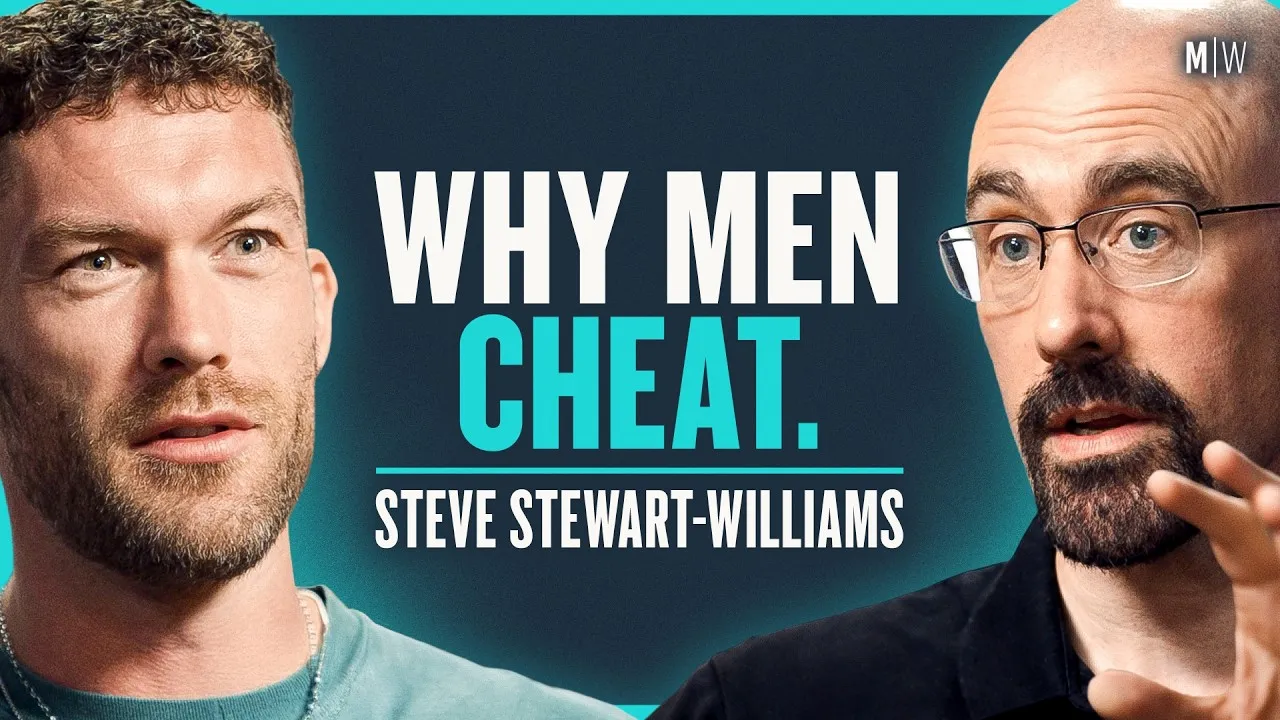
Steve Stewart-Williams says castration before puberty could erase the male lifespan gap
The evolutionary psychologist’s bleak little longevity claim is less a life hack than a warning label on testosterone.
Listen on YouTube
 WATCH NOW↓
 Steve Stewart-Williams says there is already a way, in principle, to wipe out the average lifespan gap between men and women: castration before puberty. This is not a pitch for the bleakest longevity startup on Earth. It’s a brutal little footnote to a bigger argument, that testosterone is not just the hormone of gym posters, jawline discourse, and podcast ads. It has a bill.
On Modern Wisdom, Steve Stewart-Williams spends most of the conversation trying to keep sex-difference science from becoming either a frat-house victory lap or a seminar-room heresy trial. Then, near the male mortality question, he drops the line that turns the room into a Victorian medical museum.
we do actually already have an intervention that we could in principle do, which would completely obliterate the the average difference in lifespan between men and women, and would extend men’s lifespan, and that is castration. It’s got to be um castration before you hit puberty though.
The verdict: the claim is shocking, but not silly. Historical eunuch data, including the Korean Joseon Dynasty example Williamson brings up, has often been used as evidence that lower lifetime testosterone exposure may extend male lifespan. That doesn’t mean we have a clean randomized trial, because, mercifully, science has not become a Saw sequel. It means the biology points in an uncomfortable direction.
Testosterone is not a personality brand
That show that it’s testosterone that is making us bigger, stronger, more aggressive, but also shortening our our lifespan as well.
That sentence is the whole Stewart-Williams project in miniature. The male side of the ledger gets size, strength, risk appetite, and a higher chance of doing something heroic or idiotic enough to end up as a story at a wedding. The same package also gets more accidents, more violence, more cardiovascular trouble, and shorter lives. Biology is not handing out prizes. It is making trades.
Williamson puts the size of that trade in the bluntest possible terms, citing Randy Nesse, the evolutionary medicine researcher whose work often treats modern health problems as evolutionary hangovers.
If male mortality were at female rates, we would save more years of life than if we cured cancer.
That’s the sentence people should argue with, not the castration gag. The eunuch point is the lurid door handle. The room behind it is male mortality, and it’s enormous. Men die younger in most societies, and Stewart-Williams argues that some of that is not just jobs, wars, cigarettes, or men refusing to see a doctor until a limb changes color. Some of it is the cost of the male developmental pathway itself.
The catch, besides the obvious
The obvious catch is that prepubertal castration is not a health policy unless your advisory board is an unwell Roman emperor. The less obvious catch is that testosterone is not a villain. It is part of a bundle. Strip out the hormone and you don’t just delete early heart attacks and bar fights. You also alter puberty, fertility, muscle, sex drive, and a great deal of what we recognize as male development.
This is where evolutionary psychology is useful when it behaves itself. It doesn’t say, “men take risks, therefore men should take risks.” It says, “here is why the risky machinery may have been built, and here is what it costs now.” Stewart-Williams is good on that distinction. He keeps refusing the lazy escape routes, the one where nature becomes permission, and the one where denying nature becomes virtue.
There’s also a funny cultural problem here. Modern masculinity discourse loves testosterone when it means vitality, libido, confidence, and shoulders. It gets quieter when the same story includes earlier death. Everyone wants the Marvel serum. Nobody wants to read the side effects label.
That is why the castration line works as more than shock bait. It exposes the emotional accounting error. If we’re going to talk honestly about sex differences, we don’t get to count only the flattering ones. Bigger, stronger, bolder, shorter-lived. Congratulations, gentlemen, the package shipped complete.
Tell men and women all the facts. This approach to life, this risky approach uh cuts both ways. You could go up, you could go down.
- Is Steve Stewart-Williams actually recommending castration?
- No. He frames it as an extreme example of how much testosterone may contribute to male mortality, not as advice. His point is that the same hormone linked to male size, strength, aggression, and risk-taking also appears to shorten male lifespan.
- Why would testosterone shorten lifespan?
- Stewart-Williams argues that testosterone helps produce traits that can be useful in competition, like strength and risk-taking, but those traits are expensive. They are tied to injuries, violence, cardiovascular strain, and other hazards that make male life, statistically, a rougher bet.
- What does Randy Nesse’s cancer comparison mean?
- Chris Williamson cites the evolutionary medicine researcher Randy Nesse’s calculation that lowering male mortality to female rates would save more years of life than curing cancer. That comparison is meant to show how large and normalized the male lifespan penalty is.
Robert Greene says Christianity is a pagan religion
The author of The 48 Laws of Power has traded boardroom knives for hummingbirds, Aphrodite, and the claim that Christianity still carries paganism in its bones.
Vittorio Angelone says ignoring young men leaves them to Andrew Tate
The comedian’s defense of Jordan Peterson is less a conversion story than a warning about who gets young men when everyone else finds them embarrassing.
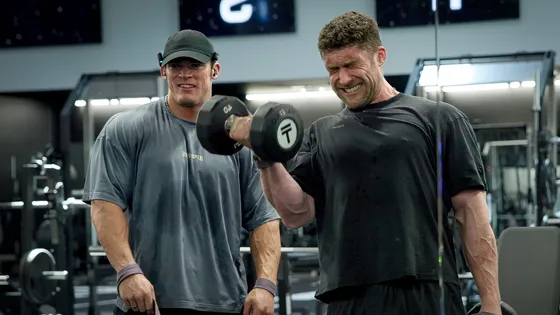
Sam Sulek says he hasn't done a real shoulder press in three or four years
The young bodybuilding star's arm-day logic is half physique audit, half glorious meathead minimalism.

Angela Duckworth says successful people don’t use willpower
The author of Grit has not disowned effort, but she is now arguing that white-knuckle discipline is the worst way to build a life.
The circuit, read weekly. No noise.