Andrew Aurigema says a $1.50 foam warp-drive thruster could get a 45-ton ship to Mars in 3 and a half days
The pitch is part garage project, part Star Trek fever dream, and the gap between two pieces of paper of thrust and a Martian landing is the whole story.
Listen on YouTube
 WATCH NOW↓
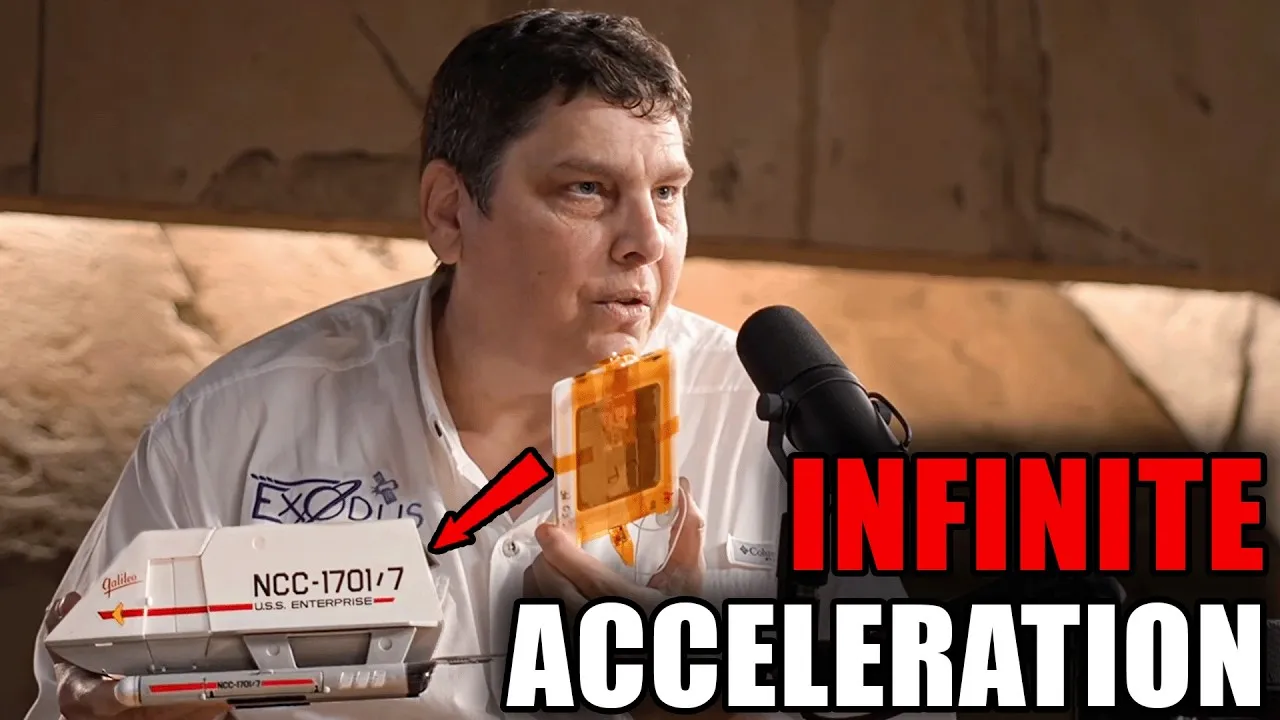
 Andrew Aurigema is not merely promising faster Mars travel. He is promising the end of the astronaut diaper era. On Danny Jones Podcast, Aurigema claimed that a scaled-up version of his grooved foam electrostatic thruster could push a 45 metric ton spacecraft from Earth orbit to the surface of Mars in 3 and a half days, with enough continuous acceleration that passengers could pour coffee, use a toilet, and avoid months of bone loss.
we can produce 0.38 G continuous acceleration from Earth orbit to anywhere on the Mars surface in 3 and 1/2 days. We could build a spaceship. We can’t because we we can’t afford a spaceship.
This is exactly the kind of sentence that makes half the internet open a new tab and the other half reach for a fire extinguisher. The romance is obvious: no nine-month cruise, no cramped chemical-rocket misery, no floating around like a haunted Roomba while your muscles quietly file for divorce. But the numbers Aurigema gives at the start are tiny. Current force, he says, is about 50 millinewtons, enough to lift two pieces of paper. The leap from paper-lifter to Mars express is not a step. It is a canyon wearing a lab coat.
The pitch is garage science with Star Trek lighting
Andrew Aurigema describes the device in gloriously unfashionable terms: a little foam object, grooves, foil, black RTV sealant, high voltage, and a string from the ceiling. Not a gleaming NASA render. Not a billionaire’s stainless-steel monument to midlife. A dangling homemade thing that, according to Aurigema, can visibly pull itself when built correctly.
That is a warp drive thruster. I know he hates it when I call it warp drive, but I love the term, so any chance I get to to call things warp drive, I do.
The phrase warp drive is doing dangerous marketing work here. Aurigema is not, in this clip, claiming a clean Star Trek jump through spacetime. He is describing an electrostatic pressure device, a sealed box that allegedly produces thrust because a large area experiences more force than tiny grooved tips. In plain English, he says the shape lets one side win.
That explanation is fun. It is also where the eyebrow climbs. Propellantless thrust claims live in the same cultural neighborhood as miracle batteries, cold fusion press conferences, and YouTube thumbnails where the word NASA is always slightly too large. The burden of proof is brutal because space propulsion is not short on dreamers. It is short on devices that work after every boring error source has been hunted down and killed.
The battery claim is the wildest part
Aurigema does not just say the ship could get to Mars quickly. He says it would not need a nuclear reactor to do it. His reason is that the system is electrostatic, not a current-hungry magnetic thruster. Once the field is formed, he says, the engine can keep going with very little energy.
The energy requirements to get to Mars are the same as your the the battery in your car could easily supply the energy to keep the engine running for the 3 and 1/2 days it takes to get to Mars.
That is the claim people will fight about. Mars in 3 and a half days is flashy. A car battery powering the trip is the part that sounds like it escaped from a forum thread at 2:17 a.m. To be fair, Aurigema is not saying a car battery supplies the kinetic energy of a 45-ton vehicle screaming through space. He is saying the thruster’s operating energy is small because the relevant field is static. Still, the practical questions pile up instantly: scaling, insulation, arcing, thermal behavior, control, structural mass, thrust verification in vacuum, and whether the measured force survives independent replication.
Then comes the phrase that makes physicists twitch: over unity. Aurigema defines it specifically, not as a free-energy claim, but as a thrust-to-weight milestone for the propulsion cell. If the cell material weighs a pound, he says, it can generate 1.8 pounds of thrust. That is a big statement, and it deserves a clean room, a hostile test team, and instruments with no patience for vibes.
We now have propulsion cells that can lift their own weight. We are over unity.
The verdict here is not that Aurigema has solved space propulsion. The current public claim, as presented, is too far ahead of the demonstrated thrust to treat as anything close to a travel plan. But it is specific enough to be falsifiable, which is more than you can say for most cosmic hand-waving. Two pieces of paper today. Mars in 3 and a half days tomorrow. The distance between those sentences is where the science has to happen.
- Did Andrew Aurigema really say his thruster could reach Mars in 3 and a half days?
- Yes. Aurigema said a scaled propulsion system could provide 0.38 G continuous acceleration from Earth orbit to the Martian surface, arriving in 3 and a half days. He framed it as a spacecraft design problem, not something his team can currently fly.
- What is the $1.50 warp drive supposed to be?
- Aurigema describes a small electrostatic thruster made from grooved foam, foil, and sealing material. He says a homemade version can hang from a string and visibly pull itself through space, though only with about a tenth of a millinewton of thrust.
- Should anyone believe the Mars claim yet?
- Not as a proven transportation system. The episode gives a bold mechanism and some claimed thrust numbers, but the leap from a vacuum-chamber device lifting paper to a crewed Mars ship is massive. The serious question is whether independent labs can reproduce the thrust in vacuum and rule out mundane effects.
Charles Buhler says he has built a Star Trek impulse engine that needs no propellant
The electrostatics researcher’s claim is wildly specific, wildly consequential, and still miles from the kind of public proof that would make physics Twitter stop throwing chairs.

Darcy Weir says the US Air Force planned to nuke the moon in 1958 to flex on the Soviets
The UFO documentary filmmaker revisits Project A119, a Cold War scheme that proves our actual space history is much weirder than the flying saucer rumors.

Ioan Grillo says Mexican cartels are dropping fire extinguisher bombs from drones to empty villages
The cartel arms race is not just bigger guns, Grillo argues, it is cheap drones, hacked phones, and a grim little feudal project in the mountains.

Nathaniel Gillis says Chris Bledsoe's 'Merlin' label means a category of UFO contactee, not the wizard
On Danny Jones Podcast, Gillis turns the goofiest-sounding Bledsoe lore into a darker theory about government study, contactees, and weaponized ridicule.
The circuit, read weekly. No noise.