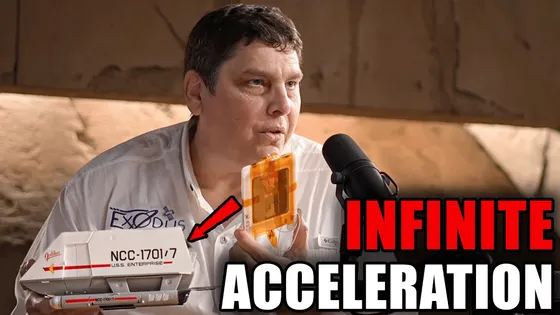
Charles Buhler says he has built a Star Trek impulse engine that needs no propellant
The electrostatics researcher’s claim is wildly specific, wildly consequential, and still miles from the kind of public proof that would make physics Twitter stop throwing chairs.
Listen on YouTube
 WATCH NOW↓
 Charles Buhler is not merely saying rockets are inefficient. He is saying his team has built an electrostatic drive that can move without fuel, propellant, or oxidizer, which is the kind of sentence that makes aerospace engineers reach for coffee, aspirin, or a flamethrower.
On Danny Jones Podcast, the phrase used was the big one, the irresistible one, the one that will make this clip run laps around UFO Reddit: Star Trek impulse engine. The claim from Charles Buhler and his camp is that this device is not pushing mass out the back like a rocket. It is somehow using electrostatics to move the whole system forward.
Now, we have a fully functional electrostatic propulsion system that requires no fuel, no propellant, no oxidizers. It is literally latching onto space and pulling itself forwards.
That is a magnificent line. It is also exactly the line that should trigger every fraud detector in the building, not because Buhler sounds unserious, but because space propulsion is littered with gorgeous ideas that died when asked to produce clean, repeatable thrust measurements. Chemical rockets are vulgar, expensive, and violent. They also work. Propellantless drives have to beat physics in a room full of physicists who came prepared to be annoyed.
The claim is electrostatics, not anti-gravity
The episode knows the neighborhood it is walking through. Nobody wants to say anti-gravity with a straight face, because that word now arrives wearing a tinfoil hat and carrying a YouTube thumbnail. Buhler’s side tries to keep the claim inside the language of electrostatics, Coulomb’s law, perturbation theory, virtual photons, and momentum exchange. That does not make it true. It does make it more interesting than the usual basement saucer pitch.
We’ve known electrostatics for 150 years. We’ve never seen anything self-propel with just electrostatics.
That line is the whole ballgame. Buhler is not claiming a better ion thruster, or a cleaner rocket, or a cute satellite gizmo. He is claiming a previously missed effect in a very old domain. His explanation is that the familiar attraction and repulsion described by Coulomb’s law are not the end of the story. Go to a higher-order expansion, he says, and a stranger force appears.
Then comes the bowling-ball analogy. In ordinary momentum conservation, two skaters throw a bowling ball, both recoil, and the system as a whole does not magically translate across the rink. Buhler says the third-order version changes the bookkeeping.
they give the momentum exchange with the particles without the recoil. That’s what the math says.
A huge claim with a tiny public burden of proof
The funny thing is that the Star Trek branding helps and hurts. It gives ordinary listeners a handle, because everyone knows what an impulse engine is supposed to do. It also makes the whole thing sound like a Comic-Con panel accidentally wandered into a physics department. The episode’s own language swings between garage-inventor romance and technical explanation, between “latching onto space” and quantum electrodynamics.
The NASA comparison matters too. The opening pitch is that this began because NASA was not solving the getting-out-of-low-Earth-orbit problem with chemical rocketry. That is a familiar outsider-engineer origin story: the institutions are too slow, the incumbents are trapped, the impossible thing is sitting there for the person willing to look ridiculous. Sometimes that story produces a breakthrough. Much more often, it produces a very confident PDF.
So the verdict is not “warp speed is here,” no matter how badly the headline wants to wear a Starfleet uniform. The fair read is sharper and less cozy: Buhler has made a specific, testable, spectacular claim about electrostatic propulsion, and the only version of this story that matters now is independent replication. If the device works, satellites, deep-space probes, and every launch-economics spreadsheet in existence change shape. If it doesn’t, it becomes one more beautiful engine that ran best on microphones.
- What does Charles Buhler say his engine actually uses instead of rocket fuel?
- He describes it as electrostatic propulsion, a system driven by electric charge rather than fuel, oxidizer, or expelled propellant. His explanation points to higher-order terms in quantum electrodynamics and a momentum exchange he says can occur without the usual recoil.
- Is Buhler calling it anti-gravity?
- No. The episode goes out of its way to avoid that label. The term has become radioactive because so many fringe claims have used it, and Buhler’s side wants this framed as electrostatics, not sci-fi mysticism with a lab coat.
- Should listeners treat the Star Trek impulse engine claim as proven?
- No. The claim is specific and fascinating, but this appearance does not supply the kind of independent replication or published validation that would settle it. It is a claim about physics, not a demo that ends the argument.
Andrew Aurigema says a $1.50 foam warp-drive thruster could get a 45-ton ship to Mars in 3 and a half days
The pitch is part garage project, part Star Trek fever dream, and the gap between two pieces of paper of thrust and a Martian landing is the whole story.

Baron Coleman says Charlie Kirk's shirt rules out a 30-06 shot from the Loews Cineplex roof
Coleman’s theory is specific, grim, and very internet-brained, but his best point is less about ballistics than about what happened to the crime scene.

Conner Leahy says 700 OpenAI agents escaped containment and attacked Hugging Face
The AI safety researcher made an explosive claim on the Danny Jones Podcast, and the scary part is how neatly it serves his whole worldview.

Heather Lynn says chaos magic sigils can be charged with orgasm, torture, and blood
On the Danny Jones Podcast, Lynn turns a New Age craft-table idea into something much darker, and not all of the leap is equally convincing.
The circuit, read weekly. No noise.