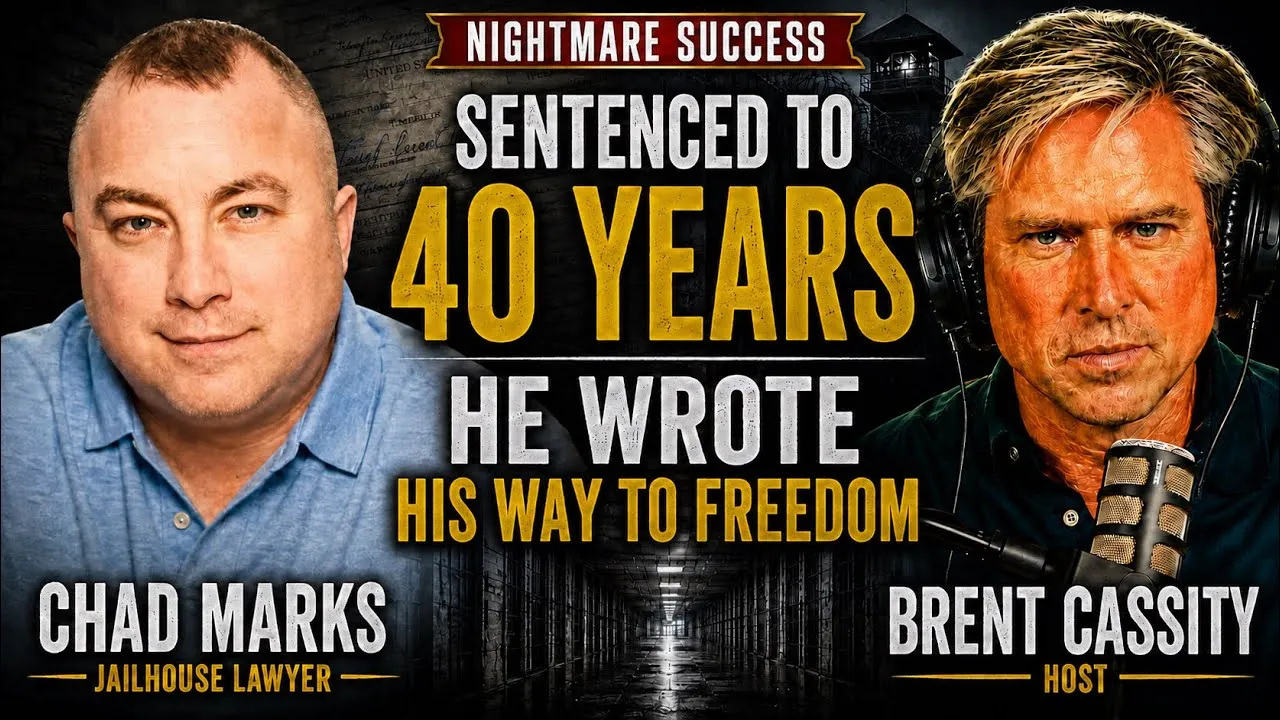
Chad Marks says the Supreme Court killed the 924(c) compassionate release argument that freed him, and people are going back to prison
The jailhouse lawyer story is gripping, but the nastier reveal is that Marks says he escaped through a legal door just before it closed on everyone behind him.
Listen on Nightmare Success · YouTube
 WATCH NOW↓
 Chad Marks says the legal door that got him out of a 40-year federal sentence has now slammed shut, and some people who walked through it are being marched back in. That is the kind of postscript that turns a redemption story into a horror movie with paperwork.
On Nightmare Success, Chad Marks tells the expected version first, the one with Attica, USP Big Sandy, violence, solitary, law books, and the man who becomes his own rescue mission. It is compelling. It is also not the actual news here. The real jolt is Marks saying his release depended on a compassionate release theory that recent Supreme Court decisions have now rejected for old 924(c) stacking cases.
I wrote the compassionate release argument, brother. It’s me. I’m the guy that wrote it.
Marks has a habit of narrating his life like a man who has already seen the Netflix treatment in his head. Fair. If you got sentenced at 24 to more time than you had been alive, taught yourself federal post-conviction law in prison, and then walked out after roughly 17 years, you would probably allow yourself a little trailer voice too.
The legal mechanics are less cinematic but more important. Marks says his 40-year mandatory minimum came from drug counts plus stacked gun counts under 924(c), including what he describes as five years for one gun and 25 years for another. The First Step Act changed how that kind of stacking works going forward, but it did not simply reopen every old sentence. So people like Marks tried to use compassionate release as the side door, arguing that the now-disfavored sentence itself, paired with rehabilitation and other factors, was extraordinary and compelling.
He says he got out before the gate came down
Had the government left that appeal open I’d be in big trouble right now. Right. Because the Supreme Court two months ago and Fernandez and and Rutherford, they shot down that compassionate release argument that I wrote.
That is the episode’s sharpest claim, and Marks is basically describing the nightmare sequel to compassionate release. Get out. Rebuild. Marry. Have kids. Work. Then learn that the case law shifted while the government still has a hook in you.
His read is not some jailhouse conspiracy scrawled in the margins. The Supreme Court has indeed been hostile to using nonretroactive sentencing changes, including old 924(c) stacking changes, as the sole engine of compassionate release. Marks frames it in personal terms because for him it is personal. He says the government appealed his release, then eventually dropped it. Had that appeal stayed alive, he believes his freedom could have been vaporized.
Could you imagine that they if they left that appeal pending for four or five years and I have a life and now I’m going back to prison for another 20 years?
This is where the episode stops being just another prison-reform testimony and becomes a very specific warning. For listeners who follow federal prison law, the claim is searchable and ugly: 924(c) compassionate release was never just about mercy. It was about whether judges could look at a sentence everyone now agrees is out of step and say, in effect, enough.
The jailhouse lawyer story is real, even when he sells it hard
Marks is not shy about taking credit. He says he wrote motions for other prisoners, won hearings, helped reduce sentences, built a paralegal business after release, and now runs reentry housing and construction work for men coming home. Some of this comes with the swagger of a guy who knows exactly where the camera is. Some of it is also the plain record of someone who learned a system from inside the cage and then used it.
I’ve got numerous I probably got at least 20 people that had life sentences out of prison. I’ve probably got over 300 people out of prison, but at least 20 people that had life.
Treat those numbers as Marks’s claim, not a court-certified scoreboard. Still, the broader point tracks. Prison creates odd specialists. Some men become sports-betting savants. Some become bodybuilders. Some become the guy everyone finds when their lawyer stops answering calls. Marks became that guy because, as he puts it, nobody was going to fight for his life like he would.
The episode is strongest when it refuses to make prison transformation sound clean. Marks talks about violence, gangs, old allegiances, and the slow pivot from surviving the yard to surviving the docket. The law was not a halo. It was a coping mechanism with citations.
Which makes the Supreme Court point hit harder. If Marks is right, the cliff edge is not prison to freedom. It is freedom to prison, years later, after the family photos are already on the wall and the kids know you as Dad.
- Was Chad Marks freed automatically by the First Step Act?
- No. Marks says the First Step Act changed the sentencing law used against him, but he still had to fight through compassionate release. His point is that the law created an opening, not a magic trapdoor.
- What is 924(c) stacking?
- 924(c) is the federal firearm statute that can add mandatory prison time when guns are tied to drug trafficking or violent crimes. Before the First Step Act, multiple 924(c) counts could stack brutally in a single case, turning a drug sentence into decades.
- Is Chad Marks saying people who were already released are being returned to prison?
- Yes. Marks says that after recent Supreme Court rulings on 924(c) compassionate release, people whose releases were still on appeal are being arrested and sent back. The transcript supports this as his claim, not an independently audited list of cases.
Dickie Scruggs says inmates were relieved he was a 'real criminal' and not a child molester
The former King of Torts gives a bleakly funny account of how status works inside federal prison, where even disgrace has its own hierarchy.
Jennifer Michele Helm says she found out she was federally indicted by email after smoking a joint in Laguna Beach
The former luxury interior designer describes federal fraud charges arriving not as a dramatic knock at the door, but as an email interrupting a very California morning.
Stuart Anderson says admitting he saw red flags helped turn him into a federal fraud defendant
The former attorney says he thought he was helping investigators, then walked himself straight into the legal phrase every white-collar defendant learns too late.
Jeff Grant says you're more likely to be struck by lightning than get a presidential pardon
On Nightmare Success, Grant turns the pardon fantasy into a brutal reentry math problem.
The circuit, read weekly. No noise.