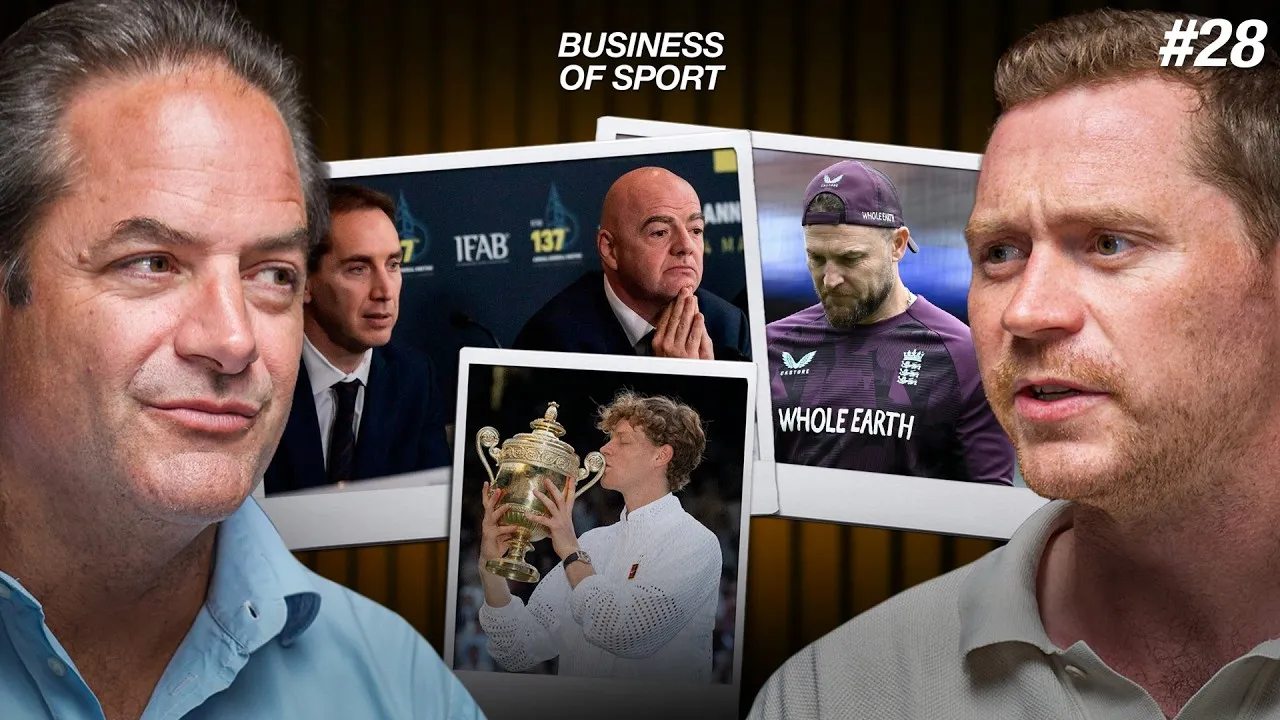
Charlie Stubbings says the FA can oppose Gianni Infantino because FIFA money is only 0.5% of its revenue
The sports-business argument here is blunt: England has enough money, status, and safety to stop pretending it has to kiss the FIFA ring.
Listen on YouTube
 WATCH NOW↓
 The FA’s best excuse for backing Gianni Infantino may have just been dragged into the sunlight and laughed at. According to Charlie Stubbings, England does not need FIFA’s money badly enough to keep playing the obedient courtier, because FIFA cash makes up only about 0.5% of the FA’s revenue.
That is the whole thing, really. Not vibes. Not high-minded blazer chat about influence. Not another panel in a hotel ballroom where everyone says governance while looking at the buffet. If the FA is rich enough to be independent, then support for Infantino becomes less a necessity than a choice.
Stubbings’ argument starts with the obvious political fact of FIFA: Infantino’s power rests on votes, and the votes of smaller associations count the same as everyone else’s. Many of those associations receive a huge portion of their operating money from FIFA. That doesn’t make them villains. It makes them dependent. England, by contrast, is not exactly rattling a tin outside Wembley.
There’s a lot of countries for whom FIFA is their main source of revenue. Obviously, we’re fortunate enough that FIFA money that we get is around 0.5% speculative of our money. For other countries, it’s probably 70 to 80%.
That line, quoted by Stubbings from FA chief executive Mark Bullingham, is supposed to explain why different countries see FIFA differently. It also detonates the FA’s own alibi. If FIFA money is pocket lint for England and oxygen for others, England is the one association with the luxury to say no.
The FA wants influence. Stubbings wants a spine.
The reported issue is whether the FA would support Infantino’s re-election in 2027. The usual reason to stay on FIFA’s good side is simple: hosting tournaments, committee access, soft power, the whole smoky backroom starter pack. England has not hosted the men’s World Cup since 1966, which has become less a date than a national weather condition. The hosts also bring up Sepp Blatter’s old jab that English football should not expect a World Cup anytime soon because of its perceived superiority complex.
But Stubbings strips the argument down. The home nations’ 2035 Women’s World Cup bid had no rival, according to the discussion, so there was no great FIFA beauty pageant to win there. A men’s World Cup under the current dispensation sounds like a fantasy anyway. So what, exactly, is the FA protecting by staying polite?
If it’s 0.5% of your revenue is coming from FIFA, you need to support them far less.
That is not a perfect sentence, but it is a perfect sports-politics diagnosis. The FA talks like a cautious mid-sized federation because caution is comfortable. Stubbings wants it to act like the governing body of one of the richest, loudest, most commercially powerful football countries on earth.
We are in a position as England to actually make a little bit of a stand while many other countries have to rely on the revenue that they get from FIFA.
The broader host then adds a useful corrective: opposing Infantino would not be cost-free. FIFA is a patronage system with a logo. Committees matter. Access matters. Being offside with the president can make life miserable for officials who have to keep showing up at these conferences and smiling through the canapés. That is all true. It is also exactly how weak institutions stay weak.
This is a moral argument wearing a spreadsheet
The strongest part of Stubbings’ case is that he doesn’t pretend England can overthrow Infantino next Tuesday. The FIFA voting system is built to frustrate that fantasy. One vote, one country means England, Germany, Spain, and Belgium cannot simply roll in like the Avengers of UEFA and tidy up the place before lunch.
But that is not the same as doing nothing. Stubbings sketches a longer campaign, one based less on immediate victory than on making the current bargain more embarrassing. If English football wants to present itself as the birthplace and conscience of the association game, then occasionally it has to do something more strenuous than issue a statement in a font chosen by committee.
I’m going to spend the next 12 years trying to change this institution and garner as much support as I can.
The eyebrow-raising bit is how much of this sounds less radical once the numbers are on the table. If a smaller federation depends on FIFA for most of its revenue, its loyalty is at least legible. If the FA depends on FIFA for roughly half a percent, then loyalty starts to look like habit, fear, or the old English specialty: wanting to be invited to the important room, then being shocked when nothing important changes inside it.
Stubbings is probably a little romantic about how easily the bigger football countries could build a reform bloc. FIFA has survived much louder outrage than this. Still, his central point holds. The FA has more room to move than most associations, and if it won’t use that room now, after openly admitting how little FIFA money matters to its accounts, then the next question is uglier: what is the FA actually afraid of losing?
- Why does Charlie Stubbings think the FA can stand up to FIFA?
- His argument is that the FA is not financially trapped. Mark Bullingham is quoted saying FIFA money is only around 0.5% of the FA's revenue, while some smaller associations depend on FIFA for 70 to 80%. Stubbings thinks that gives England the freedom, and maybe the obligation, to challenge Gianni Infantino rather than support him.
- What would the FA risk by opposing Gianni Infantino?
- The risk is political isolation inside FIFA, less committee influence, and an even colder path to hosting a men's World Cup. The hosts accept that would be uncomfortable. Their point is that England already looks unlikely to get a men's World Cup under the current order, and the 2035 Women's World Cup bid had no rival, so the usual incentives are weaker than they sound.
- Is the 64-team World Cup part of Infantino's re-election strategy?
- Stubbings treats the idea that way. He argues that expanding the World Cup offers hope to smaller federations, which makes it a useful political sweetener before the 2027 FIFA presidential election. That doesn't mean expansion is only cynical, but in FIFA politics, hope is a currency.
James Haskell says Wasps offered him £120,000 while he was playing for England
The former England flanker makes the grim rugby money case, players deserve more, but the business model can’t pay them.
Charlie Methven says Ipswich Town spent more on transfers than Barcelona, AC Milan, Juventus and PSG
The Premier League transfer market has reached the point where a promoted English club can look richer than European royalty.
Nikhil Mohindra says padel participation will overtake tennis in 10 years
The Team GB padel player makes the bullish case for the sport, then accidentally explains why the boom could also eat itself.
The Twenty Minute VC hosts say Britain’s £300 million elite tennis pipeline has produced almost no champions
The episode’s best point is not that Jannik Sinner is ruthless, it’s that Italy’s club-heavy tennis system makes Britain’s expensive elite pipeline look weirdly barren.
The circuit, read weekly. No noise.