Henrik Svensmark says a 1 or 2 percent shift in low ocean clouds can rival all greenhouse gases
The Danish physicist’s cosmic-ray climate theory is still a fight, but his cloud math is the part you can’t just swat away.
Listen on YouTube
 WATCH NOW↓
 The climate fight usually arrives with a carbon chart and a grave face. Henrik Svensmark brings something stranger to the Danny Jones Podcast: he says a 1 or 2 percent change in low ocean clouds can have a climate effect comparable to all greenhouse gases.
That is the grabber. Not because it proves his whole theory, it doesn’t, but because it lands on the most uncomfortable fact in climate change: clouds are both crucial and maddeningly hard to model. If you want a climate-system goblin hiding under the bed, do not pick volcanoes or cow burps. Pick low marine stratus clouds, those endless gray blankets over the ocean that look boring from an airplane and behave like a planetary thermostat.
the idea was immediately that it had to be with cosmic rays.
The Milky Way enters the group chat
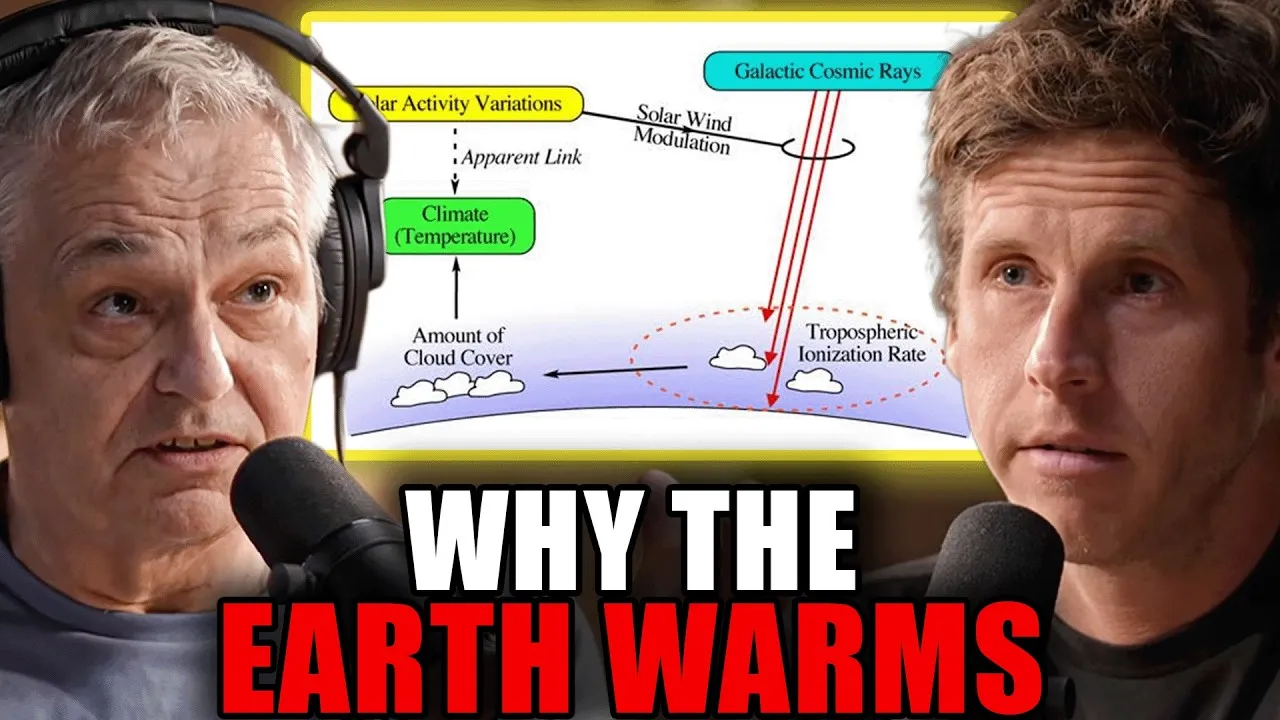
Svensmark’s theory starts with cosmic rays, which is a name that still sounds like it belongs on a 1950s cereal box. He explains them as energetic particles from the galaxy, often born from supernova explosions, that shower Earth’s atmosphere. Solar activity, in his telling, acts like a screen: stronger solar wind scatters more of those particles away, weaker solar activity lets more in.
The proposed chain is neat, maybe too neat: more cosmic rays means more charged particles in the atmosphere, which stabilize tiny molecular clusters, which grow into aerosols, which become cloud condensation nuclei, which help make clouds. Danny Jones, to his credit, keeps pushing for the physical mechanism, not just the vibe. Svensmark answers with cloud chambers, muons, ship tracks, and the image of cargo ships accidentally drawing lines in low clouds with engine particles. It is the rare podcast moment where the visual aid is not decorative. It is the argument.
The 1 percent problem
Here is where Svensmark’s claim becomes genuinely searchable, and not just another climate-skeptic-adjacent campfire story. He says low marine clouds reflect enough sunlight that a tiny systematic shift in them could match the warming influence of greenhouse gases. That does not require believing the entire cosmic ray hypothesis. It requires accepting that clouds are not a side dish in climate physics. They are the kitchen.
if you change that by just by 1 or 2%, it is similar, you know, to all the greenhouse gases.
The call: the cloud arithmetic is plausible enough to be irritating, but the cosmic-ray-to-climate chain is not settled science. Svensmark is strongest when he talks about cloud sensitivity and weakest when the implication hovers nearby, that this mechanism could explain away more of modern warming than mainstream climate science allows. Clouds really are a monster uncertainty. That does not make every cloud theory a dragon slayer.
Svensmark frames the scientific reaction as institutional defensiveness. In his version, the criticism came fast and hot after his 1996 presentation, with the climate establishment first saying there was no known mechanism, then conceding maybe there is an effect, but not an important one. That is a familiar outsider-scientist narrative, and sometimes it is true. Sometimes it is also how every losing theory describes peer review.
No, no, no, no, nobody has disproven anything.
That line sounds triumphant, but science is not a courtroom where acquittal equals victory parade. “Nobody has disproven it” is not the same as “this is a dominant climate driver.” Svensmark knows that, or at least he gives himself one useful brake near the end, when he points at the correlation between cosmic rays and low clouds that started his whole project.
So, you see there is a beautiful correlation. But, it doesn’t mean that we now understand why it’s there.
- What exactly is Henrik Svensmark claiming about clouds?
- Svensmark argues that low marine clouds are so powerful in Earth’s energy balance that shifting them by only 1 or 2 percent can have an effect comparable to the forcing from greenhouse gases. His bigger claim is that cosmic rays may help create the particles that seed those clouds.
- Is Svensmark saying carbon dioxide does not matter?
- Not in the excerpt here. He is saying clouds are an enormous and difficult part of the climate system, and that cosmic rays could be a missing driver of cloud variation. That does not automatically overturn greenhouse warming, and the cosmic-ray link is still far more contested than the cloud sensitivity point.
- Why was his theory so controversial?
- Because it points climate attention away from the usual carbon-first story and toward solar activity, cosmic rays, and cloud microphysics. Svensmark says critics initially objected that there was no known mechanism, then later shifted toward saying the effect might exist but be too small to matter.
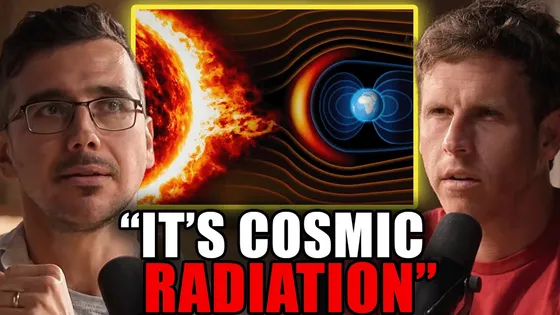
Matt Ehret says cosmic rays, not human CO2, are the real causes of climate change
On the Danny Jones Podcast, Ehret revives the Henrik Svensmark cosmic-ray theory and says the scientist was professionally punished for challenging the CO2 consensus.
Daniel Whiteson says the Princeton simulation evidence is a cosmic-ray glitch thought experiment, not proof
The physicist likes the sci-fi of it, but he treats the viral simulation claim less like a smoking gun than a very nerdy stress test for reality.
Darcy Weir says the US Air Force planned to nuke the moon in 1958 to flex on the Soviets
The UFO documentary filmmaker revisits Project A119, a Cold War scheme that proves our actual space history is much weirder than the flying saucer rumors.

Ioan Grillo says Mexican cartels are dropping fire extinguisher bombs from drones to empty villages
The cartel arms race is not just bigger guns, Grillo argues, it is cheap drones, hacked phones, and a grim little feudal project in the mountains.
The circuit, read weekly. No noise.