Daniel Whiteson says the Princeton simulation evidence is a cosmic-ray glitch thought experiment, not proof
The physicist likes the sci-fi of it, but he treats the viral simulation claim less like a smoking gun than a very nerdy stress test for reality.
Listen on YouTube
 WATCH NOW↓
 The title promises Princeton has receipts for the Matrix. Daniel Whiteson brought something less sexy and more useful: the idea that ultra-high-energy cosmic rays might look like glitches in a simulated universe, plus the important adult-in-the-room clause that there’s “no way to prove that.”
That’s the difference between a fun physics podcast and a dorm-room whiteboard after midnight. On Danny Jones Podcast, Whiteson doesn’t sneer at the simulation hypothesis. He enjoys it. He just won’t let it sprint from “this reminds me of a computer” to “congratulations, you live inside a server rack run by cosmic Twitch moderators.”
So, if we are inside a computer that computer is following laws of the outer universe. We’re Super Mario, right? We can’t learn about the laws of that outer universe.
The Super Mario argument is the cleanest antidote to a lot of simulation hype. If Mario becomes a physicist, he can learn about mushrooms, pipes, lava, and the suspicious plumbing choices of the Mushroom Kingdom. He can’t infer the semiconductor industry. Whiteson’s point is that even if our universe were simulated, the rules inside the simulation don’t have to resemble the rules outside it. Maybe the outer universe runs on quantum hardware. Maybe it runs on physics we don’t have metaphors for yet. Maybe “hardware” is already a provincial little ape word.
The cosmic-ray glitch is the good version of the argument
Whiteson’s best example is not S. James Gates Jr.’s much-shared claim about Claude Shannon-style codes inside supersymmetric equations. It’s cosmic rays, because the mystery starts with an actual measurement. Some particles from space arrive with absurd energy, the kind Whiteson compares to “a whole baseball at 100 miles an hour” packed into a single particle. Black holes, supernovae, cosmic slingshots, none of the usual suspects fully satisfy the detective.
there’s some particles out there we’ve seen that have insanely high energy like like so much energy it’s hard to imagine. You know, like a single particle having the energy of like a fastball, like a a whole baseball at 100 miles an hour.
Then comes the Princeton-flavored sci-fi. Whiteson says he read a paper from a researcher at the Institute for Advanced Study in Princeton proposing that if the universe were simulated in giant cubes, particles with ridiculous energy might cross those cubes too quickly for the simulation’s update step. In other words, cosmic rays as lag spikes. Reality buffering, but with better math.
if the universe is a simulation and it’s cut into huge cubes in which the simulation is being done, really, really fast particles might like make it through the cube too quickly, so that they they like get caught by the update, and it’s basically a glitch in the simulation.
That’s the searchable claim. It’s also the limit of the claim. Whiteson likes it because it at least imagines a place to look: extreme cases where the laws might stutter. That’s better than vibes, better than “computers are popular now, so maybe the cosmos is one,” and much better than treating every mathematical analogy as a divine QR code.
I mean, there’s no way to prove that. It’s just like a cool thought experiment, you know, ways you might identify that the universe is a simulation by looking for flaws in the assumptions that are built into it.
The computer-code claim gets downgraded
Danny Jones plays the famous Neil deGrasse Tyson clip in which S. James Gates Jr. says he found error-correcting codes, associated with Claude Shannon, inside equations tied to string theory and supersymmetry. It’s catnip for simulation believers because it sounds like a backstage pass to the source code. Whiteson hears something less apocalyptic: a real mathematical connection getting dressed up for the cameras.
what he’s talking about in that video is saying that like he sees evidence for like structure within string theory that’s similar to computer code. And you know, I think that’s a bit of a reach.
That verdict is probably right. Gates’s claim is fascinating, and he’s not some crank in a tinfoil lab coat. But “error-correcting codes appear in a mathematical framework” is not the same sentence as “the universe is programmed.” Whiteson’s skepticism has the dry comedy of a man who has opened too many emails beginning, “I figured out the universe.”
Jones tries to connect the simulation idea to telepathy, plant consciousness, Rupert Sheldrake’s morphic resonance, and the old chestnut about records falling quickly after the four-minute mile. Whiteson doesn’t bite. He gives the boring answer, which is also the stronger one: once people know a barrier can be broken, they run differently. No server-side patch required.
So yes, the Princeton simulation claim is real enough to Google and weird enough to argue about. But if the universe is a game, Whiteson is not selling cheat codes. He’s asking where the frame rate drops.
- What did Daniel Whiteson say the Princeton simulation evidence actually is?
- Whiteson described a speculative paper from someone at the Institute for Advanced Study in Princeton that imagines the universe as a simulation divided into huge cubes. In that picture, ultra-high-energy cosmic rays could move through the grid so fast that they expose a kind of update error. His call was clear: cool thought experiment, not proof.
- Does Daniel Whiteson think cosmic rays prove we live in a simulation?
- No. He said cosmic rays are genuinely mysterious because some particles have energies that known cosmic engines struggle to explain. But he framed the simulation explanation as one possible sci-fi-flavored way to look for internal inconsistencies, not as evidence strong enough to cash the check.
- What did Daniel Whiteson say about S. James Gates Jr. finding computer code in physics?
- Whiteson pushed back on the leap from mathematical resemblance to cosmic computer code. He explained that supersymmetry and string theory contain structures that can be compared to error-correcting codes, but he called the stronger claim that the universe is literally written in that code a reach.
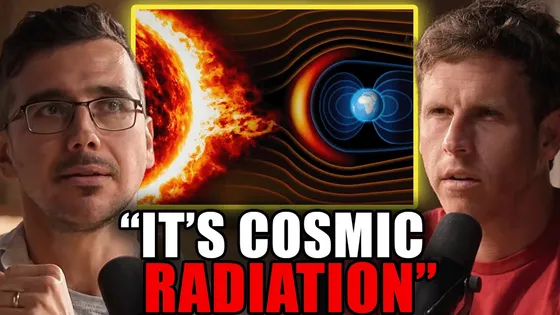
Matt Ehret says cosmic rays, not human CO2, are the real causes of climate change
On the Danny Jones Podcast, Ehret revives the Henrik Svensmark cosmic-ray theory and says the scientist was professionally punished for challenging the CO2 consensus.
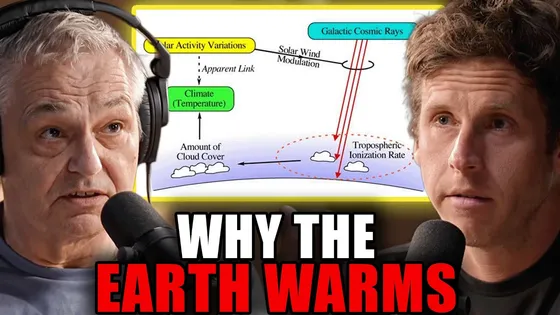
Henrik Svensmark says a 1 or 2 percent shift in low ocean clouds can rival all greenhouse gases
The Danish physicist’s cosmic-ray climate theory is still a fight, but his cloud math is the part you can’t just swat away.

Professor Jiang says Xi Jinping is a frontman for red nobility families who run China from overseas
On the Danny Jones Podcast, Professor Jiang offers a spicy theory of Chinese power, useful as a provocation, weaker as a full explanation.

Heather Lynn says Noah didn't build an ark, he led a breakaway civilization of scientists
The fun part is that Lynn is not doing ancient aliens here, she is making Noah sound like the logistics director of a post-collapse research commune.
The circuit, read weekly. No noise.