Matt Ehret says cosmic rays, not human CO2, are the real causes of climate change
On the Danny Jones Podcast, Ehret revives the Henrik Svensmark cosmic-ray theory and says the scientist was professionally punished for challenging the CO2 consensus.
Listen on YouTube
 WATCH NOW↓
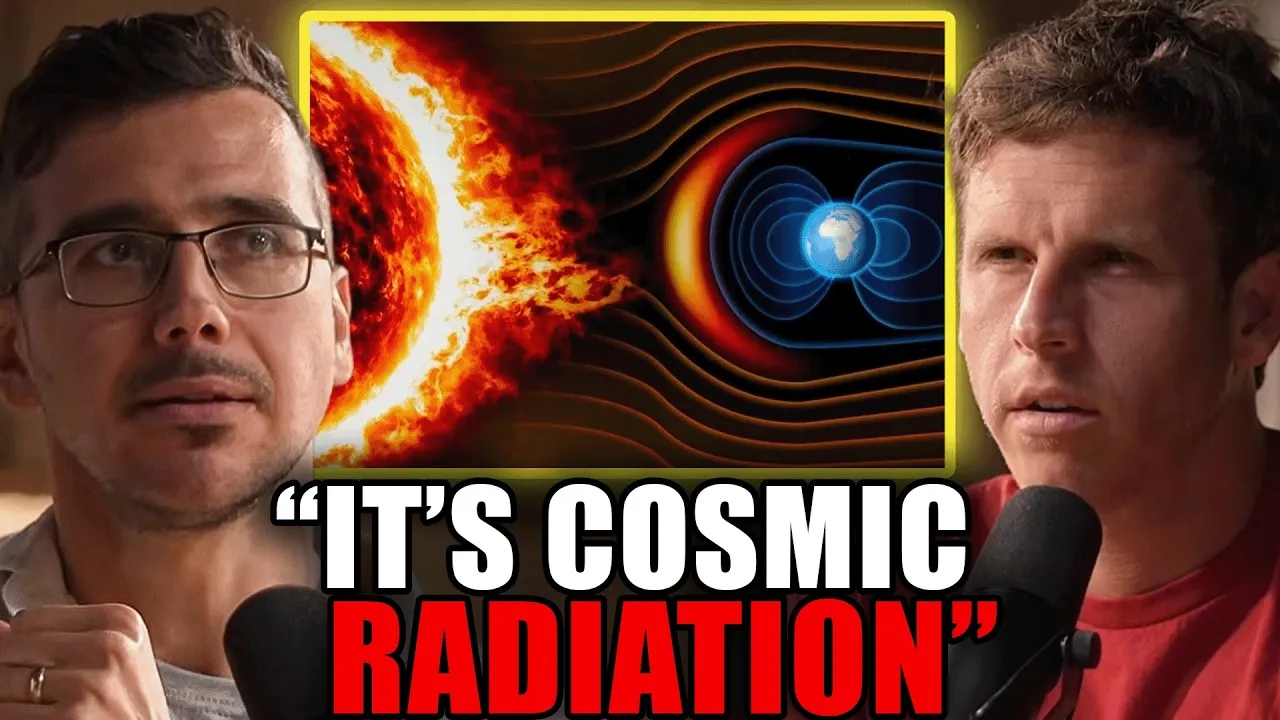
 Matt Ehret wants to move the climate culprit off your tailpipe and into deep space. On Danny Jones Podcast, he argues that cosmic rays, solar flares, the Van Allen belt, and the magnetic mood swings of the sun matter more to climate change than the human-made CO2 story most people have absorbed since middle school.
That is the whole electricity of the clip. Not because “space weather affects Earth” is crazy. Of course it does. The surprise is the scale of the claim, and the persecution frame he puts around it. Ehret doesn’t just say the climate system is more complicated than a bumper sticker. He says the “real causes of climate change” have been professionally punished out of polite scientific society.
It’s about the the real causes of climate change.
The scientist at the center of Ehret’s case is Henrik Svensmark, the Danish physicist associated with the cosmic-ray cloud hypothesis. The idea, in its shortest form, is that cosmic rays can affect cloud formation, clouds affect how much heat Earth retains, and therefore climate models that focus too narrowly on CO2 are missing a monster variable. Ehret recommends Svensmark’s documentary The Cloud Mystery and describes the work as “tight.”
He couldn’t get published anymore. He couldn’t get grants, couldn’t get anything because he wouldn’t shut up about his research which was very peer reviewed.
The cosmic-ray claim is real. Ehret’s certainty is the problem.
Here’s the annoying middle that no one wants at a dinner party: cosmic rays are a legitimate climate variable, and Svensmark is not a fictional martyr invented in a Telegram thread. Scientists have studied whether high-energy particles from space help seed clouds. That part is not nonsense.
But Ehret leaps from “this may matter” to “this is the real cause,” which is where the chair starts wobbling. The broad climate-science consensus does not say Earth is a sealed Tupperware container with CO2 as the only knob. It says recent warming is overwhelmingly explained by human greenhouse-gas emissions, with solar, volcanic, orbital, oceanic, and atmospheric variables accounted for imperfectly but seriously. Ehret’s version has the familiar podcast-conspiracy silhouette: a complex technical dispute becomes a morality play about brave truth-tellers and institutional cowards.
As not being really that that seriously affected by human made CO2 but rather more being affected by these natural cycles of cosmic ray entries
Danny Jones helps the claim along by pulling up long-range temperature graphs and noting that Earth’s climate has swung wildly for millions of years. True, and also the oldest trick in the climate-argument book. Geological time makes humans look tiny, which is emotionally satisfying and scientifically incomplete. Yes, Earth has been hotter, colder, wetter, icier, stranger. No, that doesn’t automatically answer what is driving the unusually rapid warming of the industrial era.
To their credit, the two briefly admit the graph game is messy. Jones says “cheap graphs posted on websites” can be wrong. Ehret agrees that scale and metrics can rest on shaky assumptions. Then, in very 2020s fashion, they half-jokingly ask AI to find a better graph, which is like asking a raccoon to organize the pantry.
Then the climate argument becomes an information-control argument
The clip’s second claim is almost as revealing as the first: Ehret worries that search itself is being collapsed into one official answer. This is where Matt Ehret is most in his element. The climate dispute becomes a story about institutions, grants, publishing, Google, DARPA, and the “world brain.” It’s less a climate segment than a worldview with weather attached.
The objective is to just have a one-answer solution to every Google insert where you get the official AI answer to everything, and that’s it.
He’s not wrong that AI search can flatten disagreement. Anyone who has watched a chatbot confidently serve lukewarm oatmeal as knowledge knows the danger. But that critique doesn’t rescue the climate claim. Bad information systems can bury good arguments, yes. They can also supercharge bad ones. The machine doesn’t care. It will summarize a consensus, a crank theory, and a Reddit fever dream in the same glassy customer-service voice.
So the verdict is split. Ehret is right to say climate is not a cartoon and that clouds, solar activity, magnetic fields, and cosmic radiation deserve attention. He oversells badly when he treats that complexity as a knockout punch against human-made CO2. The interesting question for listeners isn’t whether the climate system is chaotic. It is. The question is whether chaos is being used here as evidence, or as fog.
- What did Matt Ehret claim about climate change?
- Ehret claimed that climate change is driven less by human-made CO2 than by natural cosmic and solar cycles, especially cosmic rays entering Earth’s atmosphere and influencing clouds. He framed this as a suppressed scientific argument rather than a fringe curiosity.
- Who is Henrik Svensmark in Ehret’s argument?
- Ehret points to Danish scientist Henrik Svensmark, whose work links cosmic rays to cloud formation. Ehret says Svensmark’s career was nearly destroyed because he wouldn’t stop arguing that cosmic rays play a major role in climate.
- Is the cosmic-ray climate theory accepted science?
- The cosmic-ray hypothesis is real science in the sense that it has been studied and debated, but Ehret presents it as far more decisive than the climate mainstream does. The dominant scientific view still holds that recent warming is primarily caused by human greenhouse-gas emissions.

Matt Ehret says Jacques Cousteau wanted to eliminate 350,000 people a day
The Danny Jones Podcast swerves from Epstein island symbolism into Cousteau, Atlantis, and a very ugly population-control quote.
Matt Ehret says the CIA shaped the National Enquirer to seed a one-world alien religion
The claim is wonderfully lurid, and also a perfect example of how a real Cold War fact can become a cosmic corkboard theory in about 90 seconds.

Matt Ehret says Majestic 12 is fake because its typewriter and Truman signatures give it away
The UFO disclosure debate gets a paperwork problem, then turns into a full CIA myth-management theory.

Matt Ehret says God letting Satan cause evil for a greater good is coping
On Danny Jones Podcast, Ehret pushed back on a Carmelite theory of Satan by arguing that divine permission for rape, murder, and genocide sounds less like theology than a bedtime story for the powerless.
The circuit, read weekly. No noise.