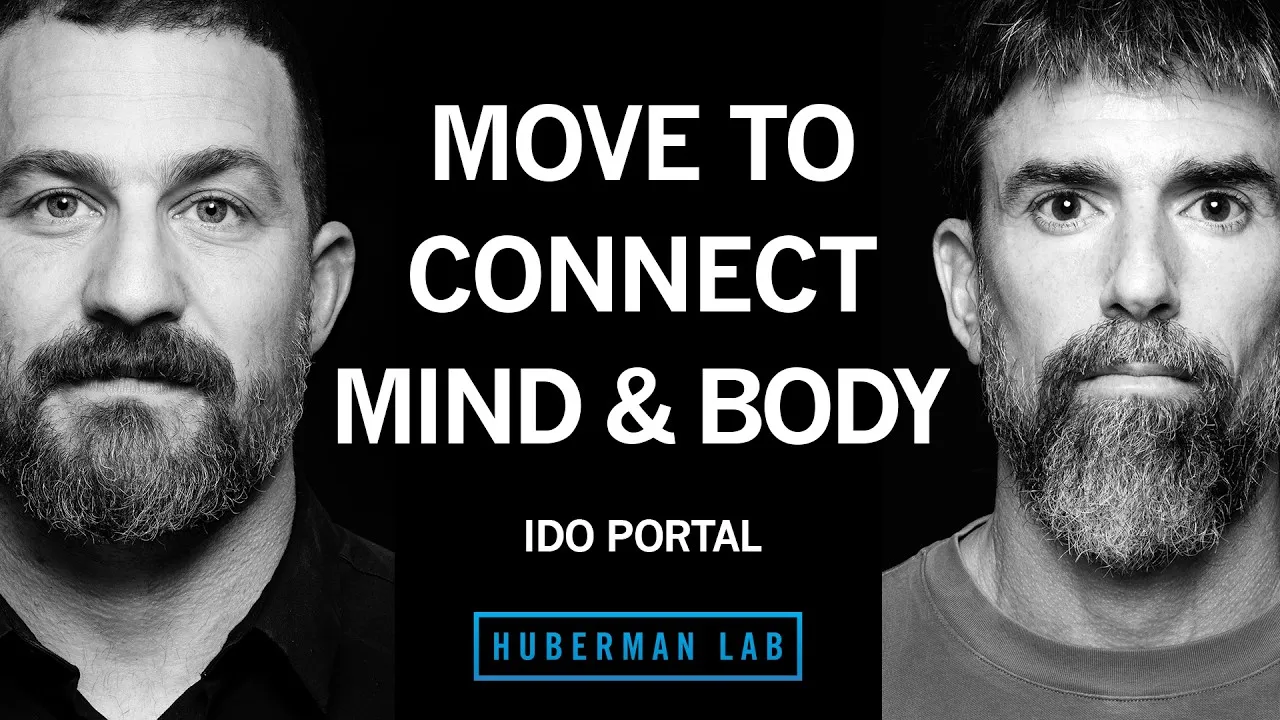
Ido Portal says willpower cannot be built, only uncovered, and discipline is the thing you've been mistaking for it
The movement teacher and philosopher makes a distinction that quietly dismantles every productivity book you have ever read.
Listen on YouTube · Spotify · Apple Podcasts
 WATCH NOW↓
 You cannot build willpower. You can only expose it. That is Ido Portal’s central claim on this episode of Huberman Lab, and it lands like a quiet bomb under the entire self-improvement industrial complex. Not because it sounds radical, but because the more you sit with it, the more it seems obviously correct and the more everything you have ever done in the name of discipline starts to look like something else entirely.
Portal, the Israeli movement teacher famous for working with fighters, musicians, and governments, is not a guy who dismisses hard work. He is pathologically rigorous. But he draws a line most people never think to draw. Discipline, he says, is real and learnable. Willpower is something different. A fixed, buried quality that only shows up uninvited, only when there is genuine resistance, and only if you have learned not to immediately smother it with caffeine, motivational videos, or sheer brute force. The moment you jailbreak past your reluctance rather than sitting in it, you have blown straight past the thing you were supposedly trying to train.
Here is the big shocker. It was for me that I discovered one does not develop the will. The will never gets developed. It’s only get exposed. Discipline gets developed. That’s what we mistaken will for.
The practical implication is genuinely strange. Portal’s prescription for finding your will is to choose tasks you only sometimes do not want to do, then wait for the exact moment you don’t want to do them, and in that moment, do nothing forceful. No YouTube clips. No slogans. No breathing tricks to spike adrenaline. Just stay there, relaxed, at the edge, and look for what he calls a thread. A gentle, almost undetectable internal pull toward the thing. That is the will visiting. And if you ram through the discomfort instead, you have not strengthened anything. You have just missed it again.
Your will is sufficient is like a mosquito’s fart. That’s the power of our will. Even incredibly powerful people because they only use discipline. So their will is totally they don’t know how to identify it.
Is He Right?
Partly, and in an interesting direction. Huberman mentions the research of his Stanford colleague on the anterior mid-cingulate cortex, the brain structure that enlarges when people repeatedly do things they do not want to do. That is a real finding and it does support the idea that something discipline-adjacent can be structurally reinforced. But Portal’s distinction holds up in a way the neuroscience does not yet fully address. The anterior mid-cingulate story is about pushing through. Portal is describing something that happens before the push, in the pause before you decide how to relate to the task at all. Those are not the same thing, and treating them as identical is probably why so many heavily disciplined people still feel like they are running on fumes. They built the machine. They never found the driver.
Where Portal is harder to evaluate is in the claim’s unfalsifiability. By his own account, the will is elusive, fleeting, unresearchable, and invisible until it isn’t. That is a useful description of inner experience but a frustrating one if you want to operationalize it. He is also not naive about this. He is honest that the will, once you catch a glimpse of it, is embarrassingly small. Most people, he says, have essentially no contact with it at all because they have spent their entire lives reaching for discipline instead.
The Scaffolding and What’s Inside It
The handstand metaphor Portal opens the episode with is the cleanest version of his whole argument. If you always push yourself off the wall when learning a handstand, you become dependent on the wall. If instead you learn to pull from your hands, from your connection to the ground, you build something that does not require the wall at all. Discipline is the wall. Useful to start, dangerous to lean into forever. The playfulness, the relaxation, the actual wanting to do the thing even when you don’t, that is the pull from the hands. The episode is nearly three hours long and covers sleep paralysis, Jorge Luis Borges read in a scalding hot tub, the biomechanics of skateboarders, and why boxing beats karate in a real fight. But the willpower distinction is the thing worth arguing about, Googling, and, if Portal is right, quietly sitting with the next time you reach for your fourth cup of coffee before doing the thing you said you would do.
I always do what I said I’m going to do, but not by disciplinary action, but by having a beautiful evasive sequence like you moving around the traffic, finding your way there. You never stopped looking for the best route. It’s a very different approach than just pushing the gas pedal forward.

Beth Shapiro says her lab has already engineered and birthed living direwolves
The evolutionary biologist tells Andrew Huberman that de-extinction is no longer a hypothetical future, and her company has three massive engineered wolves to prove it.
Arthur Brooks says trying to avoid unhappiness makes you miss happiness
On Huberman Lab, Brooks argues that happiness is built from enjoyment, satisfaction, and meaning, and none of the three comes pain-free.
Ralph Adolphs says AI can diagnose your personality from one page of text
The Caltech neuroscientist argues that text may reveal more about your personality than your face does, which is bad news for anyone who thinks their punctuation is innocent.
Dr. Tommy Wood says six months of Norwegian 4x4 intervals protected older adults' hippocampus for five years
The Huberman Lab guest made the anti-cortisol crowd sound like people afraid of rain because floods exist.
The circuit, read weekly. No noise.