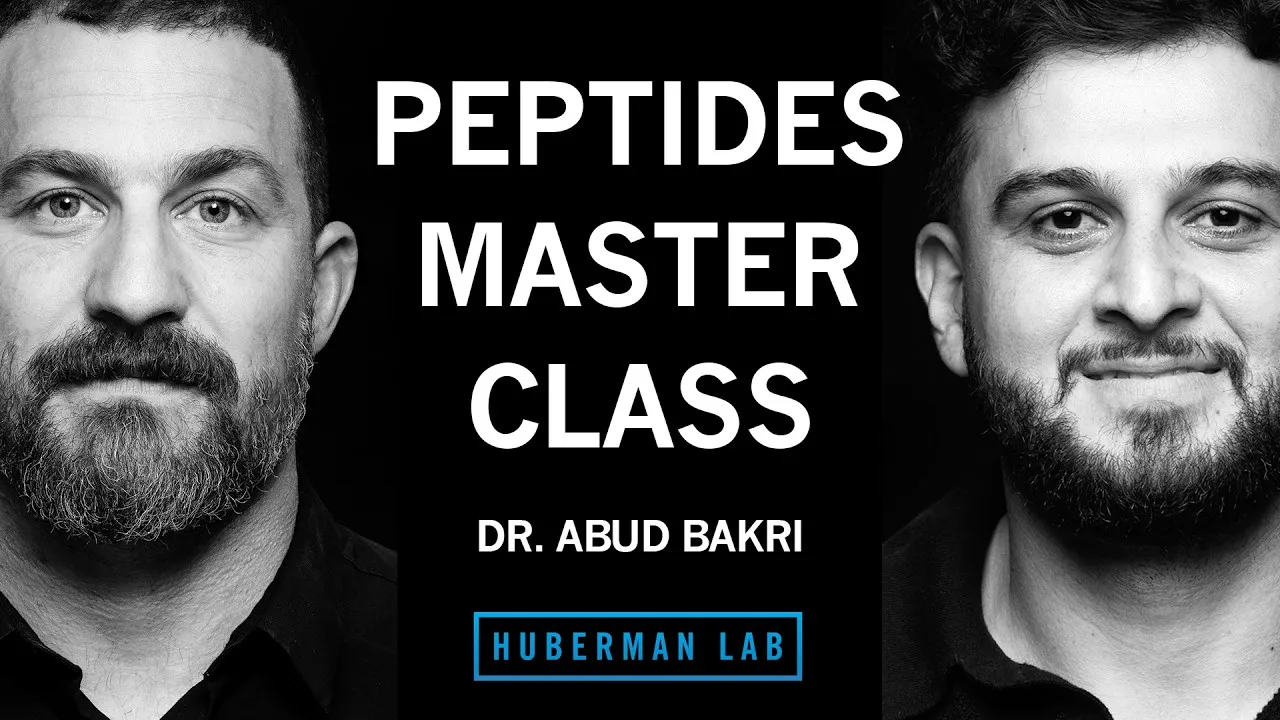
Dr. Abud Bakri Knows Where the Peptides Come From, and It's All China
A 33-year-old internal medicine physician walks into the Huberman Lab and proceeds to explain why millions of people are injecting compounds sourced from one Croatian research group and one country.
Listen on YouTube · Spotify · Apple Podcasts
 WATCH NOW↓
 Here is a thing that is true and somewhat embarrassing: the peptides that soccer moms are selling on TikTok, the ones that CEOs are quietly stacking with their testosterone and GLP-1s, the compounds that a 33-year-old internal medicine physician injected directly into a torn tricep and was back in the gym in three weeks… they all start as raw materials synthesized in China. Every single one. ‘There are no such thing as American-made peptides,’ Dr. Abud Bakri tells Andrew Huberman, with the flat calm of someone who has accepted this and moved on. The research-purposes-only vials, the compounding pharmacy scripts, the Eli Lilly pens. Same source. Different filters.
That’s the framing device for this genuinely useful, genuinely strange three-hour conversation, which is ostensibly about peptides but is really about what happens when millions of people start self-experimenting with compounds that have extraordinary animal data, minimal human trials, and a regulatory framework that changes depending on which state your doctor is licensed in. Bakri is the best possible guide for this territory: trained as a physician, practicing in actual hospitals with actual critically ill patients, and also someone who keeps oral BPC-157 in his bag when he travels so he doesn’t get sick at conferences. He holds both of those things simultaneously without apparent discomfort.
The Part Where We Learn BPC-157 Doesn’t Even Have a Known Receptor
The most clarifying move Bakri makes early is splitting the entire peptide universe into two categories: compounds with known receptors, like the GLP-1 drugs, which have ‘a very strong clinical effect,’ and compounds like BPC-157 and TB4, where ‘we don’t have a receptor identified.’ This is not a minor distinction. It’s the difference between a drug that science understands mechanistically and one that demonstrably does things in animals, and sometimes apparently in humans, through pathways that remain genuinely mysterious. Huberman, who spent years studying optic nerve repair, keeps returning to how bizarre it is that a gut peptide seems to accelerate healing across tissue types with nothing in common. Bakri’s answer is basically: yes, that’s weird, we also don’t know where it goes after you swallow it.
Either BBC is as amazing as we think it is and it’s unfortunate that millions of people don’t have access to it, or BBC is actually either ineffective or harmful to people and millions of people are injecting it right now by buying it through online sources. Both cases are very bad endpoints.
The Croatian origin story is legitimately fascinating. A research group in the early 1990s, building on Pavlov’s gastric juice business and Hans Selye’s stress adaptation theory, isolates a 15-amino-acid fragment of a much larger protein found in stomach tissue. They name it BPC-157. They then proceed to do basically every experiment imaginable on mice: severing Achilles tendons, burning wounds, inducing alcohol withdrawal, getting them drunk and running them through mazes. The results are consistently striking. The problem, which Bakri returns to repeatedly, is that almost all of this data comes from one group. ‘All the animal data comes from one group,’ he says. ‘Almost all of it.’ And that group is in Croatia, which is not a knock on Croatia, but does mean the studies have never been independently replicated at the scale that would make an American regulatory body comfortable.
The Celebrity Protocol, Named and Explained
People are now stacking their GLP-1 as their insulin sensitivity tool, their growth hormone or their GHR and their androin modulation therapies as this trinity stack to get very fit, very healthy quickly. So a lot of these transformations you see in CEOs and celebrities and stuff is using a combination of those three things.
Bakri opens the episode by describing what he calls ‘the celebrity protocol,’ which is effectively TRT plus a GLP-1 plus a growth hormone secretagogue, and which explains a lot of the dramatic body recompositions you’ve been noticing in tech and entertainment. ‘Is that healthy? We’ll find out,’ he says, with appropriate restraint. He’s similarly measured on the growth hormone debate, which is real and unresolved: growth hormone-deficient animals live longer, small dogs outlive large dogs partly due to lower IGF-1, and yet the somatopause that happens in your 30s does seem to be associated with accelerated aging. Bakri doesn’t resolve this tension because it can’t be resolved yet. He just maps it clearly.
The regulatory section is where things get practically useful and also kind of depressing. BPC-157 moved from the FDA’s Category 1 compounding list to Category 2 in late 2024, meaning compounding pharmacies can’t legally make it. Compounders immediately rebranded it as PDA, pentadecapeptide arginate, which is the same molecule in a different salt form. ‘It’s the same exact thing,’ Bakri says. State medical boards may or may not care. Telehealth prescriptions are governed by where the patient sits, not where the doctor is licensed. No malpractice insurer will cover you for prescribing non-FDA-approved peptides. And the gray-market research-purposes-only websites that have supplied most of the people currently using these compounds? Batch quality is entirely unknown, varies wildly, and the payment used to go through Venmo to a name that kept changing.
The best job in 2025 was to be a peptide affiliate. People made my yearly salary in a month selling peptides illegally on TikTok.
The Thymus: The Organ Nobody Told You Was Running Your Immune System
The genuinely unexpected section of this conversation is the long stretch on the thymus. Bakri makes the case that the thymus, which grows until puberty and then slowly involutes under the pressure of the hormones everyone wants more of, androgens, estrogens, corticosteroids, is a key driver of the immune decline that precedes almost every disease of aging. He cites a Nature paper showing that people with higher thymic scores on MRI have lower mortality across cardiovascular disease, cancer, and other conditions. He mentions a New England Journal study linking surgical thymus removal during open-heart procedures to elevated mortality within five years. And then he points out that there is a $3 lab test, the lymphocyte-to-monocyte ratio on a standard CBC with differential, that almost everyone has already had done, that tracks thymic function reasonably well, and that approximately zero physicians are using for this purpose.
Bakri himself takes thymosin alpha-1 twice a week when he’s working hospital wards, at 2.5 milligrams, as a prophylactic. He didn’t get sick once during a recent rotation. This is not a controlled trial. He knows it’s not a controlled trial. That’s kind of the whole problem with everything discussed in this episode, and Bakri is more honest about that epistemological bind than most people operating in this space. He’s not selling anything. He keeps a tricep-tear anecdote in his back pocket as evidence that BPC-157 might be extraordinary, and he keeps saying ‘we need data’ in the same breath. That combination, clinical experience plus genuine scientific humility, is rarer than it should be, and it’s what makes this three hours worth your time.
Dr. Alan Castel says feeling younger than your age predicts how long you'll live better than your actual age
The UCLA memory researcher gives the Huberman crowd a squishy variable with surprisingly hard stakes.
Jeff Cavaliere Says Your Back Pain Is a Glute Problem
The Athlean-X founder makes the case that the small muscles everyone ignores are the only reason the big lifts keep working.

Cesar Millan says learning how to walk your dog eliminates 90 percent of behavior problems
On Huberman Lab, the Dog Whisperer reduced most canine chaos to one blunt prescription, walk the dog before you try to love the dog into sanity.
Beth Shapiro says her lab has already engineered and birthed living direwolves
The evolutionary biologist tells Andrew Huberman that de-extinction is no longer a hypothetical future, and her company has three massive engineered wolves to prove it.
The circuit, read weekly. No noise.