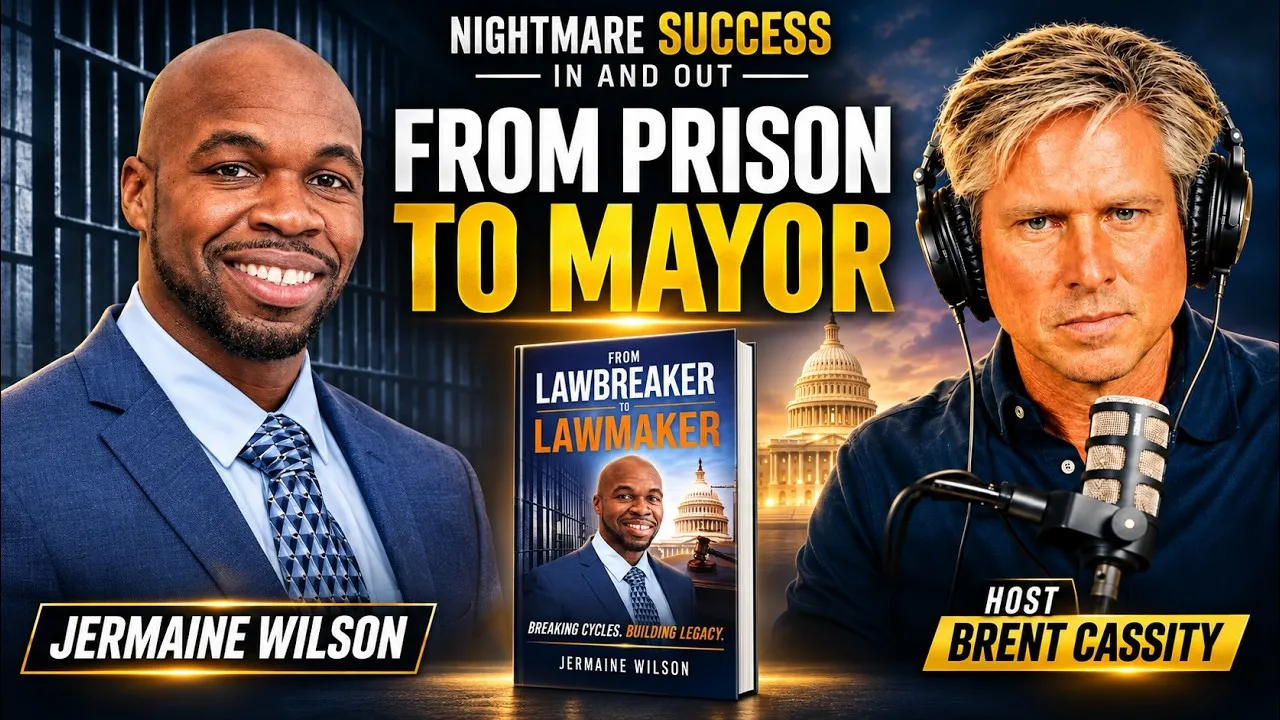
Jermaine Wilson says he got both the key to Leavenworth and the key to his old prison cell house
The former mayor of Leavenworth turned his second chance story into an almost absurdly perfect symbol, one key from the city, one from the prison.
Listen on Nightmare Success · YouTube
 WATCH NOW↓
Jermaine Wilson said on Nightmare Success that he received both the key to the city of Leavenworth and, later, the key to the cell house at Lansing Correctional Facility where he had been imprisoned. Wilson framed the paired keys as proof of his message that people can help unlock someone else’s second chance.
It is almost too clean as symbolism, the sort of detail a screenwriter would cut because the studio note would say, “We get it.” But Wilson’s story has that blunt, civic-poetry quality. A man goes from a prison cell to the mayor’s chair in a town whose name is practically shorthand for incarceration, then walks back into the prison and is handed a key. Subtle? Absolutely not. Effective? Come on.
I want to encourage everybody to be the key to unlocking someone else’s second chance.
Wilson’s new book is called From Law Breaker to Law Maker, and the title is not shy about its own before-and-after poster energy. On the episode, though, the former mayor sounds less like a man polishing a redemption brand and more like someone still startled by the physical objects that now follow him around. Keys. Chairs. Office doors. Cell houses. The props keep changing, but the geography doesn’t. It is all Leavenworth.
The key story works because the ugly parts stay ugly
The danger with second-chance stories is that they can become inspirational air freshener. Spray enough purpose language over the room and suddenly every hard fact smells like vanilla. Wilson avoids that by being specific about what he did and what it cost. He says he was 15 when he committed a robbery and was sent to juvenile corrections. He says he tried to escape and got more time. He says that later, in adult prison, he turned 21 locked down 23 hours a day, thinking about his father, brother, sister, and his own eight-month-old son.
The cleanest moral turn in his story arrives through a brutally practical question from a mentor. Wilson had gang tattoos and was in the Prison Fellowship Academy when the mentor asked whether that was the life he wanted to pass to his son. Wilson’s answer was no. The follow-up was the whole sermon.
kids may not necessarily do what you tell them, but they would do exactly what you show them.
That is the claim under the claim. Wilson isn’t just saying he changed. He is saying the visible version of your life becomes someone else’s instruction manual. It is a little churchy, sure. The man is a minister and works with Prison Fellowship. But it also lands because it is not abstract. He had a son. He had gang ties. He had to decide which future his child was allowed to see.
His most painful admission comes later, when he talks about writing the book and revisiting what he had buried. Wilson says he once justified selling drugs to his father because, in his mind, at least his father was getting them from him. That is the kind of family logic addiction invents when it needs a lawyer.
I sold drugs to my own dad, fed his addiction and justified it thinking that I’m looking out for him.
That line does more for the episode than a dozen polished phrases about purpose. It gives the redemption story a floor. Wilson is not merely saying he had a rough past. He is naming the transaction. He is saying the generational cycle wasn’t a metaphor. It had a buyer, a seller, and a family name.
His campaign strategy was basically barbecue and not pretending
Wilson’s path into politics begins with a community event meant to bring residents and law enforcement together. He says the event drew a real mix of people, including church leaders, politicians, homeless residents, Black residents, white residents. People started asking whether he had considered politics. He says he had not. In fact, his first instinct was wonderfully direct: politics was the devil’s playground.
Then came the part every campaign consultant should be forced to study while sitting in a folding chair under fluorescent lights. Wilson tried knocking doors in a suit when it was about 100 degrees outside. He says he knocked on five doors. Three people were not home. One rejected him because he was a felon. At the fifth, he panicked after a little girl announced there was a Black man at the door, threw his flyer, and ran away.
This is the rare campaign anecdote that feels honest because it is deeply embarrassing. Then Wilson stopped cosplaying a candidate from a stock photo. He got a barbecue grill and went to a Family Dollar.
Ain’t nobody going to deny no free food, especially some barbecue chicken.
There it is, the most believable piece of American political theory in the whole hour. Wilson says he handed out food, made people laugh, told his story, and asked for votes. His pitch was not that his past didn’t matter. It was that his past gave him a useful angle on a city shaped by law enforcement, incarceration, and the problem of whether people can ever become more than their record.
That claim can be over-romanticized. A criminal record still blocks jobs, housing, licenses, and ordinary trust in ways one great mayoral story cannot fix. Wilson says he was rejected repeatedly by employers after prison, fired from a daycare job because of his record, and started washing dishes before being promoted into inventory work. The system did not fling open its arms because he had found purpose. He had to grind through the no.
But Wilson’s key story is not flimsy. It is specific enough to resist becoming generic motivation sludge. He says the same prosecutor connected to his prison sentence later helped with expungement work. He says the community elected him anyway. He says he later advocated for second chances on Capitol Hill. The moral is not that redemption is easy. The moral is that public trust is rebuilt in public, one awkward door knock, one community event, one plate of chicken at a time.
The city key and the cell key
Wilson gives the episode its cleanest image near the end. He says he left office on December 9, 2025, the same date he walked out of prison in 2010. On that day, he received the key to the city. Then, he says, he returned to the prison and the warden gave him the key to his old cell house.
the warden gave me the key to my cell house.
Is it a little too perfect? Yes. That is allowed. Life occasionally has the decency to hire a decent props department.
What changes if Wilson is right is not just how listeners think about prison, or politics, or faith. It changes the assignment. A second chance is not a vibe you applaud from the cheap seats. Somebody has to hand over a key.
- What keys did Jermaine Wilson say he received?
- Jermaine Wilson said he received the key to the city of Leavenworth after serving as mayor, then later received the key to his old cell house at Lansing Correctional Facility. He used the paired keys as a symbol for his larger message about second chances.
- How did Jermaine Wilson become mayor after prison?
- Wilson said he rebuilt trust through community service, especially by organizing events that brought residents and law enforcement together. His campaign, by his own telling, got traction when he stopped imitating polished politicians and started meeting people as himself, including by handing out barbecue outside a Family Dollar.
- What did Jermaine Wilson reveal about his father?
- Wilson said his book forced him to confront a painful part of his past, including a time when he sold drugs to his own father. He framed that confession as part of breaking a family cycle of addiction and incarceration rather than hiding it from his children.

Jennifer Michelle Helms says she went from HGTV interior designer to a four-year federal prison sentence
The Nightmare Success episode frames Helms’s fall as a brutal reversal: a designer who once visited her father in prison later ended up serving time herself.
Dickie Scruggs says inmates were relieved he was a 'real criminal' and not a child molester
The former King of Torts gives a bleakly funny account of how status works inside federal prison, where even disgrace has its own hierarchy.

Judith Negron says she survived a 35-year prison sentence by not thinking about the 35 years
The Nightmare Success guest turns a brutal sentence into a story about presence, advocacy, and the weird modern clemency pipeline that can run through Alice Marie Johnson and Kim Kardashian.
Dean Vagnozzi says the SEC froze his accounts and left him with $80 before trial
The financial salesman tells Nightmare Success that a civil SEC case blew up his business, his bank accounts, and his reputation in 72 hours.
The circuit, read weekly. No noise.