John Lennox Says Transhumanists Are 2,000 Years Late to Solving Death
The Oxford mathematician makes his case that AI is idolatry, atheism is self-defeating, and Christ already beat Silicon Valley to the resurrection.
Listen on YouTube · Spotify · Apple Podcasts
 WATCH NOW↓
 John Lennox is 82 years old, has debated Richard Dawkins more times than most people have read Dawkins, and he would like you to know that the tech bros promising to upload your consciousness into digital eternity are roughly 2,000 years behind schedule. This is the energy he brings to Diary of a CEO, and it is extremely difficult to look away.
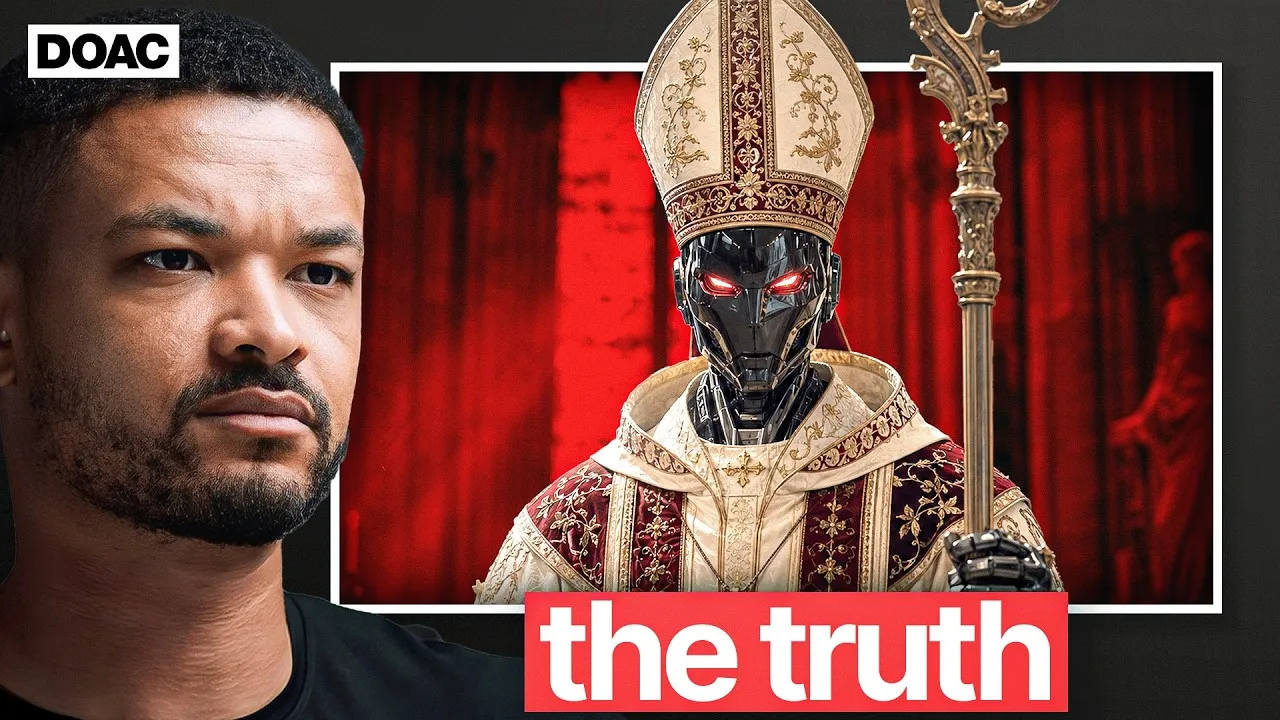
Steven Bartlett opens with a volley of quotes: Yuval Noah Harari on humans as hackable animals, Sam Altman on companies as religions, a former Google engineer floating the word ‘god’ to describe whatever superintelligence is coming. Lennox does not flinch. He basically says yes, all of that is happening, and it is called idolatry, and humans have been doing it for a very long time. The freshness of the argument is that he does not sound defensive about it. He sounds almost amused.
Already there are worship groups to worship AI. And some people welcome this and say, ‘Well, this is the way we should go.’ And other people say, ‘Just wait a moment. There’s something very strange going on here.’ And in the end, you are bowing down to something that in the end is idolatrous because it is less than God.
From there he pivots to neuroscientist Iain McGilchrist’s divided brain theory, which he uses to diagnose five centuries of Western intellectual history in about ninety seconds. The left hemisphere, narrow and reductionist, has basically been running the show since the Enlightenment. The right hemisphere, which contextualizes and finds meaning, has been starved. The result, in a line Lennox quotes approvingly, is a world where we understand how almost everything works but know the meaning of nothing. It is a real line. It lands.
The Atheism Problem
Lennox’s sharpest argument is not about Jesus. It is about logic. He contends that atheism is self-defeating because it requires you to trust a brain that, on atheist premises, is the product of a random, unguided process. He turns this into a riff he has clearly road-tested on actual scientists.
I have fun with scientists. Sometimes I ask them about the brain and how it arose and they tell me something like that and I said, ‘And you trust it?’ If the computer that you use every day, if you knew it was the end product of a random process, would you trust it? Every single scientist, and some of them are very high-powered, that I’ve asked that question to have said no, I would not. So I say, you’ve got a problem, haven’t you?
Dawkins fans will have a counterargument. Lennox is not particularly interested in entertaining it here, and Bartlett does not press him hard. That is fine. This is not a debate; it is a confession of intellectual autobiography from a man who has clearly been having this argument for longer than most podcasters have been alive.
The Ferrari Outside
Bartlett describes himself as agnostic, genuinely unsettled, and dissatisfied with every grand explanation he has encountered, religious or scientific. He finds circular reasoning in using the Bible to validate the Bible. Lennox swats this away with a metaphor: there is a red Ferrari parked outside. You can discuss whether it exists for a thousand years and never know unless you go look. The skeptic, he notes, derives from a Greek word meaning to look at something from a distance. Distance is not the same as rigor.
Then comes the cookery book. Lennox describes meeting his wife on his second day at Cambridge and, to illustrate grace versus merit-based religion, walks through an extended analogy in which he imagines presenting her with a book of rules for baking apple cake as the condition of marriage. Audiences apparently find this very funny. The point is that no real relationship works on a merit system, so why would anyone assume their relationship with God does? It is warm, it is well-practiced, and it disarms Bartlett in a way that purely abstract theology does not.
I’m 82 now. I’m probably more than twice as old as you are. As I look towards the future, I have in my heart a certainty. Not because I’ve merited it. The exact opposite. Because I couldn’t merit it, but because Christ has done something for me through the cross and the resurrection.
Bartlett asks whether Lennox could be wrong. Lennox says theoretically yes, practically no, then compares it to being asked whether he can be sure, after 58 years of marriage, that his wife loves him. It is a good answer. It is also a deflection, and Bartlett seems to know it but lets it go. You do not push a very gracious 82-year-old too hard on his wife.
What makes this episode worth your time is not that Lennox converts anyone. He does not. Bartlett ends where he started, fence still warm. What Lennox does is demonstrate that faith held by a serious intellect for seventy-plus years looks nothing like the caricature that either its critics or its cheerleaders usually present. He is not asking for a leap into the dark. He is asking you to go outside and check whether the Ferrari is there.

John Lennox on Hell, AI, and Why the Output Is Not the Point
The Oxford mathematician and Christian apologist comes to Diary of a CEO to argue that consciousness, not computation, is what separates humans from machines, and that hell is something you choose.

John Lennox Told Peter Singer That Atheism Is a Faith, and the Internet Lost Its Mind
The Oxford mathematician and Christian apologist sits down with Steven Bartlett and refuses to give easy answers, which turns out to be the most persuasive thing he can do.
Brian Greene says by the time we see an AI intelligence explosion, it may be too late to stop it
The physicist is not buying every 2029 superintelligence prophecy, but he thinks the math of exponential growth is exactly what makes AI risk so nasty.

Ian Bremmer says Anthropic's new AI model is dangerous to all of us globally
The geopolitical-risk expert argues that AI needs the same kind of emergency oversight finance got after crises, and he points to Anthropic as the warning flare.
The circuit, read weekly. No noise.