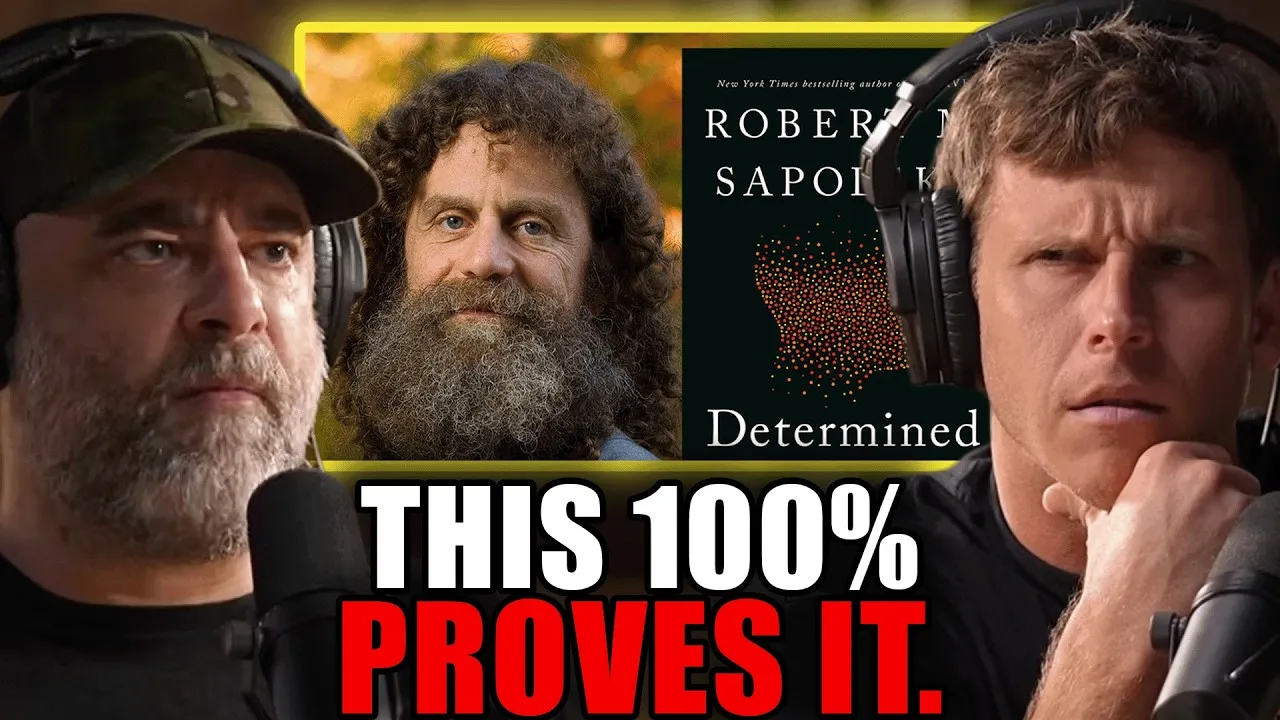
Kurt Metzger says Robert Sapolsky is wrong about free will because consciousness doesn't come from the brain
Metzger turns Sapolsky's determinism into a spiritual bar fight, and the funniest part is that his weakest evidence points at a real philosophical sore spot.
Listen on YouTube
 WATCH NOW↓
 Kurt Metzger says Robert Sapolsky is wrong about free will because consciousness doesn’t come from the brain, and because choice is not something humans possess, it is what humans are. This is not a peer-reviewed rebuttal. It is a lit cigarette flicked into the faculty lounge.
On the Danny Jones Podcast, Metzger takes aim at Robert Sapolsky, the Stanford biologist whose public case against free will has made him the grim reaper of personal responsibility on the podcast circuit. Sapolsky’s basic position, as Danny frames it, is that human behavior follows from genetics, environment, biology, stress, culture, history, and everything that happened before the moment you thought you were choosing. Metzger’s response is less counterargument than exorcism.
Finally, you are choice. There’s no way to get rid of free will. You literally, the part that’s you, okay, of your body and souls, whatever parts make the thing, is cho- choice is that’s what you are.
That line is the whole performance in miniature. Metzger is not trying to beat Sapolsky on footnotes. He is trying to make determinism sound spiritually stupid, like a guy in a lab coat explaining romance as a hydration event. His central move is to deny the premise underneath Sapolsky’s argument: that the self can be fully explained by the body, the brain, and the chain of causes that shaped them.
The Sapolsky fight is really a brain fight
Metzger’s most specific claim is that Sapolsky’s case only really works if consciousness is produced by what he calls brain material. If consciousness is not reducible to the brain, then the neat causal machinery starts to wobble. This is where Metzger is at his most interesting, even when he sounds like a man arguing with a TED Talk from inside a thunderstorm.
The only way for his argument to work is if consciousness comes from your brain and Right. Even then I don’t think it works to be honest
As philosophy, this is a real pressure point. As a takedown of Sapolsky, it is not enough. Sapolsky would not need to show that people are predictable like slot machines. He would need to show that every choice is caused by prior conditions, including conditions inside the nervous system that never ask your permission. Metzger responds by pointing to the weirdness of human surprise. People rebel against their background. People do what nobody expected. True. Also not quite the knockout punch he thinks it is.
True random is the thing that I think is um Some people will do things you don’t [ __ ] expect and it doesn’t matter what their background. Some people will go against everything that their environment told them to do.
Unpredictability is not the same as free will. A hurricane is hard to predict. Nobody invites it to therapy. Metzger’s video-poker riff, about programmers not being able to simulate true randomness, gestures toward mystery but doesn’t get him all the way to agency. Randomness may embarrass determinism, depending on the model, but random choice is not morally satisfying either. If your decision is uncaused, it is not obviously yours. It is just cosmic confetti.
The comedy is doing the philosophy’s dirty work
The best case for Metzger here is not scientific. It is cultural. Sapolsky’s no-free-will argument has a way of making ordinary moral life feel like a courtroom where everyone has been declared not guilty and somehow still sentenced. Metzger hears that and reaches for religion, Kabbalah, Jesus, the black cube, Sam Harris, Iran, Gaza, Ukraine, the Atlantic Council, Sam Smith at the Grammys, Pfizer, Jehovah’s Witnesses, and the flag. This is not a clean argument. It is a browser with 47 tabs open, several of them playing audio.
Still, his suspicion has a shape. He thinks credentialed anti-free-will arguments smuggle in a worldview while pretending to be simple science. He calls Sapolsky a genetic determinist and keeps circling back to the idea that academic language can make a crude claim sound profound. On that, he is not completely wrong. A lot of public-intellectual determinism does come packaged with a peculiar moral swagger: relax, nobody chose anything, but also please admire how bravely I noticed.
all simpleton [ __ ] philosophies that they they complicate with academic language. Um [ __ ] you are choice.
The verdict, without calling it a verdict because the podcast already has enough men declaring reality from a swivel chair: Metzger does not disprove Sapolsky. He does something messier and more useful for a comedy guest. He finds the nerve. If Sapolsky is right, our systems of blame, punishment, pride, shame, and self-improvement need a rebuild. If Metzger is right, the person who breaks pattern is not a statistical anomaly. They’re the point.
Some people will go against everything that their environment told them to do.
- What is Kurt Metzger's argument against Robert Sapolsky on free will?
- Metzger says Sapolsky's argument depends on a materialist view of the mind, where consciousness comes from the brain and behavior is just the output of biology plus environment. Metzger rejects that premise and insists that choice is not an add-on to human life, it is the core of what a person is.
- Is Metzger making a scientific rebuttal to Sapolsky?
- Not really. His case is more spiritual and intuitive than scientific, and his example about true randomness does not actually prove free will. Still, he does hit the popular discomfort with Sapolsky's view, which is that lived experience feels full of resistance, surprise, and moral agency.
- Why does Sam Harris come up?
- Danny Jones mentions Sam Harris as another public intellectual who has argued against free will. Metzger uses that opening to attack Harris politically, especially over Iran, Israel, and Gaza, turning the free-will argument into a broader rant against atheist intellectual authority.
Kurt Metzger says the Hat Man people see on Benadryl is Papa Legba
The comedian turns a grim diphenhydramine folklore meme into an occult radio theory, which is funny, vivid, and not remotely good medical advice.
Carl Hayden Smith says 78% of IV DMT users see entities, and some meet the entities' children
The claim is wild, oddly domestic, and a useful reminder that psychedelic research keeps producing data that sounds like a Pixar sequel written in a hospital ward.
Carl Hayden Smith says DMT entities told him he was not scheduled to die in an fMRI scanner
The psychedelic researcher’s wildest claim is not that DMT produces entities, but that those entities appeared to treat his lab scan like a cosmic false alarm.

Matt Cox says Karen Read is guilty, but planted evidence meant she had to go free
Cox's take is not that Karen Read was framed because she was innocent, but that police may have framed a guilty person and handed her reasonable doubt on a platter.
The circuit, read weekly. No noise.