Carl Hayden Smith says DMT entities told him he was not scheduled to die in an fMRI scanner
The psychedelic researcher’s wildest claim is not that DMT produces entities, but that those entities appeared to treat his lab scan like a cosmic false alarm.
Listen on YouTube
 WATCH NOW↓
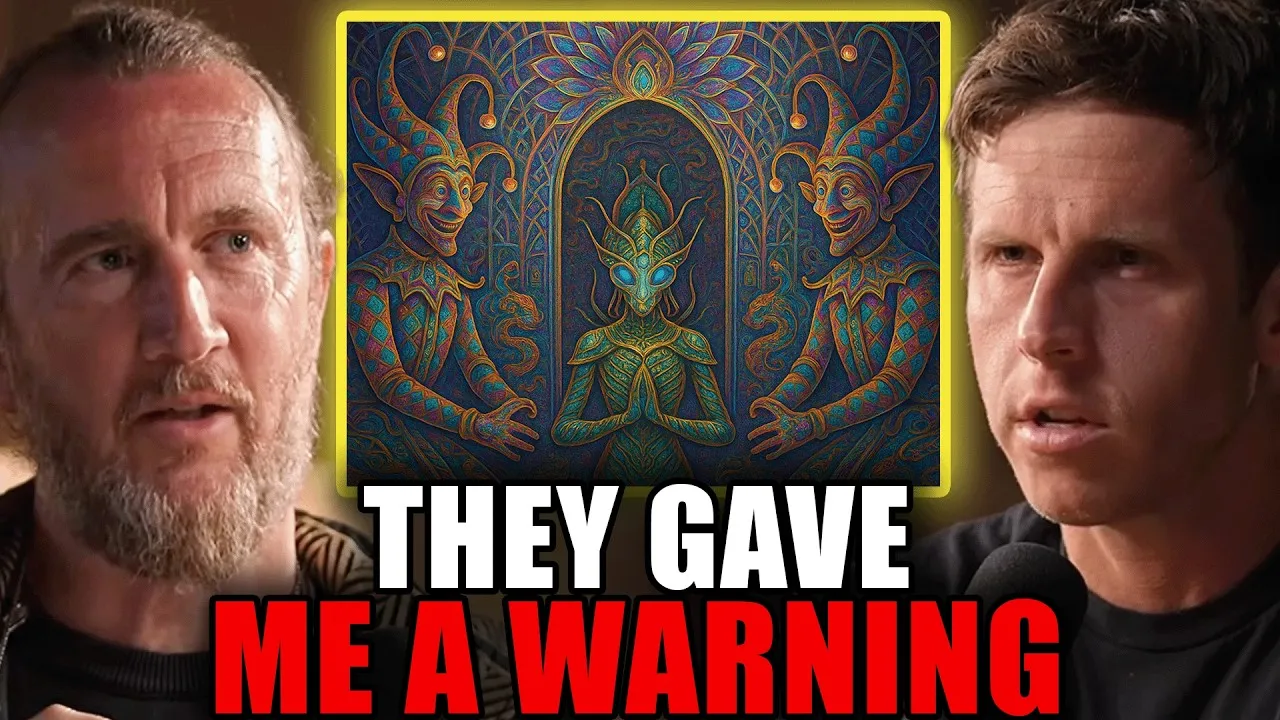
 The most deranged phrase in modern psychedelic science might be “fMRI plus injected DMT,” which sounds less like a study design than a dare from a sleep-deprived grad student. Carl Hayden Smith says that is where DMT entities appeared to tell him he was “not scheduled,” meaning, in his interpretation, not scheduled to die.
That is the claim worth dragging out of this Danny Jones Podcast episode and putting under a bright light. Not “DMT is mysterious.” Not “psychedelics may help us understand consciousness.” Those are seminar-room fog machines. Smith’s specific story is much stranger: while immobilized in a screaming scanner, dosed through an IV, he says the entities arrived like cosmic safety inspectors who had just found a human being doing something profoundly stupid.
And then immediately the entities arrive en masse as if to say bang. They gave me like a like a flash of light to say that you’re you’re made of light. You’re like an immortal being. But you’re in a human form right now and you’re not scheduled.
This is not a small claim. It’s not even the normal “I saw elves” DMT lore, which has become so culturally familiar that it now feels like a Pixar development slate with worse lighting. Smith is saying the entities behaved as if they knew something about his mortality calendar. The afterlife, but with Outlook invites.
The scanner is the trip monster
The best reason to take Smith seriously is not that the entities are definitely real. Please, let’s not sprint straight into crystal Reddit. The best reason is that he describes the setting with enough physical misery that the experience makes psychological sense even before you get to metaphysics. An fMRI scanner is loud, tight, immobilizing, and designed by people who apparently believe the human head should be lightly punished for having thoughts.
Smith says he was not in control of the timing, could barely move, and had to deal with both claustrophobia and the drug’s launch sequence. If DMT is a “non-specific amplifier,” as he puts it, this was less a mystical temple than a haunted MRI tube. Of course the trip had a medical emergency flavor. The set and setting weren’t decorative. They were the main character.
I’m not claustrophobic generally, but the the claustrophobia induced by this incredibly loud very confined, your head’s like you you know, you can’t move an inch.
Smith’s own explanation is more sober than the headline version of his story. He says the same dose and same experiment two weeks later produced no entities, which is a useful little puncture in the balloon. If the beings are eternal guardians, apparently they also reserve the right to stop taking your calls.
What was crazy is 2 weeks later I had to go back in the scanner and do the next phase of the study, same dose, same experiment, and no entities came.
A professor, a cosmic claim, and a very necessary eyebrow
Smith is careful in a way that saves the segment from turning into pure dorm-room theology. He calls himself a scientist and a professor, then refuses to lock the entities into one explanation. They could be archetypes. They could be “your higher self.” They could be “you in the future.” They could be something external. That list contains wildly different ontologies, but at least he admits the uncertainty.
The trouble is that his language keeps sliding from caution into mythology. He says “guardians.” He says “scheduled.” He says they knew he wasn’t going to die. That’s thrilling podcast material, but it also outruns the evidence. A first-person report under a powerful psychedelic in a distressing lab environment can tell us a lot about consciousness, fear, embodiment, and expectation. It cannot, by itself, prove that death has a bookings department.
I’m a scientist, I’m a professor, I’m I’m still on the fence as to whether these entities are your archetypes or your higher self or you or you in the future or something you’re tapping into.
Still, the claim has real cultural juice because it sits at the fault line where psychedelic science keeps becoming psychedelic religion. Researchers can measure heart rate, dosing, scan data, and reported experience. They can’t yet measure whether the machine elves are worried about your insurance deductible.
Smith’s most grounded point is also the one that psychedelic evangelists should probably tattoo somewhere tasteful: context runs the show. He estimates that “80% of the medicine” is contextual, meaning mindset, body state, and environment. That’s not as sexy as “entities know when we die,” but it is far more useful if you care about what people actually experience on psychedelics.
If Smith is right about the entities, then death has a schedule and somebody on the other side was extremely unimpressed by the research protocol. If he’s wrong, the story is still a perfect warning label: put a human being inside a deafening metal coffin, inject one of the strongest psychedelics on Earth, and don’t be shocked when the universe shows up wearing a lab coat.
- Did Carl Hayden Smith really claim DMT entities knew when he would die?
- Yes. He says the entities told him he was “not scheduled,” which he interpreted as meaning he was not going to die during the scan. He frames them as possible guardians, while also saying he is still on the fence about what entities actually are.
- Was this a recreational DMT trip?
- No. Smith describes taking part in research using intravenous DMT, first with EEG and later with fMRI. The stated goal, according to him, was to explore consciousness rather than treat a condition like depression or ADHD.
- Is his claim proof that DMT entities are real?
- No. The claim is a first-person report from a psychedelic state, not proof of outside beings. What makes it interesting is that Smith is not just telling a campfire story, he is a professor describing a lab context, while still admitting that the entities could be archetypes, a higher self, future self, or something else entirely.
Carl Hayden Smith says 78% of IV DMT users see entities, and some meet the entities' children
The claim is wild, oddly domestic, and a useful reminder that psychedelic research keeps producing data that sounds like a Pixar sequel written in a hospital ward.
Kurt Metzger says Robert Sapolsky is wrong about free will because consciousness doesn't come from the brain
Metzger turns Sapolsky's determinism into a spiritual bar fight, and the funniest part is that his weakest evidence points at a real philosophical sore spot.
Matt Cox says Karen Read is guilty, but planted evidence meant she had to go free
Cox's take is not that Karen Read was framed because she was innocent, but that police may have framed a guilty person and handed her reasonable doubt on a platter.

Sean Stone says Osama bin Laden was CIA and the man killed in Abbottabad may have been a dummy
On the Danny Jones Podcast, Stone turns the official bin Laden story into a full intelligence-op theory, but the most explosive part is also the least proven.
The circuit, read weekly. No noise.