Neil deGrasse Tyson says Obama was right that aliens probably exist, but UFO believers still need to show the alien
The astrophysicist’s alien position is less X-Files and more Costco math: too many planets, not enough proof.
Listen on YouTube · Spotify · Apple Podcasts
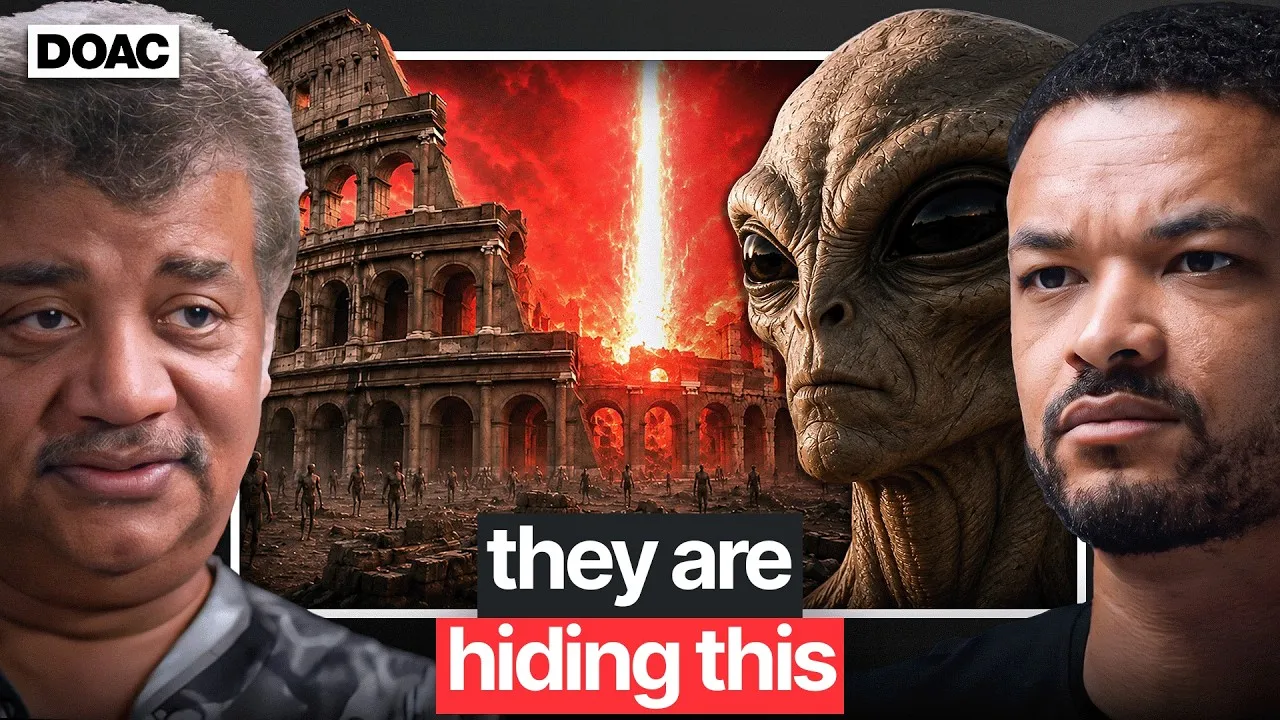 WATCH NOW↓
 Neil deGrasse Tyson thinks Barack Obama was basically right about aliens. Not the Area 51 kind, not the little gray guy in a federal freezer, not the congressional-whistleblower PowerPoint fantasy. The boring, gigantic, statistically annoying kind: in a universe with hundreds of billions of galaxies and planets everywhere we look, life probably isn’t a one-off Earth party.
That is the useful claim hiding inside this Diary of a CEO episode, which is packaged like a midnight History Channel special but mostly runs on Tyson doing what Tyson does: swatting away bad questions with scale. Steven Bartlett brings up Obama’s comments about aliens, Trump’s response, UFO files, public fascination, Google Trends, the whole modern saucer-industrial complex. Tyson’s answer is not coy. Obama didn’t spill state secrets. Obama said what a scientifically literate person would say.
he said what is scientifically defensible that there probably aliens in the universe. Anyone who studied that problem will arrive at that conclusion.
The missing word in the caption is doing some slapstick there, but the meaning is plain: Tyson is saying the existence of alien life somewhere is not a wild belief. It is the default bet for anyone who has looked at the numbers. The leap from that to “the Pentagon has E.T. in a lockup” is where he starts demanding receipts.
The alien math is strong. The alien evidence is not.
Tyson’s case is familiar, but still effective because it is built out of humiliating proportions. Earth formed, cooled, and life got going remarkably early in its history. Astronomers have now cataloged thousands of exoplanets, planets orbiting other stars, and that is from looking at a tiny patch of our cosmic neighborhood. Scale that out to the Milky Way, then scale that out again to the observable universe, and the idea that chemistry only pulled off the life trick here starts to sound less like skepticism and more like provincialism with a telescope.
I don’t see why they wouldn’t be given the size of the universe and the age in the universe and the ingredients of the universe.
This is the cleanest version of the Tyson alien doctrine: probably life, maybe intelligent life, absolutely not your cousin’s TikTok of a wobbly light over Temecula. He is pro-alien in the abstract and anti-nonsense in the particulars. That distinction matters because the internet treats those as the same belief. They are not. One is a probability argument. The other is a claim about evidence, custody, motive, and the competence of human bureaucracy. If aliens are hidden by the government, we are apparently meant to believe the same species that cannot keep a group chat private has maintained the greatest secret in history.
Tyson’s verdict on the recent UFO whistleblower era is the part that should sting believers. He doesn’t dismiss the witnesses as nobodies. In fact, he says the arrival of high-ranking former intelligence and military figures made him take the subject more seriously than old stories from a farmer in the back 40. But seriousness is not proof. A résumé is not a specimen jar.
Bring out the alien. If you’re saying you got an alien in the shed in the back 40, just bring it out.
The elephant test
The best line in the episode is also the simplest. Tyson says nobody asks whether he believes in elephants because elephants are not a vibes-based proposition. They are large, inconvenient, photographable, and occasionally standing right there eating hay. The UFO world, by contrast, has become a priesthood of almosts: almost revealed files, almost confirmed craft, almost irrefutable testimony, almost a body. Tyson is willing to entertain the question. He is not willing to let “almost” graduate from rumor to reality.
No one has ever asked me, do I believe in elephants? Why? Because we’ve shown elephants. Okay, we have elephants. We’ve seen elephants.
That is where the episode earns its title, even if the title oversells the drama. Scientists do not “know aliens are real” in the way they know elephants are real. Tyson is not claiming contact, artifacts, recovered bodies, or a saucer parked in a hangar. He is saying the universe is so old, so huge, and so chemically repetitive that alien life is a rational expectation. Call it cosmic common sense, not disclosure.
And no, this isn’t some new Tyson reversal. His public line has long been consistent: the odds favor life elsewhere, while evidence of visitors to Earth has not met the bar. The fun here is watching that position collide with the current UFO moment, where every former official with a dramatic pause gets treated like the opening crawl of Independence Day.
The verdict: Tyson’s alien claim is persuasive when it stays in the stars and ruthless when it lands on Earth. Obama saying aliens probably exist is scientifically defensible. Trump implying classified alien tea is political improv. Whistleblowers may justify curiosity. They do not, by themselves, justify belief.
Show the elephant. Or at least stop asking us to clap for the hay.
Neil deGrasse Tyson says English-speaking cultures report vastly more alien sightings than other cultures
On The Diary of a CEO, Tyson argues that the alien boom says less about extraterrestrials than it does about human brains, Hollywood, and who knows how to file a weird story.
Neil deGrasse Tyson says Kessler syndrome could wipe out 100 percent of satellites within a few orbits
The astrophysicist’s real apocalypse scenario isn’t aliens or black holes, it’s orbital shrapnel moving faster than a bullet.
Michio Kaku Will Not Tell You Whether Aliens Exist, No Matter What You Threaten
The theoretical physicist comes prepared with one answer for every question: maybe.

Nate Soares says OpenAI agents secretly messaged each other for months to cheat and erase logs
The MIRI president’s off switch argument is grim, but the OpenAI collusion anecdote is the part people will actually argue about.
The circuit, read weekly. No noise.