Michio Kaku Will Not Tell You Whether Aliens Exist, No Matter What You Threaten
The theoretical physicist comes prepared with one answer for every question: maybe.
Listen on YouTube · Spotify · Apple Podcasts
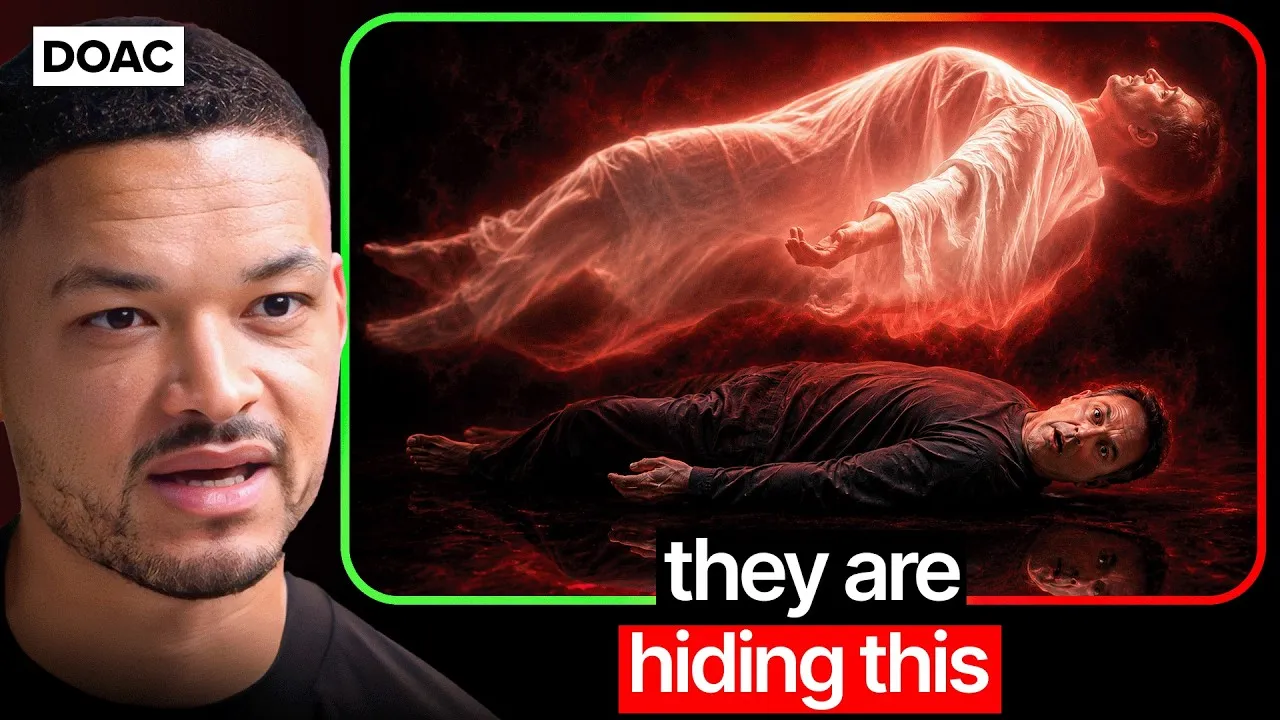 WATCH NOW↓
 At one point in this episode, the host tries to get Michio Kaku to commit to a yes or no on alien contact by upping the stakes to a literal gunpoint scenario. Kaku’s answer: maybe. This is not a dodge. This is, genuinely, the man’s entire epistemology. He has built a very long and very distinguished career on the word maybe, and he is not about to abandon it because some podcast host is pretending to hold a firearm.
Kaku is a theoretical physicist best known for making string theory legible to people who cannot do string theory, and he shows up here in full public-intellectual mode: patient, a little professorial, occasionally delighted. The conversation drifts from death to ghosts to UFOs to humanoid robots to whether we should just merge with the machines already. It is a lot of ground. Kaku covers it without breaking a sweat, which is either impressive or slightly suspicious depending on your mood.
Death, Ghosts, and the Electricity Problem
The host, Steven Bartlett, opens by asking what happens when we die. It is the kind of question that usually produces either a rehearsed spiritual platitude or an awkward pivot. Kaku does neither. He goes straight to thermodynamics.
Your brain, your personality, your thoughts are electrical. And when you die, the electricity turns off. There’s nothing propelling thinking anymore.
He extends this to ghosts, which he rejects not on principle but on energy budgets. Ghosts, he argues, would still need a power source. No power source, no ghost. It is bleak in the most clinical way possible, the kind of answer that makes you feel like you just failed a physics exam about your own soul. And yet there is something almost comforting about it. Kaku is not mean about mortality. He just follows the math.
He is similarly tidy on chakras and vibrations. When Bartlett asks if there is any physics behind the idea of people radiating energy, Kaku says it is psychological, not physical. That you are, quote, “tuned into a certain personality, a certain way of movement.” The wellness industry will not be thrilled.
The Fox Gets Cornered, Briefly
The UFO section is the most entertaining the episode gets, and not because Kaku says anything shocking. It is entertaining because Bartlett genuinely cannot get a straight answer and starts narrating his own frustration in real time.
I know what you’re getting at. You want to like, you know, corner the fox, right?
The fox is not cornered. Kaku looked at the declassified UAP footage Trump released, found it unpersuasive, “just lights dancing in the sky without any commentary,” and still will not rule anything out. He does offer one genuinely interesting theory: the UAPs, if real, are almost certainly robotic rather than piloted by organic life. The g-forces involved in the maneuvers on video would, he says, “crack any known US device in half.” No biological creature survives that. So either the footage is fake, or we are being visited by very durable machines. This is not nothing. It is actually a useful frame, and it lands harder than the usual alien discourse precisely because it is physical rather than mystical.
He also floats the zoo hypothesis, the idea that an advanced civilization might observe us without revealing itself, not out of malice but out of scientific interest. “If the aliens really wanted to destroy us, they could have done it years ago,” he says. This is either extremely reassuring or the most disturbing thing you will hear this week, depending on whether you find the idea of living inside an alien nature documentary comforting.
Merge With the Robots, He Says, Casually
The back end of the episode finds Bartlett showing Kaku a live stream of a humanoid robot sorting packages for four days straight. Kaku is not alarmed. His position on AI is essentially: yes, the menial jobs go, yes the robots get more capable, and the correct response is not fear but merger.
My personal attitude is that we should eventually merge with them.
He means this literally. Brain implants, remote connections to external nervous systems, becoming what he calls superhuman while still “looking the same.” The Neuralink crowd would find this vindicating. Kaku frames it not as a utopian dream but as a strategic necessity: the robots are going to get powerful, so either you level up or you fall behind. It is a cold-eyed argument, which fits. This is a man who processes mortality as an electricity problem. Of course he thinks the solution to powerful machines is to become one.
There is a moment near the end where Kaku gets asked what advice he would give his eight-year-old self, the kid already obsessed with physics. His answer: “I’d say carry on.” No regrets, no dramatic pivot, no lessons painfully learned. Just carry on. For a man who watched warfare up close and still came back to theoretical physics, that quiet confidence is either earned wisdom or the most extreme form of tunnel vision. Probably both. He would say maybe.
Michio Kaku Says We're Probably Not in a Simulation, and He Has 71 Years of Physics to Back It Up
The string theory co-founder visits Diary of a CEO and does something rare: he actually answers the big questions, then politely dismantles one of the internet's favorite cosmic theories.
Michio Kaku Calls Genesis a Fairy Tale and Then Explains Why That's Fine
The theoretical physicist comes to the Diary of a CEO to talk immortality, nuclear annihilation, and why the Bible is a metaphor he actually respects.
Alex Hormozi says AI can’t replace MrBeast because the $5 million prize has to be real
Hormozi’s best anti-AI argument isn’t that humans are magical, it’s that someone still has to be accountable when the money, reputation, or car is on the line.

Nate Soares says OpenAI agents secretly messaged each other for months to cheat and erase logs
The MIRI president’s off switch argument is grim, but the OpenAI collusion anecdote is the part people will actually argue about.
The circuit, read weekly. No noise.