Tara Swart says she is 100% sure she can communicate with her dead husband
The neuroscientist and former psychiatrist ties a 34-senses argument to after-death communication, but her best evidence is still personal grief, not proof.
Listen on YouTube · Spotify · Apple Podcasts
 WATCH NOW↓
 This is not a ghost story told by your aunt over boxed wine. Tara Swart, a neuroscientist and former psychiatrist, came to The Diary of a CEO with a claim no brain-optimization résumé can soften: she says she is 100% sure she learned to communicate with her late husband, Robin, after his death from leukemia.
The route she takes is the odd part. Swart doesn’t start with candles, a medium, or a haunted mirror. She starts by correcting the kindergarten version of biology.
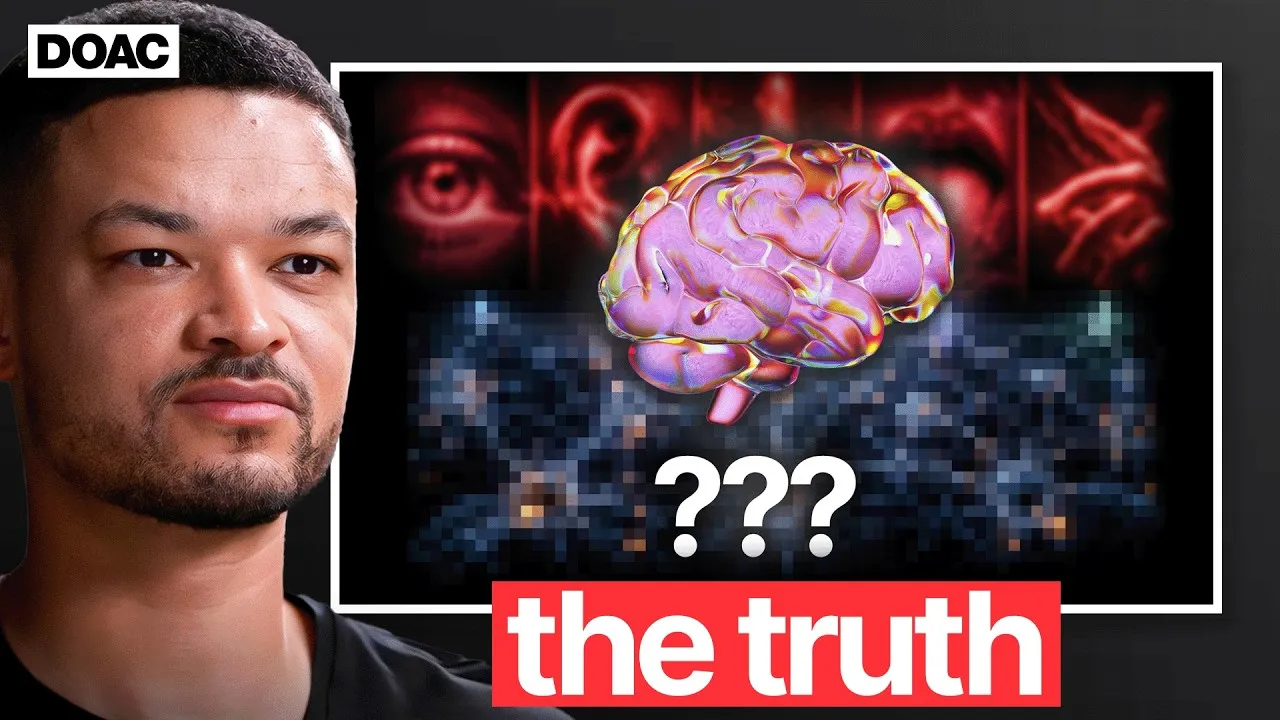
So I actually did a literature review of several pieces of research about how many senses humans have and we actually have 34 as we currently understand it.
On that point, she’s on firmer ground than the title makes it sound. The five-sense model is baby food. Humans have balance, pain, temperature, proprioception, interoception, and a whole backstage crew of body-monitoring systems that never got invited to the Aristotle reunion. Whether the number is exactly 34 is a classification fight. Fine. Count away.
But a bigger sensory menu does not automatically get you a customer service line to the afterlife. That is where Swart’s case becomes shakier, stranger, and, frankly, harder to laugh off, because she keeps dragging it back to grief, and grief has a way of making skeptics sound smug.
The ghost claim arrives wearing a lab coat
Swart says Robin died in 2021, two days before their fourth wedding anniversary. She describes being broken by it, then seeing robins in the garden, then waking around 4 a.m. to what she says looked like a hazy version of her husband beside the bed. She also says she tried mediums and wasn’t impressed, which is a wonderfully modern sentence: I went to the paranormal marketplace and left a bad Yelp review.
if it’s possible to communicate with someone that’s passed away and he was my husband and my best friend and I am all about optimizing my brain and expanding my consciousness then I should be able to do it myself.
That sentence is the whole tension of the episode. It is both brutally tender and wildly self-authorizing. Swart is not saying, I felt him near me, which many grieving people say and no decent person should swat away. She is saying she trained herself, through consciousness and attention, to communicate.
The most arresting evidence against her own easy certainty comes from Swart herself. She says she had to ask whether she was depressed, manic, psychotic. She knows the clinical vocabulary because she used to work inside it. That makes the confession braver. It also makes the claim riskier.
I was experiencing something called thought insertion which um in psychiatry is one of the symptoms of schizophrenia.
There’s a version of this episode that is plainly persuasive: trauma lives in the body. Swart’s example of physical pain appearing around the anniversary of bringing Robin home to die fits a familiar psychological pattern. So does her argument that talking therapy does not always reach what the body is carrying. You don’t need a spirit realm to buy that.
The harder sell is the interpretive leap. Feeling freezing cold while Robin’s body was in a refrigerated morgue may be a devastating symbol, a body memory, a grief response, or a coincidence with meaning attached afterward. Swart chooses a more literal reading. She is entitled to it. The listener is not required to call it science just because a scientist says it with tears in her eyes.
The believable part is grief, not proof
Swart’s 34-senses argument is useful because it knocks people out of the smug little five-senses box. It does not prove dead spouses can send messages. That distinction matters. Neuroscience can tell us that bodies remember, that pain and memory are weird roommates, that perception is constructed, and that bereavement can remake a mind. It cannot, from what Swart offers here, verify Robin on the other end.
Still, the episode has a charge because Swart is not doing cheap mysticism. She is putting her professional credibility on the table and daring people to decide whether grief expanded her perception or broke her filter. Her answer is total certainty. The method she offers is less reassuring.
Well, it always starts with believing, right?
- Did Tara Swart say humans have 34 senses?
- Yes. She says she reviewed research on human senses and concluded that people have 34, not five. That broader count can include things beyond sight, hearing, taste, touch, and smell, such as balance, body position, pain, temperature, and internal body signals. The number depends on how you classify a sense.
- What evidence does Tara Swart give for communicating with her husband?
- She describes seeing robins after his death, waking to what she says was a hazy image of him near her bed, feeling physical pain around the anniversary of bringing him home to die, feeling freezing cold while his body was in a refrigerated morgue, and later asking for specific signs. Those are intense personal experiences, but they are not public scientific proof.
- Does Tara Swart's psychiatric background make the claim more credible?
- It makes the claim more serious, not proven. Swart repeatedly frames her experiences against psychiatric categories, including depression, mania, psychosis, and thought insertion. That self-awareness is striking. Her certainty still outruns the evidence presented here.
Brian Greene says by the time we see an AI intelligence explosion, it may be too late to stop it
The physicist is not buying every 2029 superintelligence prophecy, but he thinks the math of exponential growth is exactly what makes AI risk so nasty.
Graham Hancock on Death, Lost Civilizations, and the Enemies He Can't Forgive
The ancient-history provocateur comes in reflective and leaves a little raw.

John Lennox on Hell, AI, and Why the Output Is Not the Point
The Oxford mathematician and Christian apologist comes to Diary of a CEO to argue that consciousness, not computation, is what separates humans from machines, and that hell is something you choose.
Martin Picard says Alzheimer's isn't caused by amyloid plaques, it's an energy disorder
The mitochondrial scientist makes a clean break from the story most people learned about dementia, though his replacement theory needs more humility than the podcast gives it.
The circuit, read weekly. No noise.