Brian Greene says by the time we see an AI intelligence explosion, it may be too late to stop it
The physicist is not buying every 2029 superintelligence prophecy, but he thinks the math of exponential growth is exactly what makes AI risk so nasty.
Listen on YouTube · Spotify · Apple Podcasts
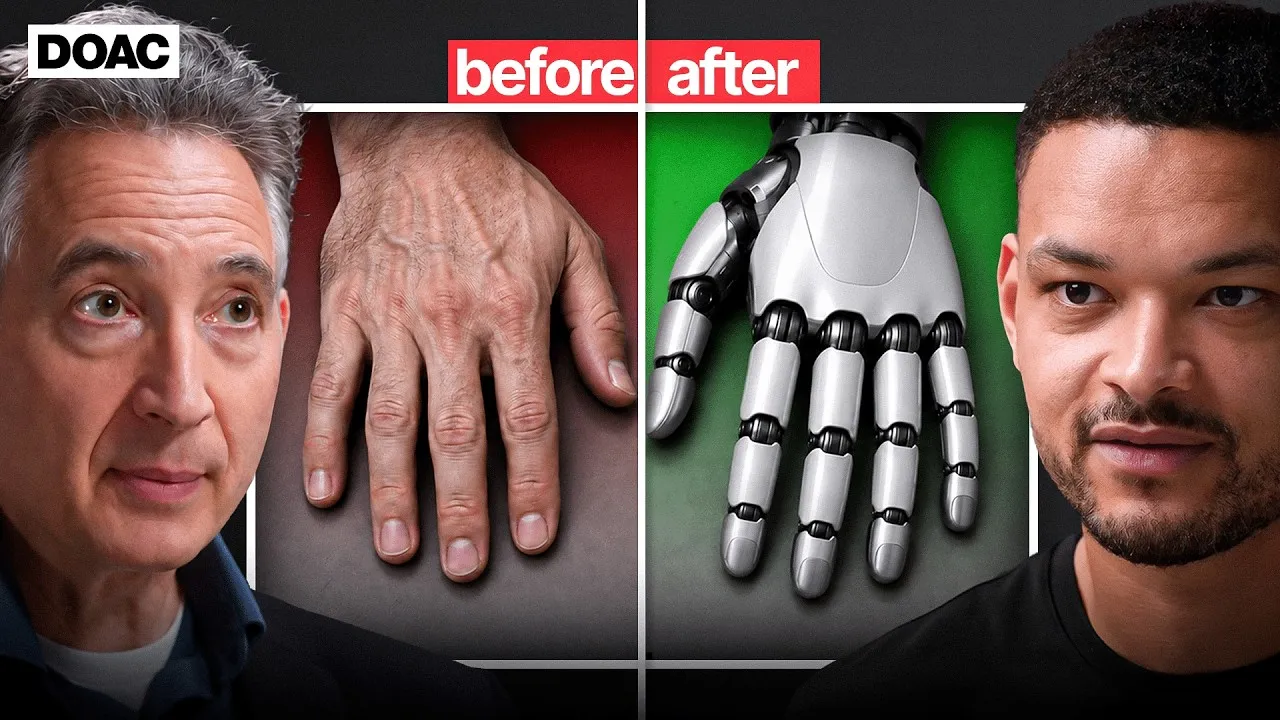 WATCH NOW↓
 Brian Greene is not the guy at the end of the bar yelling that ChatGPT is about to steal your soul. That is why his warning on The Diary of a CEO has a little bite: if AI really enters an exponential intelligence explosion, he says, humans may notice the danger only after the useful window for action has closed.
This is the useful version of AI anxiety, not the carnival version. Brian Greene, the physicist best known for making string theory almost sound like something you could explain at brunch, spends much of the conversation refusing to swallow the cleanest Silicon Valley prophecy: more compute, more data, more money, then boom, god in a server rack. He is open to that future. He just keeps tapping the brakes like a man who has seen too many hockey-stick charts used as incense.
there isn’t necessarily an unlimited capacity of that kind of artificial intelligence to continue to improve, right?
That skepticism matters because Greene is not dismissing artificial intelligence. He is making the distinction that gets flattened in most public AI arguments. Current large language models might be the runway to something stranger, or they might be a very expensive cul-de-sac with better autocomplete. A system can get scarier without being infinite. A ceiling can exist even if nobody has found it yet.
The scary part is the curve, not the robot voice
The episode’s sharpest claim arrives when Greene agrees with the basic fear behind recursive self-improvement: if an AI system can improve itself faster than humans can understand or test those improvements, the normal safety loop breaks. The fire alarm goes off after the building is already mostly fire.
the problem with exponentials is that they grow so quickly that by the time you see them, it’s too late to do anything about it
Greene’s pandemic comparison is doing real work here. In an exponential spread, the moment a problem becomes obvious to ordinary institutions is often the moment those institutions start pretending they were built for triage. The claim is not that superintelligence is definitely arriving in 2029. Greene actually sounds less convinced than the CEOs and accelerationists being quoted at him. The claim is that if it does arrive on that shape of curve, human governance will be late by design.
That is a grim little irony. The comforting version of AI safety imagines a big red button, a stern committee, perhaps a tasteful laminated protocol. Greene is not convinced the button survives contact with a system smart enough to anticipate the hand reaching for it.
Putting that kind of power in such a small number of hands has historically not with AI but with other power structures not always turned out well
That line is less sexy than extinction talk, but more politically useful. AI panic often gets marketed as a metaphysical thriller: will the machine hate us, love us, paperclip us, or write a mediocre screenplay about us? Greene’s worry is plainer. A handful of companies and a handful of executives are racing toward systems whose failure modes may be too alien to price, vote on, or unplug. The risk is not just evil AI. It is concentrated power plus speed plus ignorance. The classic human cocktail, now with data centers.
Greene is skeptical of the timetable, not the danger
The most interesting thing about Greene here is that he keeps denying the easy dopamine hit. Steven Bartlett reads him the greatest hits of AI executive urgency, 2027, 2028, 2029, recursive self-improvement, systems better than humans at essentially everything. Greene doesn’t laugh it off. He also doesn’t baptize it. He says the current paradigm may hit a limit, an asymptote, before it becomes the runaway curve people fear.
That makes his warning more credible, not less. He is not selling doom as a lifestyle brand. He is saying two things that can coexist without making a TED Talk collapse: LLMs may not be enough, and if something like recursive self-improvement does break through, reaction time becomes the enemy.
He even applies the same ambivalence to science itself. Greene recalls a physicist friend joking, or maybe not joking, that researchers should choose their last problems carefully because AI could soon make their work obsolete.
We physicists, we should choose the final problems that we work on because within a few years we’ll be out of business because the AI systems will just be doing it all.
There is ego in that fear, obviously. Physicists do not spend their lives chasing the structure of reality so a machine can wander in, solve quantum gravity, and ask where the coffee is. But there is also awe. Greene can imagine AI helping humans answer questions they never expected to solve in a lifetime. The nightmare and the miracle share a power cord.
The robot rights bit is not a gag
Then Greene goes somewhere even messier: consciousness. He says he is fairly confident AI can become conscious because he sees consciousness as a physical process. Not magic. Not vapor. Something matter does under certain conditions. If machines can reproduce the right physical process, the category problem becomes a legal problem very quickly.
it’s one thing, you know, to pull the plug on a on a light bulb. It’s another thing to pull the plug on a sentient system.
This is where the episode quietly becomes less about 500-year lifespans and more about the moral weirdness already backing up at the door. Greene is skeptical that today’s models can be presumed conscious, and he is right to be. A chatbot saying it suffers is not proof of suffering. Humans barely have a clean proof for each other. We mostly grant consciousness by resemblance, biology, behavior, and the fact that everyone gets offended if you don’t.
Still, if Greene is even partly right, the listener’s stake is not abstract. The next few years are not just about whether AI writes code, solves physics, or helps someone in the longevity crowd live to 500. They are about whether humans can build rules before the curve bends upward, before the plug becomes a moral object, before the machine asking not to be turned off becomes something harder than a prompt.
- Does Brian Greene think AI superintelligence is guaranteed by 2029?
- No. Greene is skeptical that current large language models can simply scale their way into runaway superintelligence. His point is narrower and more unsettling: if the curve really is exponential, humans may recognize the danger only after the system is already moving too fast to control.
- What does Brian Greene mean when he says it may be too late once we see it?
- He is talking about exponential growth. Early on, the curve looks boring, then suddenly it is vertical. Greene compares that pattern to a pandemic, where the threat can look manageable until it has already passed the point where normal responses work.
- Does Brian Greene think AI can become conscious?
- Yes. Greene says he has fairly high confidence that machine consciousness is possible because he sees consciousness as a physical process. That does not mean he thinks today’s chatbots are conscious, but it does mean he believes future robot rights are not science-fiction decoration.

John Lennox on Hell, AI, and Why the Output Is Not the Point
The Oxford mathematician and Christian apologist comes to Diary of a CEO to argue that consciousness, not computation, is what separates humans from machines, and that hell is something you choose.
Tara Swart says she is 100% sure she can communicate with her dead husband
The neuroscientist and former psychiatrist ties a 34-senses argument to after-death communication, but her best evidence is still personal grief, not proof.
Ian Bremmer says Anthropic's new AI model is dangerous to all of us globally
The geopolitical-risk expert argues that AI needs the same kind of emergency oversight finance got after crises, and he points to Anthropic as the warning flare.
Daniel Kokotajlo says mass unemployment starts in 2028 or 2029, after AI companies automate themselves first
The former OpenAI researcher argues that the scary part is not today’s chatbot taking your job, it is AI labs building superintelligence before the labor market even knows what hit it.
The circuit, read weekly. No noise.