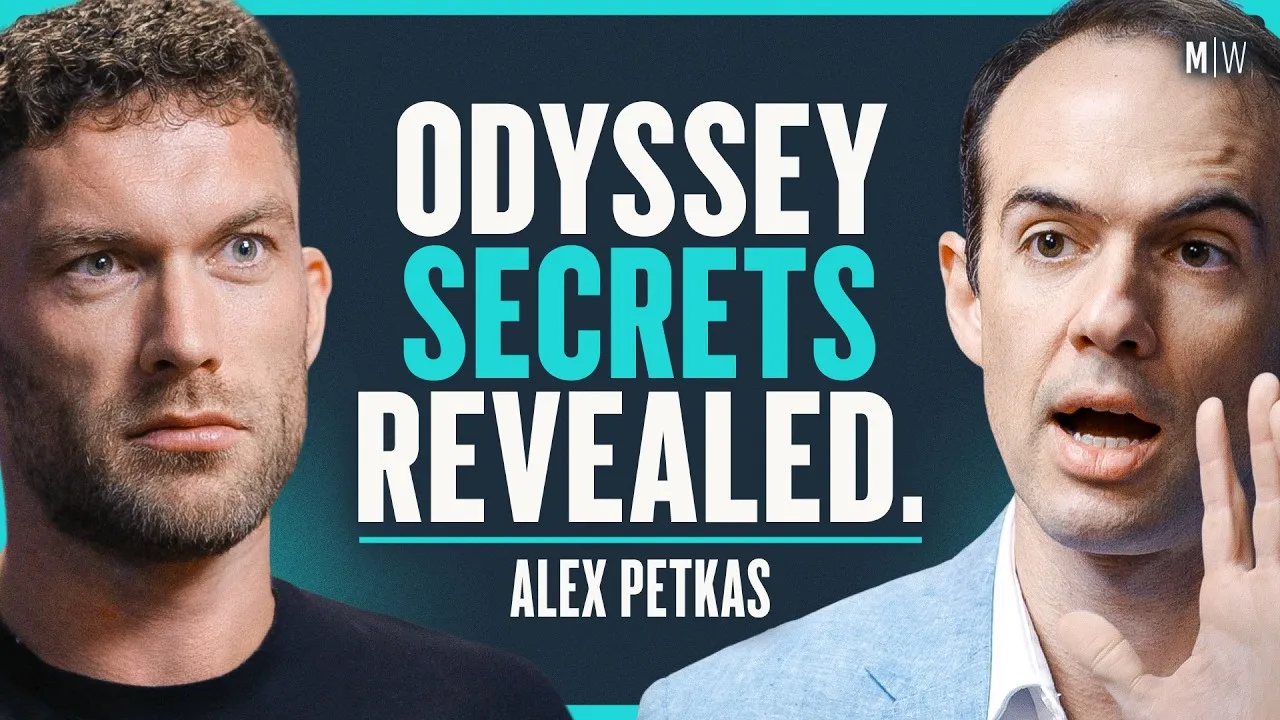
Alex Petkas says The Odyssey is about the collapse of the patriarchy and how violence restores it
The Cost of Glory host reads Homer less as a travel adventure than as a bloody manual for putting a household, and a civilization, back in order.
Listen on YouTube
 WATCH NOW↓
 Alex Petkas’ Homer is not the sandal-wearing grandpa of eighth-grade English class. On Modern Wisdom, Alex Petkas says The Odyssey is really a story about the collapse of the patriarchy, and the restoration plan involves disguise, patience, locked doors, hidden weapons, and 108 dead suitors.
it’s kind of a story about the collapse of the patriarchy and how it gets restored. Uh what it what it takes to restore that.
That is the episode’s claim, and it is much better than another reverent misting of the marble bust. Petkas is not saying Homer invented trad Twitter. He is saying the poem’s domestic plot is not domestic at all. Ithaca without Odysseus becomes a failed state with better catering. The father is gone. The son cannot command. Penelope can delay, brilliantly, but not end the siege. The suitors are not romantic rivals, they are entropy in linen.
The suitors are not Love Island, they are a coup with snacks
Petkas keeps returning to the household as the political unit that matters. Odysseus’s absence does not create a cute bachelor scrum around Penelope. It creates a moral weather event. The suitors eat his animals, ignore sacred hospitality, plot to kill Telemachus, and turn the house into a frat basement with Bronze Age table manners. Chris Williamson jokes that 50 percent of the poem is Love Island. Petkas lets the joke breathe, then makes the uglier point: these men want Penelope because taking her means taking Odysseus’s status. It is René Girard with more goat meat.
there’s there’s the whole anarchy versus patriarchy going on. And there’s the kind of usurped glory.
This is where the reading gets interesting, and also where it starts picking fights with the modern classroom. Petkas’ Odyssey is not chiefly about whether Odysseus is problematic. It is about whether cunning can rescue order when brute force alone will lose. That is why Athena matters. That is why Odysseus survives Calypso, Circe, the Cyclops, the Sirens, and finally his own rage. He is not the biggest hammer. He is the man who knows when to wait, when to flatter, when to lie, and when to shoot first.
Petkas thinks Homer is less conflicted about Odysseus than we are
The episode has a quiet argument with the current prestige instinct to sand every hero into moral fog. Petkas takes a swipe at the famous Emily Wilson rendering of Odysseus as a complicated man, preferring a reading of polytropos that emphasizes turns, tricks, guises, craft. In his version, Odysseus is not a therapy intake form with a boat. He is a civilization hero, which means he can be deceitful without the poem becoming a prosecution brief.
100% worth emulating, but that doesn’t mean he’s perfect.
That verdict is forceful. It is also convenient. A host whose whole project is extracting leadership lessons from antiquity has a natural incentive to make Odysseus usable. Still, Petkas has the poem on his side more often than not. Homer does not present the slaughter of the suitors like a tragic overreaction. He stacks the case against them for 24 books. Bad guests. Bad men. Bad politics. By the time Odysseus strings the bow, the room has been morally sealed before it is physically sealed.
Homer doesn’t think that he took it too far. He the justice of Zeus was coming down upon them.
That is the hardest sell now. Not because modern audiences cannot handle violence, please, we made John Wick a folk saint. The difficulty is the moral cleanliness Petkas attributes to it. Odysseus uses a bow, a weapon Petkas notes is dishonorable in the Iliad’s warrior code, precisely because this is not a duel. It is pest control with divine authorization. You can admire the structural elegance while still wincing at the hangings that follow.
Nolan’s problem is not monsters, it is moral simplicity
The Christopher Nolan thread gives the whole conversation its voltage. Petkas is excited for the film, but the real question is whether Nolan will trust Homer enough to let Odysseus be admirable without embalming him in ambiguity. Williamson, who sounds charmingly exhausted by the content mines, wonders if audiences are hungry for stories that do not hand them another homework packet of ambivalence. Petkas agrees, mostly: Homer can be morally simple without being stupid.
That is the useful distinction. Petkas’ claim is exaggerated if you hear patriarchy as a modern policy plank. It is dead on if you hear it as Homeric household order, father, mother, son, gods, guests, servants, inheritance, meals, prayers, beds. When that order breaks, Homer does not send in a committee. He sends in Odysseus, dressed like a beggar, carrying a bow.
If Nolan’s Odyssey keeps that, the culture-war arguments about casting may turn out to be the decoy horse at the gate. The real fight will be whether a 2020s blockbuster can look an audience in the eye and say: here is a good man, he lies beautifully, and when justice arrives, it has blood on its hands.
- Does Alex Petkas really think The Odyssey is about patriarchy?
- Yes. Petkas frames the poem as a story about what happens when the father, king, and household center disappears. Telemachus is weak, Penelope is besieged, the suitors eat through the estate, and order returns only when Odysseus comes home and reclaims authority.
- Is Petkas saying Odysseus is just a simple good guy?
- Mostly, yes, with asterisks. Petkas says Homer sees Odysseus as worthy of emulation, even though he lies, manipulates, makes mistakes, and uses dishonorable tactics. The difference, in his reading, is that Odysseus lies to enemies in defense of order, not to betray friends.
- Why does this matter for Christopher Nolan's Odyssey movie?
- Petkas thinks the modern temptation will be to make Odysseus morally murky in the usual prestige-drama way. His bet is that Homer is doing something sharper and older: giving us a flawed but admirable hero whose cunning serves civilization against chaos.
Kanika Batra says she'd encourage her future children to date a sociopath
The self-described diagnosed sociopath argues that a loyal psychopath can be a romantic shield, which is either brutal honesty or the darkest dating ad ever written.

Arthur Brooks says conspiracy theories are a meaning crisis, not a facts problem
The happiness scholar's best point on Modern Wisdom is also his riskiest one: your uncle's rabbit hole may be less about bad information than a life that stopped making sense.
Chris Williamson says too much self-awareness can make you a coward
The Modern Wisdom host turns Hamlet into a diagnosis of the modern overthinker, and he is more right than a Shakespeare scholar would enjoy admitting.
Suzanne Venker says daycare is the bottom of the bottom for children under 3
The author argues that career-first culture pushes mothers into outsourcing the exact years when children need quantity time most.
The circuit, read weekly. No noise.