Andrew Scull says Nazi gas chambers were developed first to kill mental patients
The historian of psychiatry connects asylum overcrowding, American eugenics, California sterilization laws, Rockefeller-funded genetics research, and the Nazi T4 program into one grim family tree.
Listen on YouTube · Spotify · Apple Podcasts
 WATCH NOW↓
 The horror-movie version of medical history is not the mad scientist in a castle. It’s the respectable committee, the public-health spreadsheet, the doctor who decides a patient has stopped being a patient and started being a burden. On the Lex Fridman Podcast, Andrew Scull makes a blunt claim: Nazi gas-chamber technology was developed first in the mass murder of mentally ill people.
That is the kind of sentence that can sound too neat, the sort of moral domino theory that turns every bad idea into Auschwitz by paragraph three. But Scull is not freelancing a dorm-room hot take. He is a historian of psychiatry, and his argument is more disturbing because it is bureaucratic. The chain begins not with Hitler, but with asylum administrators who promised miracle cure rates, failed to deliver them, and then found a very old escape hatch: blame the patients.
They’d lost their essential humanity because their brains were defective.
Scull’s story starts in the asylum boom, which he describes as born in “intense optimism.” Early institutions, he says, did help some people. Then the arithmetic curdled. If an asylum discharged 35 or 40 percent of patients rather than the promised 70 or 80, every year left more chronic patients behind. The public image of the asylum became the long-stay patient who “only leaves in a pine box.” Once cure rates collapsed, the medical story changed. Maybe these people were not failed patients. Maybe they were degenerates.
The road from bad statistics to sterilization
Here Scull is at his most useful, because he is not saying “medicine bad” in a bumper-sticker way. He is describing how a healing profession, under pressure, can launder failure into biology. If mental illness is treated as inherited defect, then the state’s question changes from “How do we help?” to “How do we stop them from reproducing?” That is where eugenics walks in wearing a lab coat.
my own state was one of the pioneers in this process and it continued to sterilize mental patients up until about 1960.
The American piece matters. Lex Fridman cites the figure of more than 60,000 sterilizations in the United States by the 1960s, with California performing a disproportionate number. Scull agrees, and then widens the lens. In the United States and Britain, he says, democratic checks kept the most extreme eugenic proposals from becoming mass killing. That is not a compliment so much as an indictment with footnotes. “We didn’t murder them” is a pretty low rung on the civilization ladder.
The nastiest detail comes from a British psychiatrist, quoted by Scull, who compared asylum patients to unwanted puppies who would be tied in a sack with lead weights and drowned. It is hard to imagine a clearer example of language preparing the room for violence. Once people are mongrels, throwbacks, useless eaters, sacks with weights become policy proposals.
The T4 program was not a side note
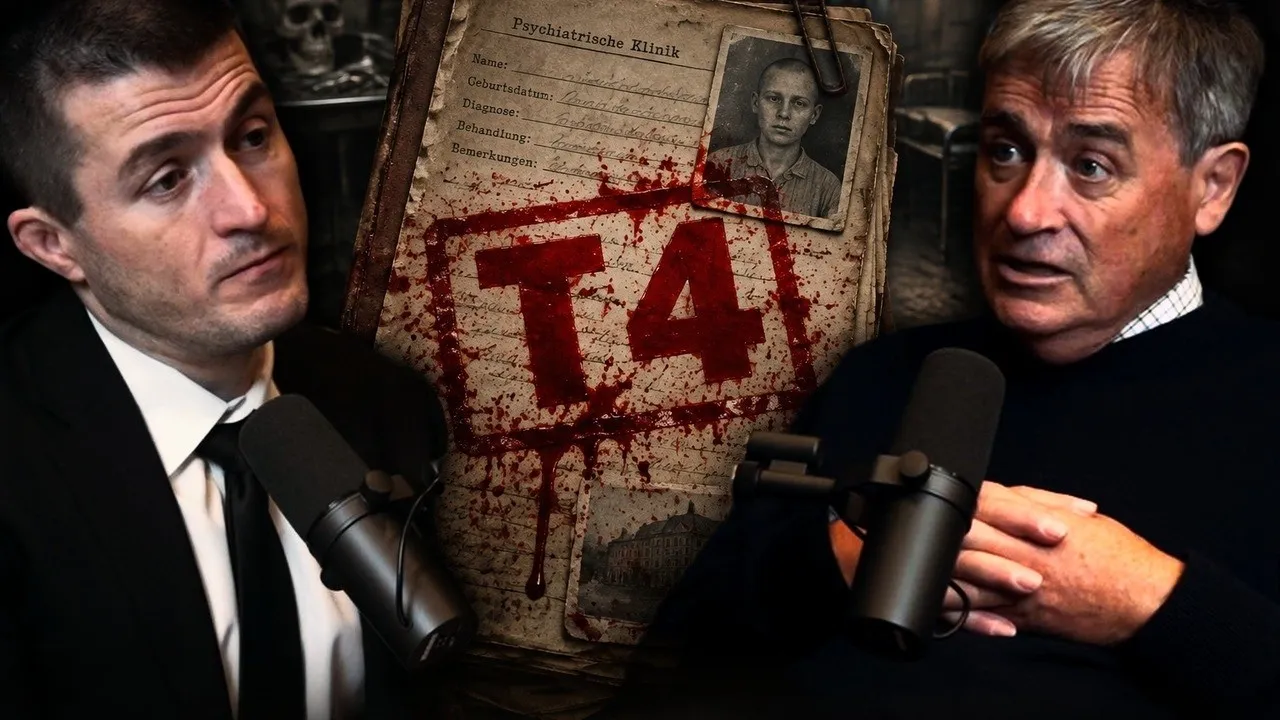
Scull’s central claim is that Nazi Germany took those ideas further because the restraints were gone. Under Hitler, mentally ill and disabled people became “useless eaters,” lives deemed not worth living. The T4 program, named for the Berlin address Tiergartenstraße 4, organized their killing. Scull says as many as a quarter million people may have been murdered.
the mentally ill were the first people to suffer from the final solution.
That line needs careful handling. Historians usually reserve “the Final Solution” for the Nazi plan to exterminate Europe’s Jews. T4 was not identical to that genocide. But Scull’s underlying point is solid and chilling: the personnel, methods, and moral permissions of mass killing were tested on psychiatric patients and disabled people before they were scaled elsewhere in Nazi Germany.
It was in the mass killing of the mentally ill, which may have been as many as a quarter million people, that the technology of the gas chamber was developed and the technology of dis of disguising the gas chamber as showers was developed.
This is the part that makes the episode more than a history lesson about old asylums with bad lighting. Scull is tracing how a clinical category can become a disposal category. The patient becomes incurable. The incurable becomes defective. The defective becomes hereditary pollution. The hereditary pollution becomes expensive. Then the state discovers a solution that looks, to itself, clean.
The Rockefeller detail is ugly, but not simple
Fridman pushes on another combustible point: American financial support for German psychiatric researchers with Nazi ties, especially Ernst Rüdin, a key figure in psychiatric genetics and sterilization policy. Scull says the Rockefeller Foundation funded psychiatric research partly because, before World War II, the federal government was not yet the giant engine of medical science. Rockefeller money went everywhere because the foundation did not know which scientific path would work.
it supported work in genetics and one of the geneticists it supported Ernest Ruden in Germany who was the leading German researcher in genetics and mental disorder
The verdict: Scull’s big claim holds, but the temptation is to make the chain too clean. California sterilization laws influenced German eugenicists. Rockefeller supported psychiatric genetics that included dangerous people. Nazi doctors built murder programs out of medicalized contempt. Still, the gas chamber was not invented by a grant application in Manhattan. The guilty actors were the ones who turned diagnosis into death.
If Scull’s warning has a modern bite, it is not that today’s psychiatry is secretly T4. That would be cheap and stupid. The bite is smaller and harder to shake: when institutions fail the people they claim to treat, they often reach first for a new story about why those people were never fully treatable in the first place.
- What does Andrew Scull say the asylum system had to do with Nazi killing programs?
- Scull argues that failed asylum promises created a brutal new story about mental patients. When doctors could not cure the numbers they had claimed they could cure, some recast chronic patients as biologically defective and socially dangerous. That shift helped justify confinement, sterilization, and eventually, in Nazi Germany, murder.
- Was the United States part of the eugenics chain Scull describes?
- Yes. Scull points to American sterilization laws, especially California’s, as part of the model later admired abroad. He also says the Rockefeller Foundation supported psychiatric genetics research in Germany, including work connected to Ernst Rüdin, though that is not the same thing as saying Rockefeller funded Nazi killing.
- Is Scull’s claim exaggerated?
- The basic claim is strong: the Nazi T4 program did precede the industrialized killing methods later used in death camps, including gas chambers disguised as showers. The possible overreach is rhetorical. “The mentally ill were the first people to suffer from the final solution” compresses separate Nazi murder programs into one line, but the historical warning he is making is real.

Don Lincoln says Maxwell's equations turned magnets and sparks into the internet
On the Lex Fridman Podcast, the Fermilab physicist makes the case that the weirdest, least practical physics is often the stuff that later rewires civilization.

Khabib Nurmagomedov says his father prepared him for Conor McGregor by making him lose judo matches at 15
On Lex Fridman’s podcast, Khabib turns his invincibility myth into something more annoying and more useful: repetition, discomfort, and losing early where nobody was watching.

DHH says Omarchy's Linux install world record is 45 seconds
David Heinemeier Hansson turns a Linux distro install time into a philosophy of overbuilt software, Elon Musk ambition, and mildly deranged stopwatch joy.

DHH says Omarchy's growth went vertical when it made Linux agent-first
The Rails creator argues that the Linux crowd’s hostility to AI is exactly why Omarchy can break out.
The circuit, read weekly. No noise.