Benjamin Hardy Says You're Measuring Yourself Wrong, and He Has the Viktor Frankl Story to Prove It
The organizational psychologist behind 'The Gap and the Gain' explains why hitting your goals might make you feel worse, and what Mr. Beast figured out at 17 that most adults never do.
Listen on YouTube · Spotify · Apple Podcasts
 WATCH NOW↓
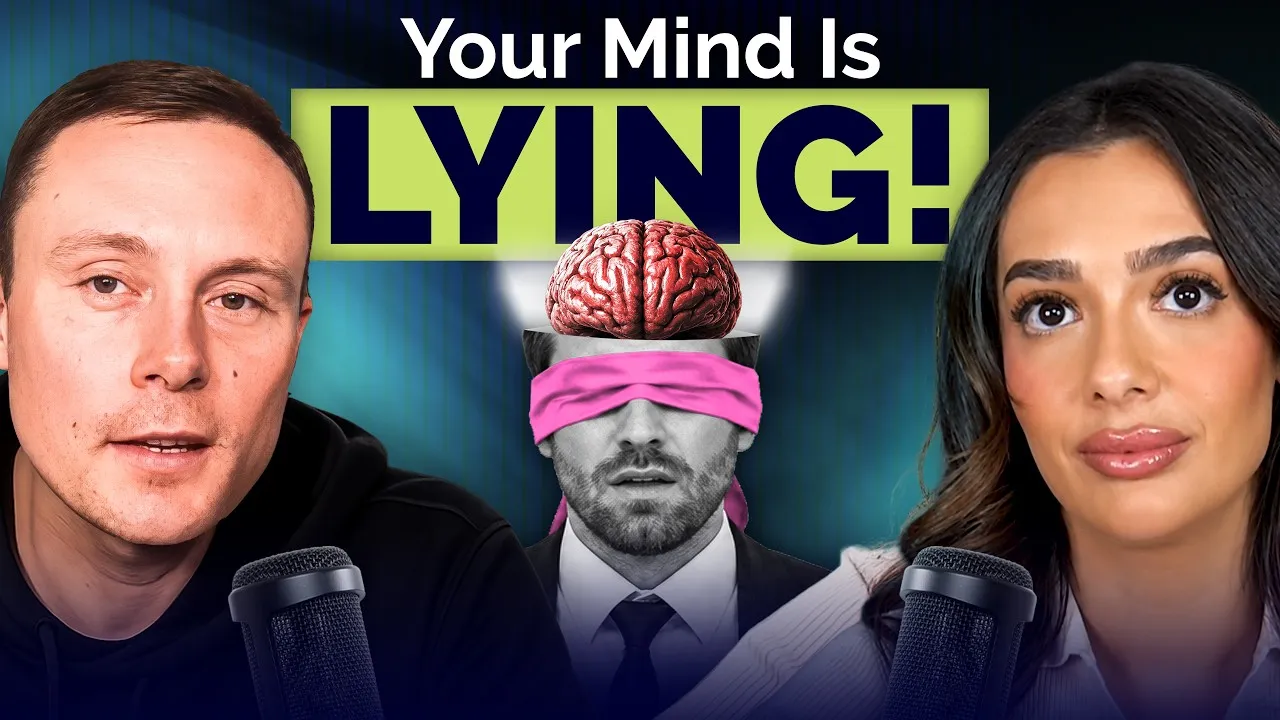
 Benjamin Hardy released his first book, landed a six-figure deal, achieved the thing he had dreamed about since 2010, and then spent four or five months in a deep depression because it did not hit the New York Times bestseller list. His publisher was thrilled. He felt like a loser. This is the central irony Hardy has built an entire framework around, and it is a more honest self-diagnosis than you usually get from someone selling books about success.
The framework is called the gap and the gain, borrowed from strategic coach Dan Sullivan, and the premise is simple enough to fit on a sticky note: you can measure your progress forward against your ideals, which always move, or backward against where you used to be, which is fixed and real. The gap is the distance between where you are and some imagined version of perfection. The gain is everything you have already covered. High achievers, Hardy argues, are structurally predisposed to live in the gap. The bigger your ambitions, the further the horizon floats away, and the more every genuine win gets quietly devalued before you even finish celebrating it.
When you’re in the gap, you’re measuring yourself against your ideals, which are always changing, always moving.
The part Hardy does not let himself off the hook for is instructive: he admits he would have gone into the gap even if the book had hit the list. The target would have moved to number of weeks on the list, then to number one, then to something else. This is not a problem you solve by succeeding harder. It is a measurement problem.
The Mr. Beast Exception
Hardy tells the MrBeast story with the enthusiasm of someone who found a perfect data point. In October 2015, a 17-year-old Jimmy Donaldson sat in his room, filmed four short videos addressed to his future self at six months, one year, five years, and ten years out, scheduled them to auto-publish on their corresponding dates, and then essentially forgot about them. When the five-year video went live in October 2020, Donaldson had 45 million subscribers, had completely forgotten the video existed, and had long since blown past the million-subscriber dream he had nervously floated into a bad camera in 2015. Hardy’s point is not that journaling about your future self is magic. It’s that getting specific about who you want to become changes what you actually do the next day, and the day after that. The videos were evidence that Donaldson committed to an identity and then grew into it, rather than drifting.
So many people are afraid to admit what they want.
Hardy connects this to a concept from psychology research Hardy credits to Harvard psychologist Daniel Gilbert: most people, especially past 30, assume their future self will be basically the same person they are today. They stop imagining it. They stop writing it down. And then they wonder why their choices feel random. Hardy’s remedy is almost aggressively practical. Pick an anchor moment, a specific date with real stakes attached. For him it’s 2030, when the oldest of his three adopted kids turns 18 and likely leaves home. That concrete event gives the future self weight, makes it someone you can actually think about disappointing.
Frankl in the Background
Hardy ends the conversation with Viktor Frankl, and it lands because he earns it. He does not drop Frankl as a name-check. He works through what Frankl actually observed in the camps: that when prisoners lost hope toward their future, they died within days. Physically. The body gave out. Hardy frames hope not as a sentiment but as a structural requirement, the thing that makes the present bearable when the present is terrible. Frankl survived partly by committing to a specific goal: reconnect with his wife, rewrite the manuscript the Nazis had destroyed.
My deep desire to rewrite that book anew and publish it allowed me to overcome the rigors and the pain of the camps.
It is a heavy place to anchor a self-help conversation, and Hardy knows it. But the logic is consistent all the way down: whether you are a 17-year-old with a bad camera and 8,000 YouTube subscribers, a psychologist who just missed a bestseller list, or a man in a concentration camp, the mechanism is the same. A specific future self gives you a reason to act well right now. Without one, as Hardy puts it, you are rudderless. Not tragic. Just drifting.
Benjamin Hardy says 10X growth requires cutting 80 percent of your life
The productivity guru’s sharpest claim is not to grind harder, but to delete most of the life that made you successful so far.

Mustafa Suleyman says AI agents will run an entire online business before 2030
The Microsoft AI CEO is bullish on agentic AI, but his most futuristic prediction also sounds a lot like the sales brochure for Copilot.
Gary Vaynerchuk says entrepreneurs who ignore their partners may not actually value the relationship
GaryVee’s productivity gospel gets its sharpest domestic translation: if you really wanted to see them, you would.

Tara LaFerrara Built a Million-Dollar Fitness Business by Refusing to Be Perfect
The Broads founder on coaching funnels, a $130,000 app failure, and why 'do the cringe thing' is actually a business strategy.
The circuit, read weekly. No noise.