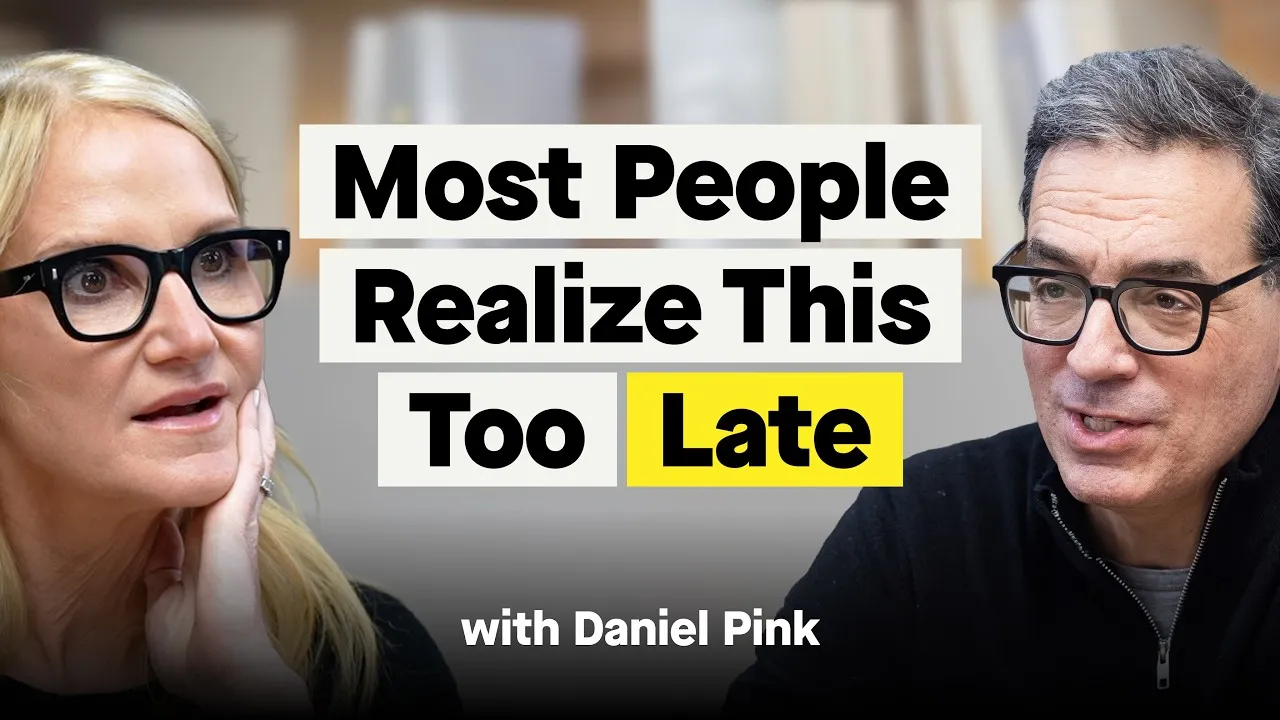
Daniel Pink Has 26,000 Regrets to Show You, and That's the Good News
The author of 'The Power of Regret' joins Mel Robbins to make the case that the emotion you've been running from is actually the most useful one you have.
Listen on YouTube · Spotify · Apple Podcasts
 WATCH NOW↓
 Here is a sentence that sounds like a fortune cookie but is actually backed by sixty years of social psychology: regret is good for you. Not the wallowing kind. Not the kind where you replay the scene on a loop for two decades. The other kind. The kind where you open the door when it knocks, see what’s there, and do something with it. Daniel Pink spent years collecting 26,000 regrets from 134 countries to prove this point, and his findings landed him on the Mel Robbins Podcast to walk through what he found. The short version: everybody has regrets, nobody taught us what to do with them, and the people who claim otherwise are, in Pink’s precise scientific framing, sociopaths.
The only people who don’t have regrets are little kids because their brains haven’t developed the cognitive capacity to do it, people with certain kinds of neurodegenerative disorders, and sociopaths.
The taxonomy Pink built from his World Regret Survey sorts human regret into four buckets: foundation regrets (I should have saved money, exercised, studied), boldness regrets (I should have asked her out, started the business, moved), moral regrets (I did a bad thing and I know it), and connection regrets (I should have called). That last category is the biggest one. Not the most dramatic. The most common. The story is almost never a blowout fight. It’s a drift. A friend you just… stopped texting. A parent you were going to call after the holidays. Someone who died the morning you finally worked up the nerve.
You’re Not That Special (and That’s a Relief)
Pink’s bluntest, most useful insight isn’t the four-category framework. It’s the demographic finding underneath it. You cannot tell, from a regret alone, whether it came from Milwaukee or Copenhagen or Taipei. You cannot tell if the person is a man or a woman. The universality is the whole point, and Pink uses it like a scalpel to cut through the self-flagellation that keeps people stuck. The reason you won’t reach out to the friend you drifted from isn’t that the situation is genuinely awkward. It’s that you’ve convinced yourself you’re uniquely weird for wanting to. You’re not. Pink puts it with a kind of cheerful brutality: some people have what amounts to reverse narcissism, feeling singularly terrible in the same way narcissists feel singularly great. The cure is the same in both cases. Come down from the mountaintop.
You’re not that special. Like it’s part of the human experience. You’re a human being and it’s not like you’re the narcissists believe they’re singularly excellent, but some of these people are almost reverse narcissists feeling like they’re singularly bad.
The connection regret section earns its runtime because Robbins doesn’t just nod along. She’s in it. A college friendship she torched through gossip and mental health chaos, thirty-plus years unaddressed. A best friend from the Midwest she simply lost to geography until they bumped into each other in their mid-forties and now share hotel rooms at work conferences. Pink’s practical instruction on this is almost annoyingly simple: when in doubt, reach out. Text someone you’re thinking of right now. The awkwardness you’re dreading is, in his phrase, ‘the most papery of paper tigers.’ You go right through it.
Inward, Outward, Forward
The three-stage framework Pink offers for actually processing a regret is where the episode stops being an interesting conversation and becomes something you might actually use. Inward: stop the lacerating self-talk. If you’d never say it to a friend, stop saying it to yourself. Pink notes, not gently, that if your internal monologue were broadcast aloud in an office, HR would intervene. Outward: write about it. Fifteen minutes a day for three days, research from the University of Texas suggests, materially reduces its menace. The blobby phantom becomes concrete words, and concrete words are something you can actually examine. Forward: draw the lesson. Refer to yourself in the third person, literally use your own name, and ask what this is teaching you and what you should do next. It sounds like the kind of advice a therapist gives in session two. It also happens to be supported by data from negotiation research, cognitive science, and six decades of psychology.
Regret is part of the human experience. It’s a signal. It’s a knock at the door. Answer the door. See what it has to tell you. And in a systematic way, approach it, draw a lesson from it, and you’re going to be better off.
There’s a moment late in the episode where Pink delivers what he calls the single most important takeaway with enough confidence that Robbins jokes he should drop the mic. He doesn’t overcomplicate it. ‘Regret makes us human, and regret makes us better.’ The research says the same thing the suitcase metaphor says. Open it. It’s less menacing than you think, and there’s something inside worth having.
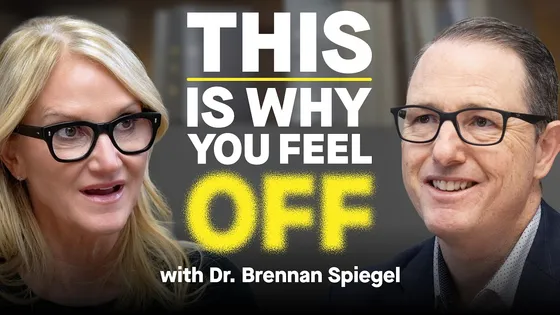
Dr. Brennan Spiegel says a thumb that touches your forearm may help explain IBS
The Cedars-Sinai gastroenterologist gives Mel Robbins a sticky new theory of gut trouble, posture, balance, grip strength, and the indignity of being a human sack of potatoes on Earth.
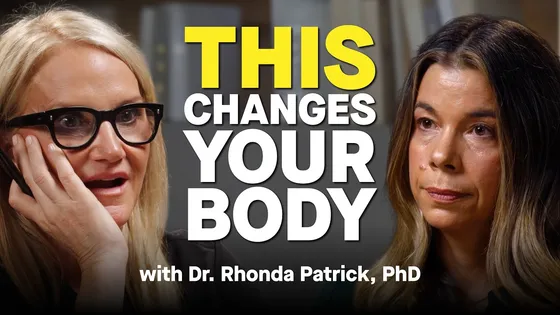
Rhonda Patrick says 1 minute of breathless exercise beats 53 minutes of walking around your house
The researcher behind the FoundMyFitness newsletter just made your gym membership guilt optional and your stair climb mandatory.

Dr. Lara Boyd says your brain changes most when you succeed only 50 to 60 percent of the time
The neuroscientist turns the usual self-help command to “do hard things” into something more precise, and more annoying, your brain likes the zone where you’re barely making it.
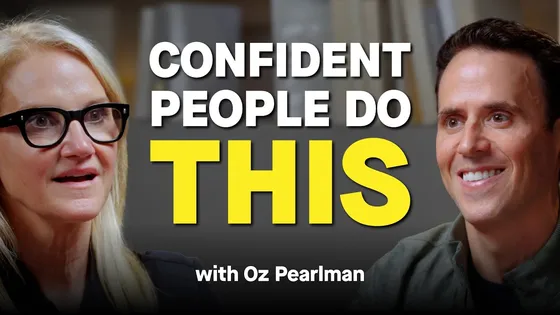
Oz Pearlman says you should approach people at an angle because head-on feels like danger
The mentalist turns a restaurant-magician survival tactic into a surprisingly practical rule for the first 10 seconds of any conversation.
The circuit, read weekly. No noise.