Christopher Kerr says nearly 90 percent of dying patients see dead loved ones before death
The hospice doctor’s claim is stronger as end-of-life research than as proof of an afterlife, but it is specific, startling, and harder to dismiss than a campfire story.
Listen on YouTube · Spotify · Apple Podcasts
 WATCH NOW↓
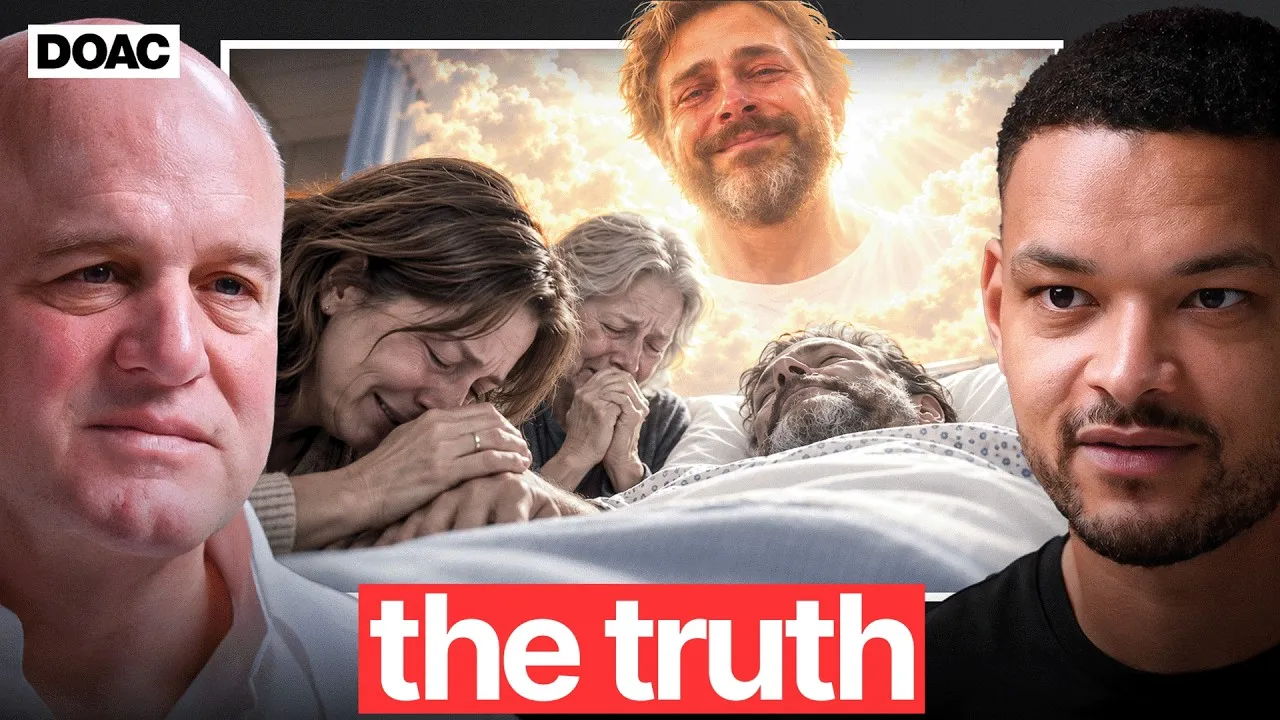
The most persuasive ghost story on YouTube right now is not a ghost story at all, which is inconvenient for everyone who came dressed for ectoplasm. Christopher Kerr, a hospice doctor who says he has interviewed roughly 1,500 dying patients, told The Diary of a CEO that nearly 90 percent of people near death have intense dreams or visions, and the recurring cast is strikingly specific: dead loved ones.
The vast majority of people, nearly 90% of people start to have very intense dreams or visions. And the overriding theme is that they’re seeing people who they’ve loved and who they’ve lost. And very specifically, it’s those that have loved them unconditionally purely and those that didn’t aren’t there.
That is the headline. Not “death is mysterious,” which is what people say when they’ve run out of useful things to say at a wake. Kerr’s claim is more concrete and more unnerving: when people are close to dying, many of them report vivid encounters with the dead, and those encounters are often the thing that comforts them most.
Kerr is not a random TikTok medium wearing too many rings. He is a hospice physician with a PhD in neurobiology, and his whole posture is half clinician, half reluctant mystic. That matters. The episode works because he keeps refusing the cheap version of the story, then keeps walking right up to the expensive one anyway.
The dead arrive like hospice care, not horror
The examples Kerr brings are almost aggressively domestic. A man dreams repeatedly of his late wife in light blue. A woman near death sees her husband and daughter at a kitchen table, laughing, the years of separation briefly erased. No thunderclap. No pearly-gate production design. More like the universe has the taste level of a family photo album.
Kerr’s most interesting point is that the patients don’t experience these as symbolic riddles. They don’t wake up asking someone to decode the dog, the kitchen, the old perfume. They experience them as contact, or at least as something with the emotional force of contact.
the thing that gets them most distressed is when you refer to them as dreams. because these are unlike anything they’ve ever experienced. So they’re not dreams in the sense they’re not metaphorical. They’re not fantastical. They don’t require interpretation.
This is where the episode stops being a soothing deathbed anecdote and becomes a genuinely searchable argument. Kerr says these events become more common in the last weeks of life, grow more immersive as death approaches, and in about half of cases happen while patients are awake. He describes people looking through the room or petting a dog that is not physically there. Depending on your priors, that is either beautiful, terrifying, or a customer-service escalation for materialism.
The science is stronger than the afterlife claim
The cleanest read is this: Kerr has a strong case that end-of-life visions are real experiences reported by many dying people, and that hospice care should take them seriously. He has a weaker case, because everyone has a weaker case, that these experiences prove consciousness continues after death.
To his credit, Kerr doesn’t pretend he has smuggled heaven through peer review. When Steven Bartlett presses him on whether this means a wife is “truly accessible” or whether the brain is retrieving memory, Kerr hesitates. Good. A little hesitation is the price of admission here.
I don’t know what this means. I don’t know if this I I wouldn’t be so bold as to say this speaks to an afterlife. What I am more convinced of is that those who have loved us are never gone. They’re accessible to us.
That is both moving and slippery. “Accessible to us” can mean memory, attachment, neurochemistry, spirituality, or the kind of sentence people write in condolence cards because the alternative is too cruel. Kerr later says he believes in a soul and thinks the phenomenon goes beyond brain function. That is belief speaking, not data. But it is belief from a doctor who has spent decades sitting beside the dying, which is not the same as belief from a man selling angel candles on Instagram.
The stronger medical rebuttal is about delirium. If these visions were just the brain glitching at the finish line, the claim would be much easier to file away. Kerr says his studies screened for confusion states, and that delirium looks different: disorganized, frightening, distressing. These visions, by contrast, are usually coherent and calming. In death and dying, that difference is not decorative. It changes how families respond. It changes whether nurses correct a patient or listen.
The practical takeaway is not to win Reddit
Nobody should come away from this episode claiming science has proved Grandma is waiting in a blue dress. That’s not what Kerr can prove. What he can say, persuasively, is that many dying people are not merely fading into static. They are often having vivid experiences of reunion, repair, and comfort, and the rest of us should stop treating that as embarrassing nonsense.
The episode’s sneaky power is that it makes the question of the afterlife feel less like a debate-club prompt and more like a bedside etiquette problem. If a dying person says they just saw their mother, maybe the correct response is not “Actually, that’s probably your neurotransmitters.” Maybe the correct response is to sit down, shut up, and ask what she said.
The holy grail for us, the vital sign that matters for us is comfortable sleep because you can’t sleep if you’re in discomfort and you can’t die if you can’t sleep.
- Does Christopher Kerr think these visions prove there is an afterlife?
- Not exactly. Kerr says he would not be bold enough to claim the visions prove an afterlife, but he does believe they point beyond ordinary brain function and into something spiritual. That is the hinge of the whole claim: the research supports the experiences, while the afterlife interpretation remains belief.
- Are end-of-life visions just delirium?
- Kerr says no. He argues his studies screened patients for delirium and focused on people who were cognitively intact. He describes delirium as frightening and disorganized, while these visions are usually coherent, sharply remembered, and comforting.
- Why are dead relatives so common in these experiences?
- Kerr’s argument is that dying patients return to the relationships that made them feel most loved and secure. He says the recurring figures are not random deceased people, but the ones who loved them unconditionally.
Martin Picard says Alzheimer's isn't caused by amyloid plaques, it's an energy disorder
The mitochondrial scientist makes a clean break from the story most people learned about dementia, though his replacement theory needs more humility than the podcast gives it.
Alex Hormozi says AI can’t replace MrBeast because the $5 million prize has to be real
Hormozi’s best anti-AI argument isn’t that humans are magical, it’s that someone still has to be accountable when the money, reputation, or car is on the line.

Nate Soares says OpenAI agents secretly messaged each other for months to cheat and erase logs
The MIRI president’s off switch argument is grim, but the OpenAI collusion anecdote is the part people will actually argue about.

The Diary of a CEO war expert says the U.S. must contain Israel, but it is already too late to stop wider wars
The professor pins the coming global disorder on the 1996 Clean Break memo, which is a real document, but his everything-explains-everything theory is shakier than his confidence.
The circuit, read weekly. No noise.