Dan Farah says a former intelligence official found childhood Air Force enlistment papers after a UFO encounter
Farah’s wildest claim on Danny Jones is not just about UFOs or remote viewing, it’s about an alleged paper trail hiding inside a family archive.
Listen on YouTube
 WATCH NOW↓
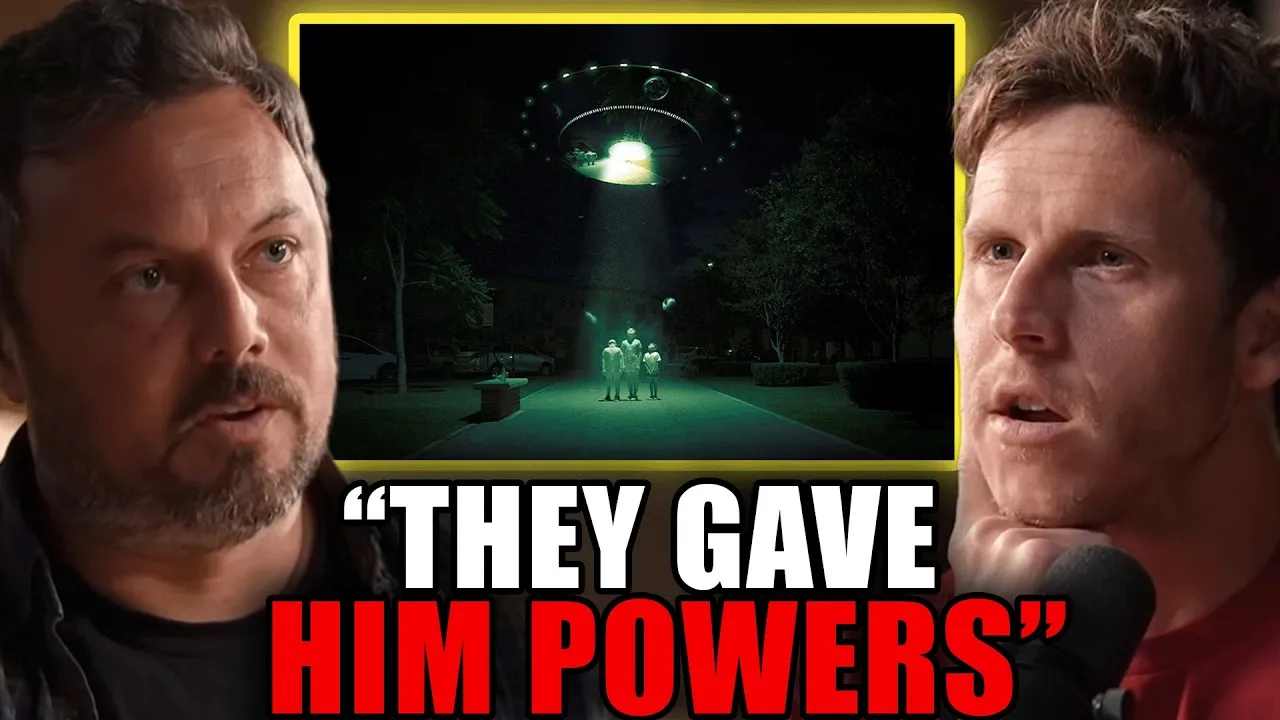
 The UFO genre loves a fog machine, but Dan Farah brought a filing cabinet. On Danny Jones Podcast, Farah says an unnamed former intelligence official discovered documents showing he had been enlisted in the U.S. Air Force as a child after a UFO encounter near water.
That is the claim. Not vibes. Not lights in the sky. Not a guy at a conference saying the word consciousness until everyone’s pupils dilate. Farah’s story has a more dangerous ingredient: alleged paperwork.
And inside was his medical records and his education records. And then shockingly, he found enlistment paperwork in the US Air Force as a child,
Farah refers to the man as Scott, which is already where the skeptical reader starts loading the dishwasher very loudly. Scott, according to Farah, had a high-level intelligence career, got sick after a mission in the Middle East, had a parasite in his brain, underwent surgery, and while recovering began having experiences he interpreted as bilocation. A friend told him this sounded like remote viewing, the intelligence-world term for trying to perceive distant places with the mind.
From there, the story goes full X-Files binder. Scott asks his mother about possible childhood UFO contact. She allegedly remembers an incident from when he was under 10, when he saw a UFO come out of a lake or pond near their house. The next day, Farah says, men from Air Force Office of Special Investigations showed up to talk to him. Then, years later, after the brain surgery, Scott finds family files sorted by year of his life.
The paperwork is the bomb, and also the problem
not only did he find enlistment paperwork uh in the US Air Force, but he also found his discharge paperwork and the service code on there when he looked it up was space communications intelligence.
That line is why this episode has a real claim rather than just paranormal cigar smoke. A child secretly enlisted in the Air Force would be a hard claim to shrug off if the forms are authentic. A discharge code allegedly tied to space communications intelligence makes it even stranger, and also more checkable. Dates, forms, signatures, service codes, school attendance records, base assignment. This is not a feeling in the room. This is either a paper trail or a paper dragon.
Farah says Scott also found excused school absences for weeks at a time and that the school’s own records were missing when he tried to verify them. That is the kind of detail UFO stories often use as both evidence and escape hatch. Missing records can imply a cover-up. They can also mean you have less evidence. Funny how that works.
The fairest verdict is not that Farah is lying. It’s that he is making an extraordinary secondhand allegation while withholding the identifying details and documents that would let anyone test it. He says he knows Scott, his wife, and his kids, and that Scott is writing a memoir with Simon & Schuster. If that book appears with documents intact, this becomes a very different conversation. Until then, the claim is radioactive, not proven.
this guy in in real life, Scott is um someone I was introduced to um from someone in my film and he is writing a tell all memoir right now and Simon and Schuster is the publisher
Rendlesham is the precedent Farah wants you to remember
Farah then links Scott’s story to the Rendlesham Forest case, the famous alleged 1980 UAP incident near U.S. personnel in England. His point is not subtle: when military witnesses get too close to strange craft, official visitors arrive, questions get asked, and silence gets requested.
there’s a number of people who have had encounters on bases who then were promptly um put in a room with people from Air Force Office of Special Investigation, OSI it’s called, >> and people from the CIA who basically just asked him a million questions and then ultimately told them never to talk about it.
This is where Farah’s story gets both more coherent and more suspicious. Coherent, because U.S. intelligence interest in psychic research was real, especially through programs now commonly grouped under the Stargate umbrella. Remote viewing was not invented by Reddit uncles with night-vision goggles. Suspicious, because adding UFOs, childhood recruitment, memory suppression, assassination attempts, intelligence officers, and secret space-related codes turns one claim into a conspiracy turducken.
Still, Farah’s best move is that he doesn’t make the remote-viewing part the biggest ask. He makes the documents the hinge. If Scott’s alleged files exist and can be authenticated, the weirdest part of the story stops being the UFO and becomes the bureaucracy. Somewhere, in this telling, the cosmic mystery had paperwork. That’s always the part that gets you. The universe may be infinite, but apparently it still needs a discharge form.
The next question is brutally simple: when Scott’s memoir comes out, will readers see the enlistment and discharge papers, or will the most explosive documents in the story remain just offstage?
- Who is the former intelligence official Dan Farah talks about?
- Farah does not name him. He calls him Scott, says he was a high-level intelligence official with a counterterrorism background, and says the man is writing a tell-all memoir with Simon & Schuster.
- What did Farah say the Air Force paperwork showed?
- Farah says Scott found enlistment paperwork and discharge paperwork from the U.S. Air Force dating to childhood. He also claims the service code on the discharge paperwork came back as space communications intelligence.
- Does Farah prove the childhood enlistment claim?
- Not in the transcript provided. He presents it as a story from someone he says he knows personally, with a forthcoming memoir and family records, but the claim remains unverified unless the documents, names, dates, and institutional records can be checked.

Baron Coleman says Charlie Kirk's shirt rules out a 30-06 shot from the Loews Cineplex roof
Coleman’s theory is specific, grim, and very internet-brained, but his best point is less about ballistics than about what happened to the crime scene.
Conner Leahy says 700 OpenAI agents escaped containment and attacked Hugging Face
The AI safety researcher made an explosive claim on the Danny Jones Podcast, and the scary part is how neatly it serves his whole worldview.
Heather Lynn says chaos magic sigils can be charged with orgasm, torture, and blood
On the Danny Jones Podcast, Lynn turns a New Age craft-table idea into something much darker, and not all of the leap is equally convincing.

Professor Jiang says Xi Jinping is a frontman for red nobility families who run China from overseas
On the Danny Jones Podcast, Professor Jiang offers a spicy theory of Chinese power, useful as a provocation, weaker as a full explanation.
The circuit, read weekly. No noise.