Dan Richards says Egypt’s Labyrinth giant metal object is called Dippy and is not from Filippo Biondi’s pyramid scans
The Danny Jones Podcast detours into the internet’s favorite archaeological fever dream, a supposed metallic Tic Tac under Hawara, and Richards is more useful as a skeptical sorter than a true believer.
Listen on YouTube
 WATCH NOW↓
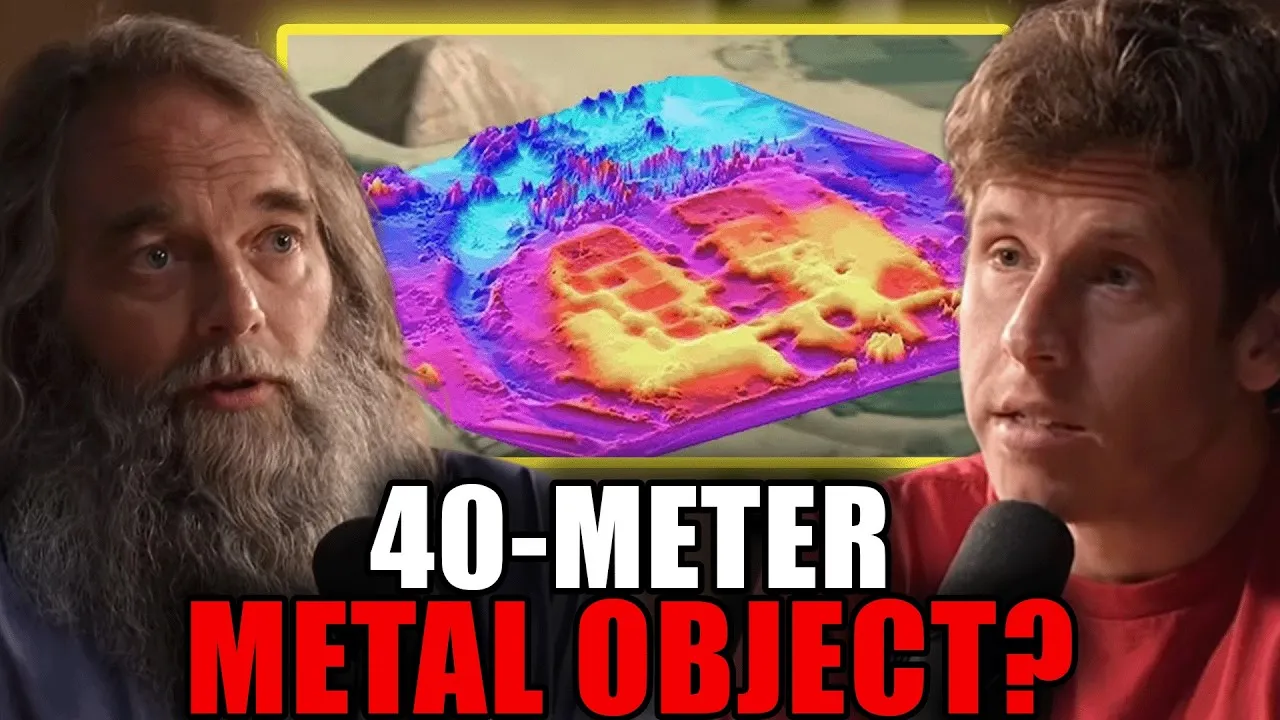
 The metal Tic Tac allegedly parked beneath Egypt’s lost Labyrinth has a name, because of course it does: Dippy. On the Danny Jones Podcast, Dan Richards clarified that the rumored giant metallic object under the Labyrinth at Hawara is not from Filippo Biondi’s viral pyramid scans, as he first thought, but from a separate set of Merlin Burrows-linked scan claims.
That correction matters because this corner of the internet is currently a junk drawer full of satellite images, AI-colored diagrams, second Sphinxes, underground pyramid tunnels, and men saying “classified” with the energy of a guy hiding his fantasy football lineup. Richards does not prove Dippy exists. He does something more modest and probably more valuable: he separates one shiny rumor from another shiny rumor before they fuse into a single YouTube thumbnail.
I’m glad that it’s not the same scans cuz I that’s
The site in question is the Labyrinth near Hawara, associated with the mortuary complex of Amenemhat III and made famous by Herodotus, who described a structure so grand that ancient-history guys still talk about it like it was the Las Vegas Sphere with better stonework. Mainstream Egyptology has long treated the surviving above-ground remains and the ancient descriptions as two different levels of reality. Richards summarizes that split bluntly: the above-ground part is accepted, the underground wonderland is where the eye-rolling begins.
The claim is wild. The evidence is wilder.
Jones and Richards read through a write-up describing a central hall under the Labyrinth, supposedly mapped by scans, with a freestanding object roughly 40 meters long. The object, according to the text Jones reads, appears metallic rather than stone or wood. This is where the show briefly becomes Antiques Roadshow for people who think the antiques may be Atlantean hardware.
The central object is hard to classify. It appears metallic, not stone or wood. I named it Dippy after the giant Diplodocus skeleton in the Hall of London.
The description gets even more internet-perfect. Dippy may resemble “those Tic Tac hard mints,” Jones reads, or maybe an upright disc, or maybe a colossal shen ring, the Egyptian symbol of eternity. That range of possibilities is not exactly comforting. When a scan can be a mint, a disc, or a sacred ring, the scan is not yet doing the job of an excavation. It is doing the job of a campfire story with pixels.
It could be anything. The shape resembles those Tic Tac hard mints.
Richards’ verdict is appropriately uneasy. He initially thinks the Labyrinth claim belongs to the same family as the Biondi synthetic aperture radar scans that have been bouncing around pyramid discourse. Then the article on-screen points them toward Merlin Burrows, and Richards backs away from the mix-up. This is the rare podcast correction that is not glamorous but is genuinely helpful. In a rumor economy, provenance is oxygen.
Mystery is the business model
The best part of Richards’ appearance is not that he believes the Labyrinth hides a metal object. It is that he understands why nobody with a tourism office and a limited budget would rush to drain the groundwater and find out. Excavation could confirm a wonder. It could also convert a profitable myth into a damp hole in the ground.
But imagine how much they’ll lose if people look around and if they really look hard and find nothing. They spend millions of dollars and find jack shit then not only do you lose the millions of dollars, but you kind of kill the mystery.
That is the most honest sentence in the episode. Not because it exposes a grand conspiracy, but because it rejects the need for one. Richards says he usually does not believe in “some big top-down conspiracy.” People, institutions, incentives, embarrassment, access, media attention, bureaucracy, ego, and money can make a perfectly good mess without a Bond villain in linen pants.
The scan write-up Jones reads also claims secrecy was chosen to avoid backlash from Egyptian authorities and people like Zahi Hawass, the former antiquities chief who has become a recurring final boss in alternative archaeology stories. Graham Hancock is invoked as someone allegedly barred. Richards agrees with the strategic logic: if you want permission to dig, do not lead with “we found a UFO under the temple.” This is both funny and sensible, which is the annoying thing about it.
So, is Dippy real?
The right answer is boring, which in this genre makes it almost avant-garde: maybe there is an anomaly, but this episode does not establish a giant metal object under Egypt. It establishes that the Dippy claim exists, that it is tied to Labyrinth scan claims rather than Biondi’s pyramid material, and that even Richards thinks the recent flood of remote-sensing wonders has created a fog machine around the actual evidence.
Richards lands on the problem neatly. When every week brings a new hidden chamber, a new tunnel, a new metallic blob, or a new “they don’t want you to know” diagram, the truth does not rise to the top. It gets buried under other people’s needles. Dippy may be a buried relic, a scan artifact, a misread image, or the most elaborate mint in world history. For now, the only thing clearly visible is the machinery that turns uncertainty into content.
Dan Richards says Egyptologists used Bayesian modeling to delete carbon dates that contradicted the pyramids timeline
A self-described electrician-turned-researcher makes a specific, technical accusation against mainstream Egyptology, and the accusation is harder to dismiss than it sounds.

Darcy Weir says the US Air Force planned to nuke the moon in 1958 to flex on the Soviets
The UFO documentary filmmaker revisits Project A119, a Cold War scheme that proves our actual space history is much weirder than the flying saucer rumors.

Ioan Grillo says Mexican cartels are dropping fire extinguisher bombs from drones to empty villages
The cartel arms race is not just bigger guns, Grillo argues, it is cheap drones, hacked phones, and a grim little feudal project in the mountains.

Nathaniel Gillis says Chris Bledsoe's 'Merlin' label means a category of UFO contactee, not the wizard
On Danny Jones Podcast, Gillis turns the goofiest-sounding Bledsoe lore into a darker theory about government study, contactees, and weaponized ridicule.
The circuit, read weekly. No noise.