Daniel Lubetzky says he gives more than $25 million a year to charity but still won’t waste yogurt
The Kind founder’s most revealing flex on Young and Profiting wasn’t the multibillion-dollar exit, it was the penny-pinching moral code behind it.
Listen on YouTube · Spotify · Apple Podcasts
 WATCH NOW↓
Daniel Lubetzky says he gives more than $25 million a year to charity, which is a very rich-person sentence. The twist, and the reason it’s actually interesting, is that the Kind founder says he still gets upset when someone wastes “that last piece of cheese or cottage cheese or yogurt.”
That is either charming, exhausting, or exactly how you build a snack-bar empire without lighting venture cash on fire. Probably all three.
On Young and Profiting, Daniel Lubetzky kept returning to the same idea, money is not a personality, it’s a tool. Spend it where it multiplies. Refuse to waste it where it only flatters you. This is not how entrepreneurs usually talk once they have a multibillion-dollar exit and a Shark Tank chair. The usual script is airport-book mogul zen: dream bigger, hire smarter, meditate near a tasteful water feature. Lubetzky’s version is more immigrant-grandfather proverb meets grocery-aisle trench warfare.
Like I give more than $25 million a year in charity. And by the way I think this is the first time I share that. So now you have news.
He was right. That is news, at least by podcast standards, where “vulnerability” often means admitting you check email too much. This is a concrete number. It is also self-reported, so treat it as a claim, not a tax document. But the more revealing part is what he did next. He immediately made the case that big giving does not excuse little waste.
The penny and the $25 million check
Lubetzky traces the whole thing back to his grandfather, a cattleman on his mother’s side, who apparently had the kind of proverb that should be printed on every startup’s free kombucha tap before the tap is removed for budget reasons.
a man that’s too arrogant to bend over to pick up a penny is not worth a penny.
That line could turn corny fast, except Lubetzky has the receipts, or at least the scars. Before Kind, he spent roughly a decade grinding through PeaceWorks, a business built around Israeli, Palestinian, Jordanian, Egyptian, and Turkish trade. He had a Stanford Law degree and was selling sun-dried tomato spreads door to door in Manhattan on a $24,000 salary. This is the part of the founder myth where the violin usually comes in. Lubetzky is more useful than that. He says the mission kept him going, but it did not make the product good enough, the name clear enough, or the distribution smart enough.
The funniest and most painful example is his bodega story. He badgered a shopkeeper, Mr. Kim, into ordering $36 of specialty spread that did not belong in the store. Nothing sold. The jars gathered dust. Lubetzky walked away with what every first-time founder eventually learns, after confusing motion with progress for far too long.
The first sale is interesting the the easiest sale. It’s the second sale and the third sale that matters because the product needs to get off the shelves so that they reorder.
Frugal almost cost Kind its best growth engine
The best part of Lubetzky’s money philosophy is that he does not pretend thrift is always wisdom. He admits that the habits that kept PeaceWorks alive also made Kind underinvest where it mattered. In 2008, he says, Kind spent only $800 on sampling, an absurdly tiny amount for a product whose whole pitch was, basically, please taste this and notice it doesn’t resemble sweetened packing material.
Frugality is when you will not waste a cent, but you will not invest a cent either.
That distinction is the episode’s actual business lesson. Not “be cheap.” Cheap is easy. Cheap is scared. Lubetzky’s better word is resourceful, which means guarding cash hard enough to survive, then spending aggressively when the evidence says the spend works. Once Kind realized that nine out of 10 people who tried a bar loved it, he says the company went from an $800 sampling budget to $800,000, and within a few years was giving away $20 million of product.
That is not penny-pinching. That is penny discipline turning into a cannon.
There is a temptation to roll your eyes at a billionaire-adjacent founder preaching humility, especially when the sermon includes a number like $25 million a year. Fair. But Lubetzky’s version has teeth because it cuts against two lazy rich-guy poses at once. He is not doing the minimalist monk thing, pretending money is vulgar now that he has enough of it. He is also not doing the “abundance mindset” fog machine, where every expense becomes an investment if you say it near a whiteboard.
His rule is colder than that. Waste is ego. Investment is evidence. Philanthropy is not a substitute for operational discipline, and operational discipline is not an excuse to hoard.
If you are building something, the stake is painfully practical. Don’t buy the fancy desk. Don’t starve the one channel that proves customers actually want what you sell. And if you ever get rich enough to give away $25 million a year, apparently you still have to finish the yogurt.
The magic is a resourceful mindset where you’re not wasting but you’re being smart about stretching those dollars about being resourceful.
- How much does Daniel Lubetzky say he gives to charity?
- Lubetzky says he gives more than $25 million a year to charity, and he framed it as something he had not shared publicly before. The number comes directly from his own telling, not from a filing or outside audit cited in the interview.
- Why does Daniel Lubetzky still care about wasting pennies if he is that wealthy?
- His point is that thrift and generosity are not opposites. He says his grandfather taught him that arrogance begins when you think you are too important to pick up a penny, and he connects that habit to the scrappy culture that helped Kind grow without blowing cash.
- What business mistake did Lubetzky make by being too frugal?
- He says Kind spent only $800 on sampling in 2008 because he treated free product as a cost. Once he saw that people who tried a Kind bar often bought more, the company started treating sampling as marketing and eventually gave away $20 million worth of product.
Chandler Bolt says his book brought in roughly $7 million in business revenue in one year
The selfpublishing.com founder’s big flex is less about Amazon royalties than the oldest trick in business clothing: use the book as the prettiest brochure in the room.

Mustafa Suleyman says AI agents will run an entire online business before 2030
The Microsoft AI CEO is bullish on agentic AI, but his most futuristic prediction also sounds a lot like the sales brochure for Copilot.
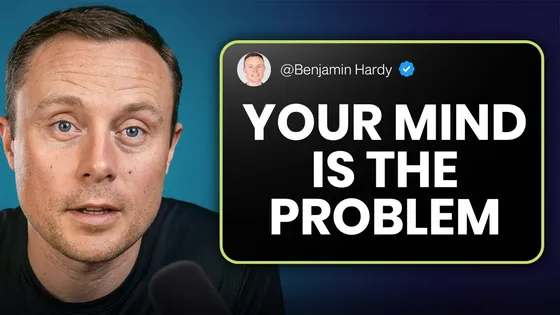
Benjamin Hardy says 10X growth requires cutting 80 percent of your life
The productivity guru’s sharpest claim is not to grind harder, but to delete most of the life that made you successful so far.
Gary Vaynerchuk says entrepreneurs who ignore their partners may not actually value the relationship
GaryVee’s productivity gospel gets its sharpest domestic translation: if you really wanted to see them, you would.
The circuit, read weekly. No noise.