Mustafa Suleyman says AI agents will run an entire online business before 2030
The Microsoft AI CEO is bullish on agentic AI, but his most futuristic prediction also sounds a lot like the sales brochure for Copilot.
Listen on YouTube · Spotify · Apple Podcasts
 WATCH NOW↓
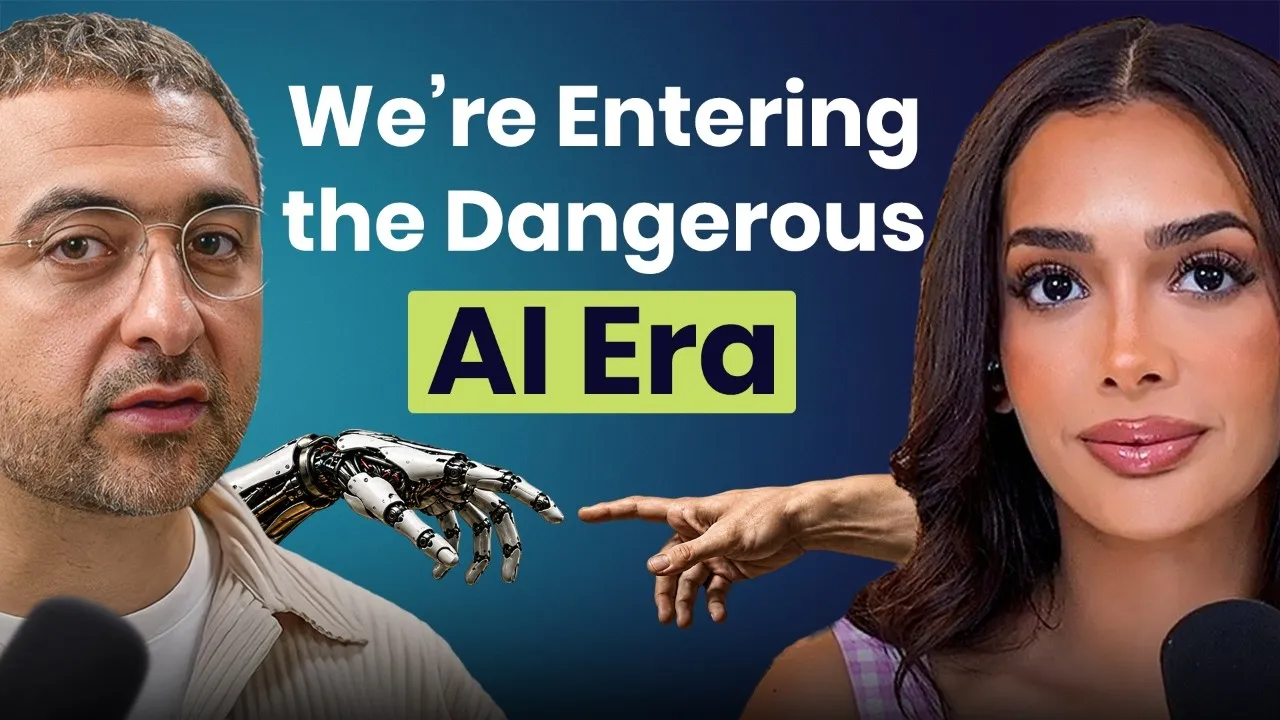
 Mustafa Suleyman thinks your next startup may not have a CTO, COO, or intern. It may have you and an AI agent that, before 2030, can invent the product, build the site, arrange dropshipping, market it, collect the money, and do the books.
That is the claim worth pulling out of Suleyman’s appearance on Young and Profiting, because it turns the usual artificial intelligence chatter into something concrete enough to argue about. Not vibes. Not “AI will change everything,” the official motto of every conference badge lanyard since 2022. A full small business, run by an agent, within this decade.
it could act independently of your direct command essentially or you give it a very general command um you know and it goes off and does all sort of sub actions that are super complicated like you know maybe even invent a new product and create a website for it and then set up a drop ship for it and then you know go and market it and take all the income and then do the accounts and so on. I mean, I think that’s kind of plausible in say 3 to 5 years. Before 2030, I think we’ll definitely have that and might well be much much sooner. Could well be like a lot sooner.
Suleyman is not a random LinkedIn prophet with a ring light and a Notion template. He co-founded DeepMind, co-founded Inflection AI, and now runs Microsoft AI, which means his optimism arrives with both real technical credibility and a giant flashing conflict of interest shaped like Copilot. When Mustafa Suleyman says the AI assistant is becoming your worker, your companion, your colleague, and maybe your co-founder, he is also describing the product category Microsoft is trying very hard to own.
The AI co-founder pitch is here
The most revealing bit is not that Suleyman thinks AI will help entrepreneurs. Everyone thinks that now. The revealing bit is how quickly he jumps from assistant to partner. Copilot is not just a smarter paper clip in his telling. It becomes a matched professional appendage, fitted to your weaknesses, filling your gaps, going into the arena with you.
I’m expecting anytime soon people to declare that it’s like them and their AI starting this new company.
This is the fun version of the future of work: one founder, one laptop, one tireless agent, zero meetings with a growth consultant named Brayden. It is also an extremely convenient story for Microsoft. Suleyman’s Copilot vision is warmer and more intimate than the old productivity software pitch. The spreadsheet used to sit there. The AI will nod along, remember your tasks, organize your life, and, if the demo gods are kind, make you feel seen.
He repeatedly stresses emotional design. His Inflection AI chatbot Pi, he says, averaged 33 minute sessions 4.5 times a week, which is less like a utility and more like a parasocial Peloton instructor. Microsoft, in his telling, wants Copilot to have IQ and EQ, to be accurate but also kind, fast but also companionable. The future of software apparently says “uh-huh” while you ramble.
His timeline is aggressive, but not ridiculous
The business-agent prediction is easy to mock until you break it into pieces. Can current AI generate product ideas? Obviously. Can it draft a website? Yes. Can it write ad copy, summarize customer feedback, produce basic code, make schedules, and help with accounting categories? Yes, often badly, sometimes shockingly well. The missing part is orchestration, trust, permissions, liability, payment rails, customer support, fraud, taxes, edge cases, and all the other boring human glue that keeps “I made a Shopify store” from becoming “I accidentally created a refund nightmare in four states.”
So the verdict is: Suleyman’s claim is plausible as a supervised workflow, inflated as an autonomous fantasy. Before 2030, plenty of people will brag that their AI helped launch a company. Some will even be right. But “AI agent runs the business” will probably mean a human granted a bunch of permissions, checked the important work, and cleaned up the mess when the robot confidently ordered 600 beige phone cases nobody wanted.
you would be a fool not to use them because it really is a complete revolution in access to information and support and so on.
That line is the honest middle of Suleyman’s argument. Don’t worship the tools. Don’t ignore them either. He tells entrepreneurs that the models, APIs, cloud services, open source projects, YouTube explainers, and public tools are already there. His advice is not mystical. It is hustle culture with better autocomplete.
The jobs answer gets slippery
When the host asks about the future of work, Suleyman gives the sunny answer: AI companions will remember tasks, lighten mental load, and make people more creative. He is convincing when he talks about routine digital junk getting smoother. He is less convincing when he glides past the fact that routine digital junk is also a paycheck.
routine work is going to go away. Like a lot of the kind of drudgery of, you know, sort of elementary, you know, digital life, it’s going to get a lot smoother and a lot easier.
Still, the episode’s center of gravity is not doom. Suleyman’s big bet is that AI lowers the cost of expertise, emotional support, and execution. The generous reading is that this gives more people a shot at entrepreneurship, especially people without parents, mentors, or expensive networks on speed dial. The skeptical reading is that a trillion dollar platform company has discovered that “your AI hype man” sounds nicer than “software that eats entry-level tasks.”
If Suleyman is right, the practical question for listeners is no longer whether to use AI. It is what part of your work you are willing to hand over first, and how much supervision you can afford to remove before the co-founder starts making decisions like a raccoon with a corporate card.
- When does Mustafa Suleyman think AI agents will be able to run a business?
- Suleyman puts the timeline at three to five years, definitely before 2030, and possibly sooner. He describes AI agents handling a chain of business tasks, from product invention to marketing to bookkeeping. That is a bold clock, especially because the hard part is not making a demo. It is making the whole thing reliable when money, customers, and laws show up.
- Did Suleyman say AI will replace workers?
- He does not frame it as mass replacement, but he does say routine work is going away. His view is that AI will clear out administrative and repetitive digital labor so people can spend more time being creative and entrepreneurial. That is the cheerful version. The less cheerful version is that a lot of people currently get paid to do the work he calls drudgery.
- Does Suleyman think people should trust AI tools right now?
- Not blindly. He says users should still double check AI outputs, but he also argues that ignoring the tools is foolish because they already offer a major jump in access to information and support. In other words, use the robot intern, but don't let it wire money unsupervised.
Benjamin Hardy says 10X growth requires cutting 80 percent of your life
The productivity guru’s sharpest claim is not to grind harder, but to delete most of the life that made you successful so far.
Gary Vaynerchuk says entrepreneurs who ignore their partners may not actually value the relationship
GaryVee’s productivity gospel gets its sharpest domestic translation: if you really wanted to see them, you would.
Tara LaFerrara Built a Million-Dollar Fitness Business by Refusing to Be Perfect
The Broads founder on coaching funnels, a $130,000 app failure, and why 'do the cringe thing' is actually a business strategy.
Benjamin Hardy Says You're Measuring Yourself Wrong, and He Has the Viktor Frankl Story to Prove It
The organizational psychologist behind 'The Gap and the Gain' explains why hitting your goals might make you feel worse, and what Mr. Beast figured out at 17 that most adults never do.
The circuit, read weekly. No noise.