Don Lincoln says quantum field theory predicts dark energy 10^120 times too large
The Fermilab physicist puts a number on the vacuum catastrophe, and the number is so stupidly large it makes ordinary scientific failure look dainty.
Listen on YouTube · Spotify · Apple Podcasts
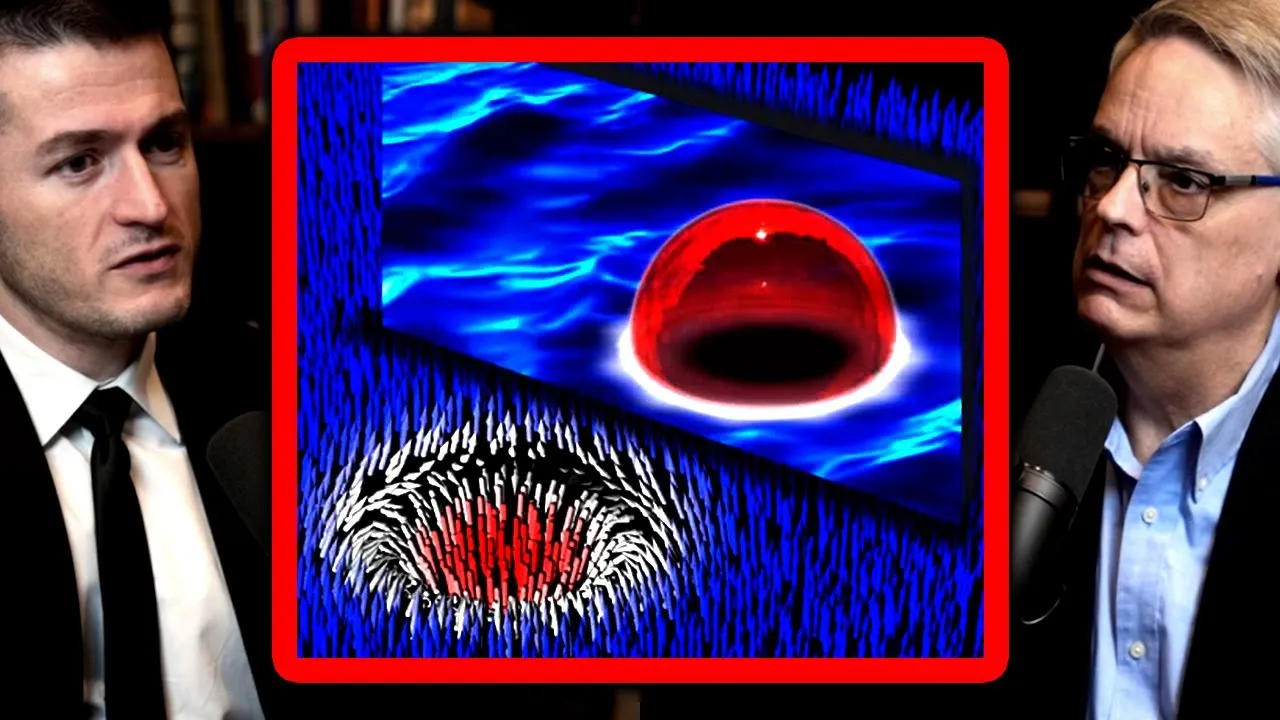 WATCH NOW↓
 If physics had a blooper reel, dark energy would be the clip where the universe slips on a banana peel and lands in notation. On the Lex Fridman Podcast, Don Lincoln says the standard quantum field theory estimate for vacuum energy misses the measured value of dark energy by 10^120, a one followed by 120 zeros.
That is the claim worth stopping for. Not because it is new, exactly. The mismatch is the famous cosmological constant problem, a.k.a. the vacuum catastrophe, the phrase physicists reach for when “we are off by more than the number of atoms in the observable universe” feels too casual. But Lincoln’s version lands because he doesn’t dress it up as mystical awe. He says the ugly number out loud, then makes it uglier.
And if you add that all up, then you get a number, and that number is the rather embarrassing 10 to the 120th power times, that’s a one with 120 zeros after it, bigger than the measurement of dark energy.
The universe is not supposed to fail math this badly
Lincoln’s setup is clean. Astronomers measure the expansion of the universe and infer a tiny energy density in empty space. Quantum field theory, meanwhile, invites physicists to add up the energy of possible field modes in a volume. Short wavelengths contribute too. Shorter wavelengths contribute too. Keep going toward the highest energies and the answer explodes.
The key detail is the fourth power. Lincoln says the equation depends on the highest energy, or smallest wavelength, “to the fourth power.” That turns an already dangerous extrapolation into a cartoon safe dropped from the sky. If you cut the calculation off at the Planck scale, the answer is the notorious 10^120 mismatch.
His nastiest point is that even a heroic near-term discovery would not rescue the calculation. Imagine, he says, that new physics appears right at the energy scale reached by our biggest particle accelerators. Great. Champagne at CERN. Nobel committee warming up the printer. The dark energy problem still laughs at you.
Don, he’s brilliant, he’s going to find something at the LHC tomorrow, he’s going to solve all this problem. Now, we’ve solved it, it’s much better. It’s only different by 10 to the 60 power. Which is still pretty bleeding big.
That line is funny because 10^60 is not a consolation prize. It is the kind of improvement that would count as a miracle in one seminar and still get you laughed out of the next. Lincoln is making a real physics point with stand-up timing: the failure is not a little excess noise near the edge of the chart. It is a structural warning sign in how quantum fields and gravity are being forced to share a spreadsheet.
The honest answer is not pretty
The tempting vulgarization is to say, “science was wrong.” That’s too cheap. Quantum field theory is one of the most successful frameworks humans have ever built. The problem is narrower and more humiliating: when its vacuum energy bookkeeping is coupled to gravity in the obvious way, the universe does not cooperate.
So, the short answer is there is very clearly something going on, something wrong, very badly wrong in the quantum field theory.
Lincoln floats the kind of fix theorists often reach for: add another field that cancels the enormous vacuum contribution. In a sense, cancellation is the easy part. Plus one and minus one make zero. Physics has symmetries and balancing acts all over the place. The hard part is that the universe does not appear to cancel the effect all the way down to zero. It leaves a tiny residue, the observed dark energy. Perfect cancellation is neat. Imperfect cancellation is where the gremlins live.
Perfect cancellation, pretty easy. Theorists do that, you know, eight times before breakfast. Imperfect cancellation, much harder.
There is a small comedy in how new fields enter the conversation. Lex Fridman asks how a physicist even invents one, and Lincoln gives the answer that both demystifies theory and makes it sound like a group project that got out of hand.
Like all theorists do. Well, let’s add something to my equation and see what happens.
That is glib, and Lincoln knows it. But it is also a decent description of the first move. You modify the equation in a way that fixes the catastrophe without ruining everything already measured. Then you ask whether any deeper theory could naturally produce that modification. The bar is brutal: change almost nothing where the old theory works, change almost everything where it fails.
So the verdict on Lincoln’s claim is yes, with a footnote the size of a galaxy. The 10^120 figure is the standard Planck-scale version of the vacuum catastrophe, not a prediction in the same everyday sense as a particle mass or an eclipse date. But as an indictment of a naive marriage between quantum field theory and gravity, it is devastating. If the number is even remotely pointing at the right sickness, then the cure is not a better calculator.
- What is the 10^120 dark energy problem?
- It is the gap between the measured energy density driving cosmic acceleration and the value physicists get if they add up the vacuum energy contributions from quantum fields up to extremely high energies. Lincoln describes that estimate as 10^120 times bigger than the observed dark energy value, which is why the problem has earned its theatrical nickname.
- Would discovering new physics at the LHC solve the dark energy problem?
- Not by itself, according to Lincoln. He says even if the calculation only had to run up to an energy scale near what our largest particle accelerators can probe, the fourth-power dependence would still leave a discrepancy of about 10^60.
- Does Lincoln think quantum field theory is simply wrong?
- He argues that something is badly wrong in how quantum field theory and gravity are being combined for this problem, not that quantum field theory is useless. His proposed shape of a solution is some additional field or mechanism that cancels most of the vacuum energy without canceling it perfectly, because the universe still appears to have a small leftover amount of dark energy.
Don Lincoln says the Higgs field turned on 10^-12 seconds after the Big Bang and gave particles mass
The Fermilab physicist gives the cleanest possible version of a very weird idea: mass, at least for elementary particles, arrived when the early universe cooled enough for the Higgs field to switch on.
Don Lincoln says galaxies with no dark matter are strong evidence dark matter is real
The physicist’s best pro dark matter argument is wonderfully backward: the missing stuff looks more real when you can find places where it’s missing.
Don Lincoln says Fermilab was two or three years from discovering the Higgs boson before CERN got there
The Fermilab physicist frames the Higgs discovery as a near miss, not a clean victory lap for CERN, and he has the machine numbers to make that sting.
Don Lincoln says Maxwell's equations turned magnets and sparks into the internet
On the Lex Fridman Podcast, the Fermilab physicist makes the case that the weirdest, least practical physics is often the stuff that later rewires civilization.
The circuit, read weekly. No noise.