Dr. Tara Narula Wants You to Stop Trying to Bounce Back
The cardiologist and TV medical correspondent makes the case that resilience isn't recovery, it's transformation, and your cardiovascular system is paying close attention either way.
Listen on YouTube · Spotify · Apple Podcasts
 WATCH NOW↓
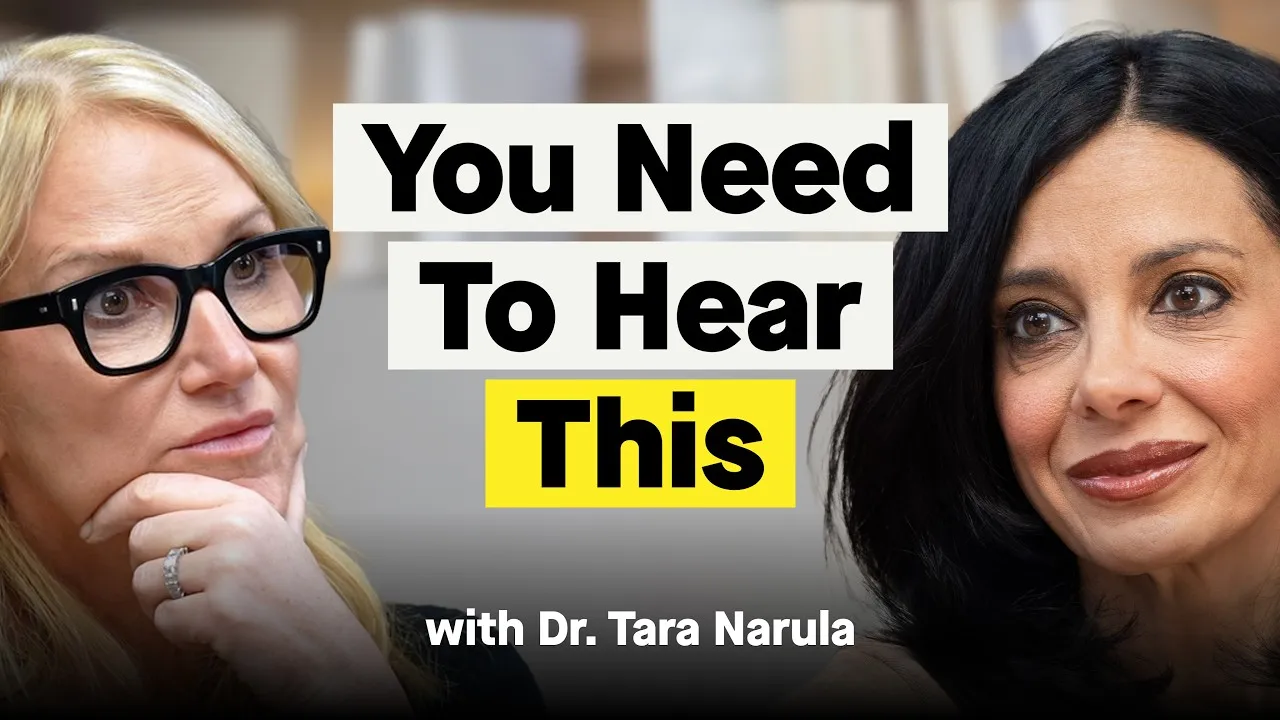
 Here is what a cardiologist tells patients who ask when they will be themselves again after a devastating diagnosis: never. That is the actual answer Dr. Tara Narula gives in the exam room, and she knows how it sounds. She says it anyway, because the second sentence is the one that matters: you can be a beautiful different version of you. That pivot, from brutal honesty to genuine hope without any detour through false comfort, is the engine of this episode, and it runs cleaner than most wellness-podcast conversations have any right to.
Narula is a cardiologist who also covered medicine for CBS News, which means she has spent her career in two rooms where people are at their worst. She brings both into the conversation with Mel Robbins, and the combination gives her more credibility than the usual self-help guest. She is not selling a mindset shift because it feels nice. She is selling it because she watches what chronic stress does to coronary arteries, and she does not love what she sees.
cardiovascular disease is already the leading cause of death for men and women. So, you add to that the stress and it’s just a recipe for disaster. This is so important and we are not talking about it.
The Goalpost Move
The most useful thing Narula does in this episode is retire the rubber-band model of resilience. Bouncing back implies returning to a prior shape, and she argues plainly that neither our minds nor our bodies work that way. We are, she writes in the book she is here to promote, the marble and the angel. Both. The marble gets carved. You do not un-carve it. What you can do is stop demanding the original block back.
She borrows a visual from resilience researcher Lucy Hone, whose 12-year-old daughter died in a car accident, and who kept going by doing something very concrete: she picked up the goalpost and moved it somewhere else. Narula uses this image to explain what flexible thinking actually means in clinical practice, what it looks like when someone whose heart function has dropped to 20 percent has to rebuild a life around a body they no longer recognize.
there are patients where I can’t give them back the heart cells that have died. I can’t give them back the movement of their arm when they’ve had a stroke. We can’t go back, but we can still help them find a different path towards meaning in their life if they have that flexible thinking.
The goalpost metaphor is good enough that Robbins stops the conversation to say it out loud again, slowly, for the audience. Which is a little much, but she is not wrong. It is a cleaner image than most of what circulates in this genre. The identity pie exercise Narula describes, where patients draw a circle and divide it into slices representing every role and interest in their life, with the diagnosis taking only one small slice, works the same muscle. You are not your diagnosis. You are also a dog owner, a baker, an athlete, and someone who has been meaning to take an art class.
What Stress Actually Does to You
Narula keeps returning to the physiology because she is a cardiologist and that is her lane, and also because it is genuinely clarifying. The stress response, she explains, was designed to help you outrun a lion. Heart rate up, digestion off, everything non-essential shut down until you escape. The problem is that your amygdala cannot tell the difference between a predator and a difficult bill in the mail. Every small insult during the day, an unreturned text, a tense email from a boss, a scary headline, triggers the same cascade. Cortisol. Adrenaline. Vascular reactivity. Over and over. That is what chronic stress is: a lion-escaping system running on a loop in a body that never actually escapes.
She is clear that you are not a victim of this system. You can turn it off. The parasympathetic nervous system is right there, available, and things like exercise, breathing work, therapy, and the deliberately unsexy act of calling a friend you have not spoken to in six months all activate it. None of this is surprising information, but hearing it from someone who also describes stress-induced heart attacks in her female patients, who are more prone to them than men, makes the stakes feel less abstract.
you have to find hope in the small moments of every single day. So, every day that you wake up and you see your wife, and you can say I love you and hear her say I love you, that’s hope.
Narula told a patient with Parkinson’s disease those words, a man who looked at her and asked directly how he was supposed to not lose hope. She sat with him and named the small things: the book he was still writing, the wife still in the room, the treatment that might exist tomorrow that did not exist today. It is the most unguarded moment in the episode, and it earns the episode’s broader argument more than any study citation could. Resilience is not a personality trait you either have or you don’t. It is, as Narula keeps insisting, a skill. You can practice it. You can get better at it. The marble does not carve itself, but the angel is already in there.

Dr. Lara Boyd says your brain changes most when you succeed only 50 to 60 percent of the time
The neuroscientist turns the usual self-help command to “do hard things” into something more precise, and more annoying, your brain likes the zone where you’re barely making it.
Oz Pearlman says you should approach people at an angle because head-on feels like danger
The mentalist turns a restaurant-magician survival tactic into a surprisingly practical rule for the first 10 seconds of any conversation.

Oakley Robbins says he had to go no contact with his girlfriend to stop hating college
The useful part of this Mel Robbins episode is not positive thinking, it is the brutal little admission that an escape hatch can keep you miserable.

Rahul Jandial says acting out your dreams can warn of Parkinson's 15 years early
The neurosurgeon’s strongest claim is not that dreams are mysterious, it is that some dream behavior belongs in a sleep clinic, not a dream dictionary.
The circuit, read weekly. No noise.