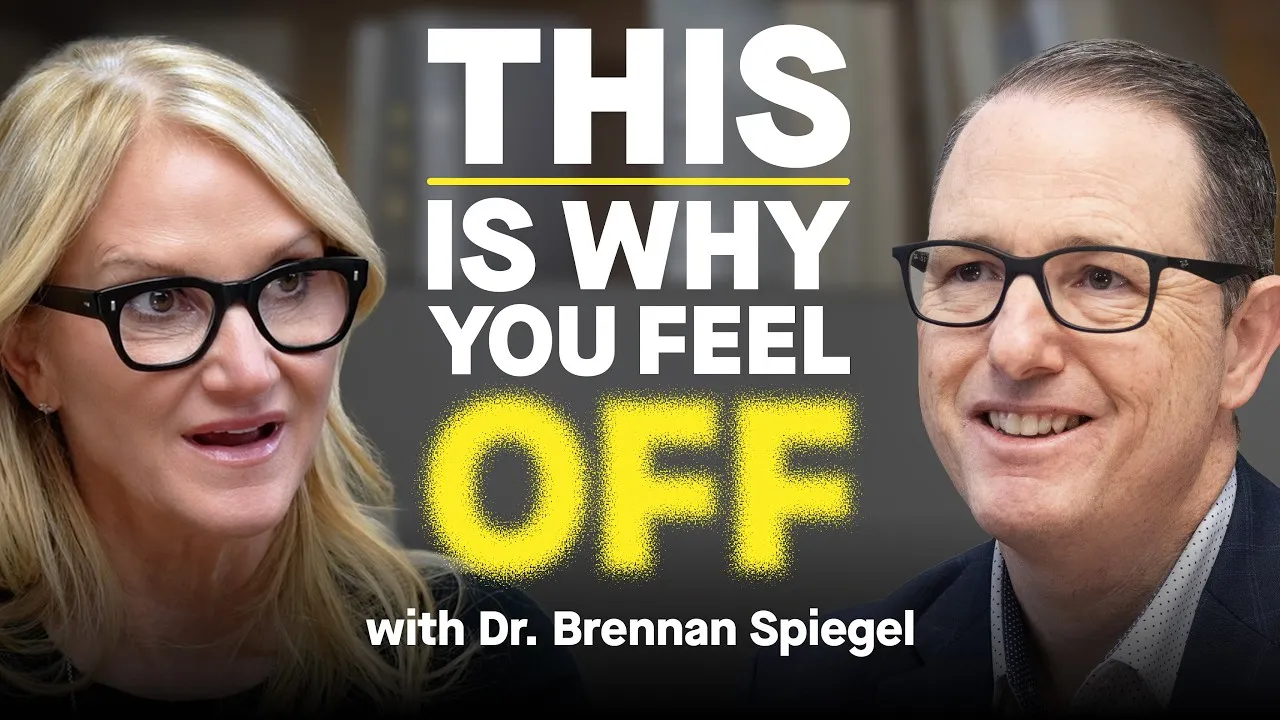
Dr. Brennan Spiegel says a thumb that touches your forearm may help explain IBS
The Cedars-Sinai gastroenterologist gives Mel Robbins a sticky new theory of gut trouble, posture, balance, grip strength, and the indignity of being a human sack of potatoes on Earth.
Listen on YouTube · Spotify · Apple Podcasts
 WATCH NOW↓
 The most viral medical test of the week is not a blood panel, a wearable, or a $600 wellness scan. It is Dr. Brennan Spiegel asking you to bend your pinky back and see whether your thumb can touch your forearm, because he says that kind of stretchiness may help explain irritable bowel syndrome.
On The Mel Robbins Podcast, Dr. Brennan Spiegel, a Cedars-Sinai gastroenterologist, sells Mel Robbins on a grand theory he calls “gravity intolerance.” The phrase sounds like something a toddler would claim to get out of gym class. Spiegel means something more serious: that a lot of exhaustion, pain, dizziness, swelling, anxiety, and gut trouble can be understood as the body failing to stand up well to the boring, brutal fact that Earth is always pulling.
Yeah, it’s gravity intolerance. If you’re stretchy on the outside, you’re probably stretchy on the inside, too.
That is the line people will repeat at brunch while forcing their friends to do thumb gymnastics over oat-milk lattes. Spiegel’s model is simple enough to be dangerous in the way all good podcast medicine is dangerous: if your joints are loose, the internal suspension system may be loose too. The gut, in his favorite image, is a “sack of potatoes” hanging inside you. If the cables are too stretchy, gravity can tug that sack downward, compressing and kinking the digestive system.
The party trick is real-ish. The universal theory is the stretch.
Here is the fair reading. The connection between hypermobility and GI symptoms is not nonsense. Clinicians do see overlap among joint laxity, connective tissue disorders, dysautonomia, dizziness, POTS-like symptoms, pain, and digestive complaints. Spiegel is putting a pop-science wrapper around a real cluster of problems.
Here is the eyebrow. He also says “gravity and name the disease,” and that is where the metaphor starts wearing a lab coat one size too large. Gravity affects every body, obviously. So does water. So does oxygen. That does not make every illness a water-intolerance disorder or an oxygen-management disorder. The useful claim is narrower: some people with loose connective tissue, poor posture, weak core and back muscles, or circulation issues may experience symptoms that get worse when the body is badly supported upright.
Spiegel is best when he stops trying to rename medicine and starts translating it. A slumped torso compresses the abdomen. Stronger back and core muscles support the gut. Swimming may feel better for very bendy bodies because it takes some pounding out of the equation. This is not woo. It is biomechanics with better branding.
exercise, it turns out, is the most effective therapy we have for IBS by far.
That line is almost more useful than the gravity theory. Spiegel lists Tai Chi, yoga, osteopathic interventions, strength training, swimming, and running, then points to trial evidence. He is careful enough to say exercise is not a cure-all, which matters, because IBS patients have already endured enough people telling them to relax, drink water, and become morally superior through fiber.
The episode becomes a gym class for people who hate gym class
Once Spiegel has Mel bending fingers and contemplating her organs as crushed groceries, he moves to tests. Stand on one leg. Hang from a bar. Squeeze a dynamometer. Wear a weighted vest if you want to cosplay as yourself on Jupiter.
you want to be able to stand on one leg for at least 10 seconds.
The balance advice is the least flashy and probably the most defensible. Balance, especially later in life, really does correlate with strength, proprioception, vestibular function, fall risk, and survival. This is where Spiegel’s gravity lens lines up neatly with mainstream longevity advice: if you cannot stay upright, life gets smaller fast.
if you can hang from a bar for one minute, you’re doing great. You are a gravity master.
The dead hang challenge is podcast gold because it is humiliating, measurable, and instantly shareable. A minute sounds easy until your hands begin negotiating directly with God. Spiegel’s larger point is grip strength tracks more than hands, it can reflect overall strength and fitness. Mel, naturally, turns the whole thing into a Survivor immunity challenge with better lighting.
The episode’s real value is not that gravity has secretly been the villain in every medical mystery. It is that Spiegel gives people a physical story for symptoms that often feel vague, scattered, and shamey: back pain here, bloating there, dizziness when standing, fatigue that makes the day feel upholstered in wet cement. If his language gets too big, his prescriptions stay refreshingly small. Stand taller. Strengthen the stuff that holds you up. Drink enough water. Sleep. Move. Maybe stop folding yourself over your phone like a defeated shrimp.
And yes, try the thumb test. Just do not let TikTok diagnose your colon.
- Does a bendy thumb mean I have IBS?
- No. Spiegel is not saying a thumb-to-forearm trick diagnoses IBS. His argument is that visible joint stretchiness may be a clue that connective tissue inside the body is also lax, which could contribute to digestive symptoms in some people.
- What does Brennan Spiegel mean by gravity intolerance?
- He uses the phrase to describe the body struggling to manage Earth’s constant pull, through posture, circulation, balance, muscle strength, hydration, and the gut. It is a catchy framework, not a standard diagnosis you are likely to see printed on a lab report.
- What does he recommend for IBS or gravity intolerance?
- His practical advice is surprisingly normal once you scrape off the cosmic paint: exercise, strengthen the core and upper back, swim if joint laxity makes pounding exercise uncomfortable, hydrate, sleep, practice balance, and work on grip strength.
Rhonda Patrick says 1 minute of breathless exercise beats 53 minutes of walking around your house
The researcher behind the FoundMyFitness newsletter just made your gym membership guilt optional and your stair climb mandatory.
Daniel Pink Has 26,000 Regrets to Show You, and That's the Good News
The author of 'The Power of Regret' joins Mel Robbins to make the case that the emotion you've been running from is actually the most useful one you have.

Dr. Lara Boyd says your brain changes most when you succeed only 50 to 60 percent of the time
The neuroscientist turns the usual self-help command to “do hard things” into something more precise, and more annoying, your brain likes the zone where you’re barely making it.
Oz Pearlman says you should approach people at an angle because head-on feels like danger
The mentalist turns a restaurant-magician survival tactic into a surprisingly practical rule for the first 10 seconds of any conversation.
The circuit, read weekly. No noise.