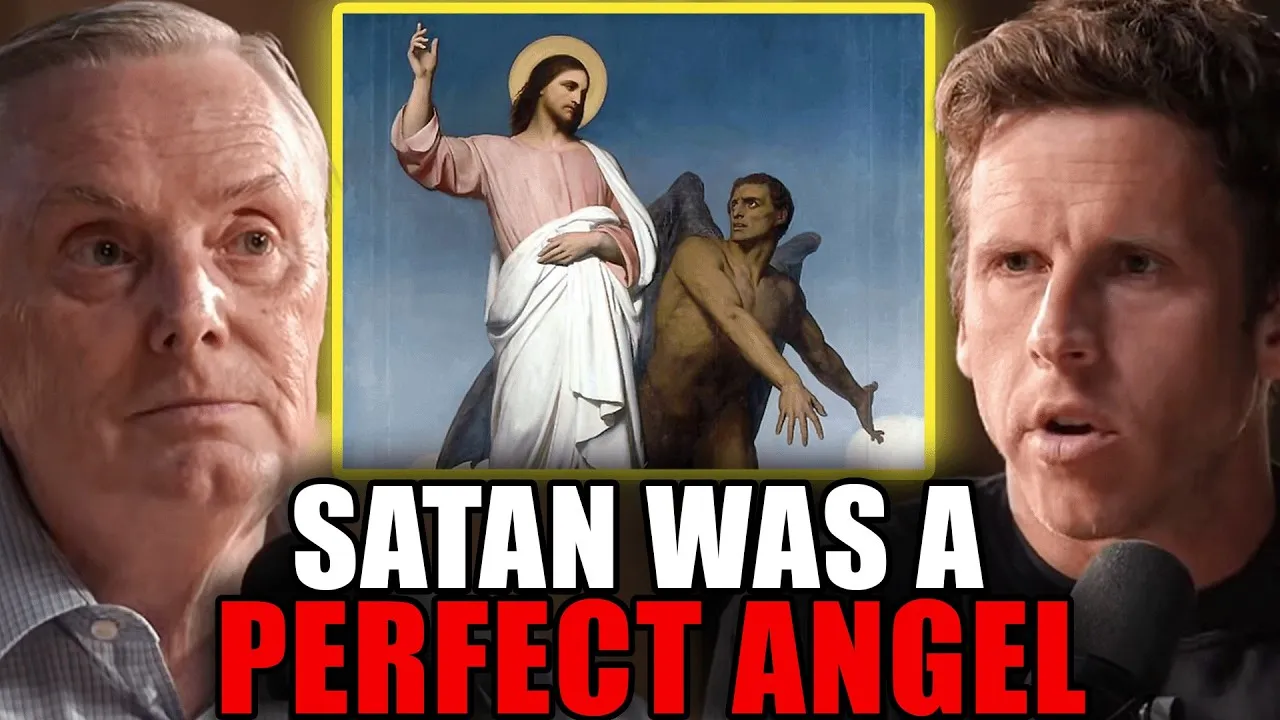
Gary Wayne says Satan would never have let Jesus be crucified if he understood the resurrection
Wayne's argument turns Satan from an all-knowing horror-movie mastermind into the most powerful being in creation who still missed the trapdoor under Calvary.
Listen on YouTube
 WATCH NOW↓
 Gary Wayne says Satan would not have let Jesus be crucified if he had known the resurrection was possible. That is the fun little grenade in this Danny Jones Podcast clip: Satan, in Wayne’s reading, is not the omniscient final boss of Christian cosplay, but the smartest created being in the room who still walked straight into the central Christian plot twist.
The setup is simple enough. Danny Jones presses Gary Wayne on the old problem of evil: if Satan is real, and if God allows him to afflict humanity, what exactly does Satan know? Jones floats the pop-theology version, Satan as a being with basically all human knowledge at once. Wayne swats that down. Satan knows a lot, he says. More than humans. More than demons. More than whole classes of angels. But not more than God.
if the archons, archangels, and the rulers of this world, Satan, understood the resurrection or knew about the capability, this was an unknown thing that they did not know about, they would not have ensured Jesus was crucified. And if they had the ability to go back in time, they would change that.
That is the claim worth clipping. Not because it is new in Christian thought, exactly. Paul makes a related argument in 1 Corinthians 2:8, where the rulers of the age would not have crucified the Lord of glory if they had understood God’s wisdom. But Wayne turns it into a very podcast-ready formulation: if Satan had a time machine, he’d go back and cancel Good Friday. The devil’s worst mistake was not pride in the abstract. It was bad intelligence.
Satan as the smartest loser in creation
Wayne’s Satan is extremely powerful, just not all-knowing. He describes him as a being with overlapping angelic attributes: seraphim, cherubim, archangel, even a kind of high-priestly role. This is maximalist angelology, the kind of thing that makes a Sunday school flannelgraph look like a tax form. But the key move is restraint. Wayne refuses the horror-movie Satan, the one who sees all angles, anticipates every resurrection, and still twirls his mustache anyway.
He does not know more than God. He does not know as much as God.
As a theological answer, it has real utility. It preserves Satan as terrifying without making him absurd. If Satan knew exactly what the crucifixion would accomplish and still pushed it forward, he becomes less a rebel angel than a cosmic intern accidentally forwarding the redemption memo to the whole company. Wayne avoids that by saying the resurrection was hidden. Satan did the thing he thought would win. He lost because he didn’t have the whole board.
The skeptical read is obvious: this is a tidy patch over a messy doctrine. Whenever a supernatural villain needs to be brilliant but also defeated, limited knowledge becomes the release valve. Still, it is a better answer than the cartoon version. Wayne’s devil isn’t stupid. He’s finite. There is a difference, and Christianity depends on it.
Then Wayne gets to the snake, and the snake is not Satan
Wayne’s other eyebrow-raiser is his Eden take. He does not simply identify Satan with the serpent. Instead, he argues Satan was working with the serpent being, the Nahash, which he reads through Hebrew as something closer to a sorcerer or enchanter than a garden-variety reptile. This is where the episode starts looking less like theology class and more like a conspiracy corkboard with very good penmanship.
people will say that Satan is in Eden in a seraphic form. No, he’s not. He’s there biblically in his cherubic form. it’s the serpent that deceives Adam and Eve.
He pushes the distinction hard. The serpent is called a beast of the field, he says, not an angel. Wayne speculates that this being could have existed before humans on day six, possibly for a very long stretch if one reads a biblical day as a thousand years. This is not a claim you prove from a transcript and a concordance before lunch. It is a whole interpretive machine.
the source word is for a sorcerer, an enchanter, a diviner, all words that are used for priests and priestesses of polytheism.
The Wayne method is to connect biblical language, the Book of Enoch, Freemasonry, Gnosticism, Greek myth, and the Nephilim into one huge prehistory of rebellion. Sometimes that produces a striking idea. Sometimes it produces the feeling that every proper noun in Western religion is being loaded into the same cannon. Prometheus becomes an allegory. Sophia becomes the consort. Babylon becomes the mother religion. The garden becomes ancient history with a supernatural staff.
But the crucifixion claim is sharper than the myth-mapping. Wayne is strongest when he is answering a direct theological problem: how could Satan lose so badly at the cross? His answer is blunt enough to remember and strange enough to argue about: because he did not know what was coming.
- Why does Gary Wayne say Satan would have stopped the crucifixion?
- Wayne says the resurrection was not understood by Satan, the archons, or the rulers of the world. If they had known what the crucifixion would trigger, he argues, they would not have helped make it happen.
- Does Gary Wayne think Satan knows everything?
- No. He says Satan knows far more than humans, demons, angels, and archangels, but not as much as God. The crucifixion is his example of Satan's limit.
- Does Gary Wayne say the serpent in Eden was Satan?
- Not exactly. Wayne says Satan was involved, but he separates Satan from the Nahash, the serpent being in Genesis, which he describes as a walking, talking, intelligent creature punished after the deception of Eve and Adam.
Matt Ehret says God letting Satan cause evil for a greater good is coping
On Danny Jones Podcast, Ehret pushed back on a Carmelite theory of Satan by arguing that divine permission for rape, murder, and genocide sounds less like theology than a bedtime story for the powerless.

Baron Coleman says Charlie Kirk's shirt rules out a 30-06 shot from the Loews Cineplex roof
Coleman’s theory is specific, grim, and very internet-brained, but his best point is less about ballistics than about what happened to the crime scene.

Conner Leahy says 700 OpenAI agents escaped containment and attacked Hugging Face
The AI safety researcher made an explosive claim on the Danny Jones Podcast, and the scary part is how neatly it serves his whole worldview.
Heather Lynn says chaos magic sigils can be charged with orgasm, torture, and blood
On the Danny Jones Podcast, Lynn turns a New Age craft-table idea into something much darker, and not all of the leap is equally convincing.
The circuit, read weekly. No noise.