Andrew Huberman says daily nicotine pouches don't boost your brain, they just fix withdrawal
Huberman's rule is brutally unfashionable in the pouch era: if you want nicotine to help performance, don't make it a habit.
Listen on YouTube
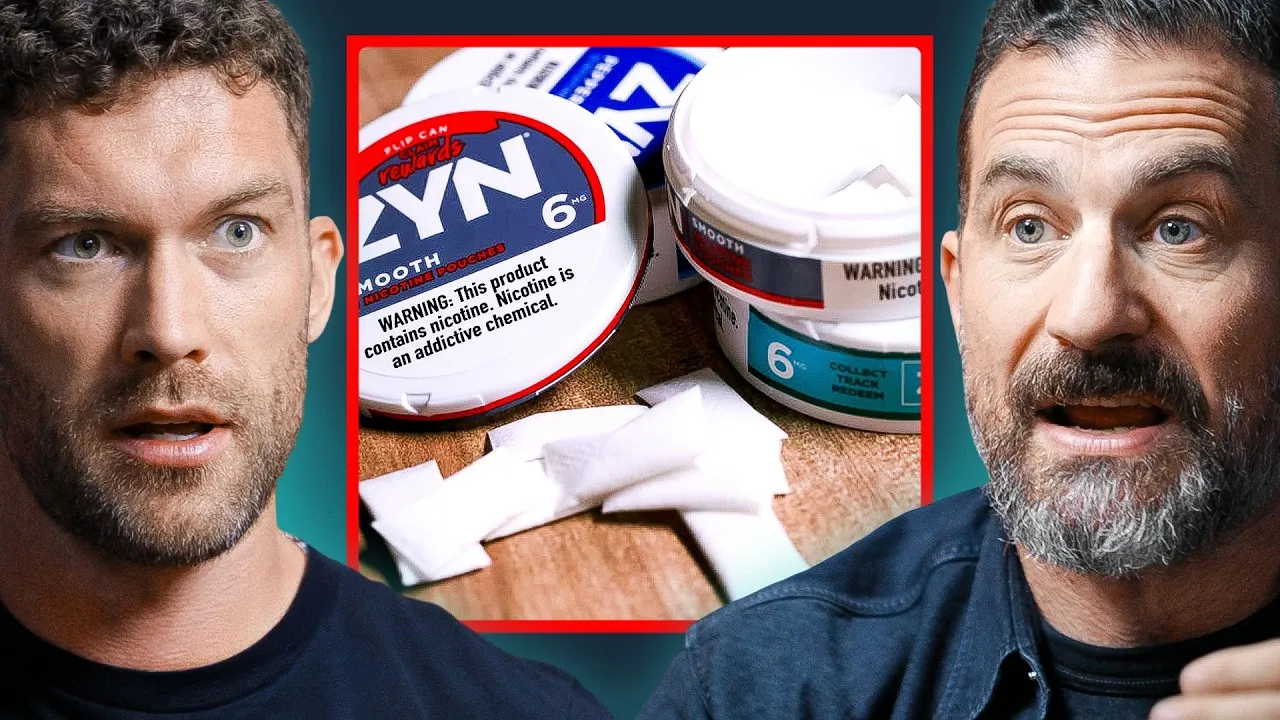 WATCH NOW↓
 Andrew Huberman has a very inconvenient message for the Zyn-in-the-gym-bag generation: your daily nicotine pouch probably isn’t making you sharper. According to Andrew Huberman, once you’re using 3 to 6 milligram pouches multiple times a day, the supposed brain boost has mostly become a rescue mission from withdrawal.
That is the useful little grenade inside his appearance on Modern Wisdom. Not the familiar cigarette sermon. Not the vague wellness warning. The claim is more annoying because it aims right at the respectable version of nicotine, the tiny white pouch tucked under the lip by people who also track sleep, cold plunge, and say things like output.
If you take 3 to six milligram pouches multiple times per day, it’s not going to have a cognitive enhancing effect. It’s just rescuing the deficit from nicotine withdrawal.
That lands because it punctures the clean-tech fantasy around nicotine. Pouches have been sold, implicitly or explicitly, as the adult-in-the-room delivery system. No smoke. No vape cloud. No sad gas-station lighter. Just a little Scandinavian-coded disc of focus. Huberman’s point is that the delivery system can get cleaner while the dependency loop stays ugly.
The Huberman nicotine rule is basically: treat it like a secret weapon, not a snack
Huberman doesn’t say nicotine is useless. He says almost the opposite, which is why the warning has teeth. Nicotine can make you feel both alert and calm, a state he describes as useful for learning. But the trick is rarity. If you use it constantly, the magic trick becomes a subscription fee.
So if you want nicotine to be a performance aid, you use it occasionally. meaning you know 3 to six milligrams once or twice total twice per week maximum
The science-adjacent verdict: the baseline argument is solid. Stimulants can feel like enhancement when what they’re really doing is relieving the drag created by dependence. Caffeine drinkers know this movie. The first coffee is a sunrise. The thousandth is a hostage negotiation.
The twice-a-week number, though, is more Huberman protocol than hard border. Useful? Yes. Searchable? Absolutely. But don’t mistake it for a bright biological line where Wednesday makes you optimized and Thursday makes you owned by a mint-flavored sachet. The real point is simpler and more brutal: if you’re reaching for nicotine several times a day, you’re probably not biohacking. You’re maintaining.
His vaping take is the scarier one, and also the easier one to overstate
Huberman also offers a neat behavioral argument about vaping: even if vaping is less dangerous than smoking per puff, people can do so much more of it that the safety advantage gets chewed up. This is the part that will make harm-reduction people twitch, because cigarettes are still a uniquely efficient public-health villain. But as a claim about behavior, not toxicology, he’s on firmer ground.
smoking was less healthy and maybe more dangerous per puff, but because the number of puffs that you’re consuming from vaping, because you can do it in more places and it’s more tasty and there’s less fatigue from it means that maybe the healthier delivery mechanism of vaping versus smoking is more than offset to the point where it’s more dangerous.
That “maybe” matters. Heard carefully, he’s saying convenience changes dose. Heard sloppily, it becomes “vaping is worse than smoking,” which is too blunt for the evidence and too perfect for a panic headline. The better read is that modern nicotine products are engineered to remove friction, and friction was doing more public-health work than anybody wanted to admit.
Chris Williamson, meanwhile, is not exactly a neutral man wandering through a nicotine forest with a clipboard. He says he has been working on pouches and suggests they could eventually outpace cans in revenue because so many users want to dial back their nicotine. That is either a harm-reduction pitch or the most elegant business sentence ever built around dependence.
So many people feel like I’m not in control of my nicotine usage and the delivery mechanism has been locked in
There’s the whole market, sitting there in one sentence. People want control back. Companies want to sell the object that promises control. Huberman’s warning is that the object can still become the leash, just with better packaging.
If he’s right, the practical stake is not whether nicotine pouches are morally worse than vapes, cigarettes, or whatever beef-jerky cosplay product haunted American childhoods. It’s whether the thing you call focus is actually relief. Check your frequency. That’s where the answer is hiding.
- Does Andrew Huberman think nicotine pouches help focus?
- Only if they stay occasional. His argument is that nicotine can create a rare alert-but-calm state, but daily pouch use quickly stops being a performance tool and becomes withdrawal management.
- How often does Huberman say someone could use nicotine as a performance aid?
- He gives a strict ceiling: 3 to 6 milligrams once or twice total per week. That is not a medical guideline so much as a dependency-avoidance rule, and it is much lower than the way many pouch users actually consume them.
- Does Huberman say vaping is safer than smoking?
- He says vaping may be safer per puff, but argues the convenience, flavors, and ability to vape almost anywhere can make people consume far more nicotine overall. His warning is about real-world behavior, not just the chemistry of one puff.

Hunter Biden says the White House cocaine wasn't his because he hadn't been there for weeks and was being drug-tested
On Modern Wisdom, Biden gave his most sitcom-floor-plan defense yet of the 2023 White House cocaine story.

Kanika Batra says she'd encourage her future children to date a sociopath
The self-described diagnosed sociopath argues that a loyal psychopath can be a romantic shield, which is either brutal honesty or the darkest dating ad ever written.

Arthur Brooks says conspiracy theories are a meaning crisis, not a facts problem
The happiness scholar's best point on Modern Wisdom is also his riskiest one: your uncle's rabbit hole may be less about bad information than a life that stopped making sense.
Chris Williamson says too much self-awareness can make you a coward
The Modern Wisdom host turns Hamlet into a diagnosis of the modern overthinker, and he is more right than a Shakespeare scholar would enjoy admitting.
The circuit, read weekly. No noise.