Kevin O'Leary says he never saw Steve Jobs happy or laughing, and that Jobs thought being nice was noise
The Shark Tank investor turns a money episode into a bleak little sermon on Steve Jobs, genius, cruelty, and the Apple ghost that still sits in the room.
Listen on YouTube · Spotify · Apple Podcasts
 WATCH NOW↓
 Kevin O’Leary says he never saw Steve Jobs happy, never saw him laugh, and learned that Jobs treated being nice as “noise.” Coming from Kevin O’Leary, a man whose public persona is basically a blazer with teeth, that still lands like a brick through the glass wall of a Genius Bar.
This episode of The Diary of a CEO is sold as money advice, and yes, O’Leary does swat at $28 lunches, index funds, stablecoins, Apple, watches, and the moral rot of an overstuffed closet. But the thing with a pulse is his Jobs material. Not because it reveals that Jobs was difficult. Please. That ship sailed, docked, got redesigned, and came back thinner. The claim is sharper: O’Leary says Jobs was not merely demanding. He was allergic to the social fabric most managers pretend to respect.
I never saw him happy. He was always barking at me. I never saw him happy. I don’t think I ever saw him laugh.
The caveat matters. O’Leary doesn’t claim to know Jobs’ private life. He says Jobs’ wife would know better. That makes the statement more credible, not less. This is not a full biography of Steve Jobs. It is a witness statement from a businessman who dealt with him across the table and came away with the impression of a brilliant, miserable, product-possessed man.
The Apple ghost in the room
O’Leary’s Jobs is not the black-turtleneck saint of keynote nostalgia. He is the guy yelling through a barely opened window after kicking O’Leary’s team out of a meeting. He is the guy rejecting market research because he already knew the answer. He is the guy who, in O’Leary’s telling, believed customers didn’t know what they wanted until he told them.
they don’t know what they want until I tell them
That line is the old Jobs myth in its purest form, half genius, half hostage note. O’Leary buys it completely. He says he used to challenge Jobs, asking how he could possibly know, and Jobs would basically demand proof that he had ever been wrong. O’Leary can’t produce the proof. Decades later, he still sounds annoyed by that.
He respected me, that’s for sure. He wouldn’t execute on my ideas. He expected me to execute on his, but he was never wrong.
This is where the story becomes less about Jobs and more about the way business culture launders cruelty through outcomes. O’Leary’s verdict is not that Jobs was kind, or balanced, or secretly misunderstood. It is that he wrote the hit songs. If the producer is awful but the album goes platinum, the studio keeps booking the room. That is not a moral defense. It is a market defense, which is the only kind O’Leary ever seems fully relaxed making.
A good story, and a dangerous lesson
The useful part of O’Leary’s memory is that it strips away the inspirational poster version of Apple. He says the company still benefits from Jobs’ philosophy, the honey of the ecosystem, the devices talking to each other, the brand universe people don’t want to leave. That rings true. Apple is not just a laptop company or a phone company. It is a velvet cage with excellent typography.
The dangerous part is the management lesson hanging off it. O’Leary says CEOs, managers, and even parents could learn from Jobs. Sure. Learn taste. Learn focus. Learn how to kill bad ideas before they become beige products with launch decks. But if the lesson becomes “be unbearable because Steve Jobs was unbearable,” congratulations, you have built a startup culture cosplay outfit and called it leadership. Most people who bark like Jobs do not ship the iPhone. They just make Tuesdays worse.
O’Leary knows the trade he is making. He loved Jobs, or at least loved the force of him. He says Jobs’ ghost is still in Apple’s rooms. He also describes a man who, when asked whether he could have been nice, would have treated the question as beside the point.
being nice is noise
- What did Kevin O'Leary say about Steve Jobs being happy?
- O'Leary said he didn't know whether Jobs was happy in private, but in his own dealings with him, he never saw it. He described Jobs as a tortured figure who was usually barking at him and said he didn't think he ever saw Jobs laugh.
- Did Kevin O'Leary defend Steve Jobs' harsh management style?
- Yes, mostly. O'Leary framed Jobs' harshness as part of a broader obsession with signal over noise, arguing that Jobs cared about making the right product, not about being pleasant while doing it. The defense is believable as O'Leary's personal experience, but it also flatters O'Leary's own hard-edged view of business.
- What does O'Leary think Apple still has because of Steve Jobs?
- He thinks Apple still has Jobs' product religion in the walls, especially the idea that customers don't always know what they want until Apple shows them. O'Leary argues that the brand, software ecosystem, AppleCare, and cross-device universe keep people from leaving.

Cenk Uygur says Israel blocks an Iran peace deal every time Trump moves toward peace
On The Diary of a CEO, Uygur argued that Trump has a deal available with Iran, but Benjamin Netanyahu keeps pushing him back toward war.

Cenk Uygur says Israel gave America a list of seven countries to attack after 9/11
The Young Turks host turns a Diary of a CEO Iran debate into a blunt accusation about U.S. foreign policy, while Kevin O'Leary argues the real issue is stopping Iran from getting a bomb.
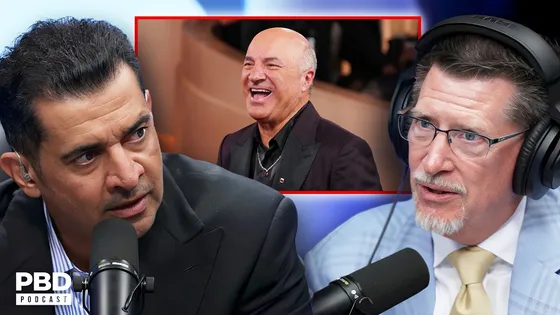
Kevin O'Leary says Steve Jobs told him entrepreneurs should do only three signal tasks a day
O'Leary's Steve Jobs story is clean, brutal, useful, and then the PBD Podcast accidentally stress-tests it with a merch pitch.

Martin Picard says Steve Jobs's reality distortion field was an energetic quality, not just charisma
The mitochondrial scientist turns Steve Jobs lore into a theory of human energy, and yes, the metaphor is doing push-ups.
The circuit, read weekly. No noise.