Khabib Nurmagomedov says he and Islam Makhachev don’t understand each other’s native languages
The former UFC champion used one tiny linguistic fact to explain why Dagestan is less a simple fight-factory stereotype than a mountain archive of peoples, faiths, food, and history.
Listen on YouTube · Spotify · Apple Podcasts
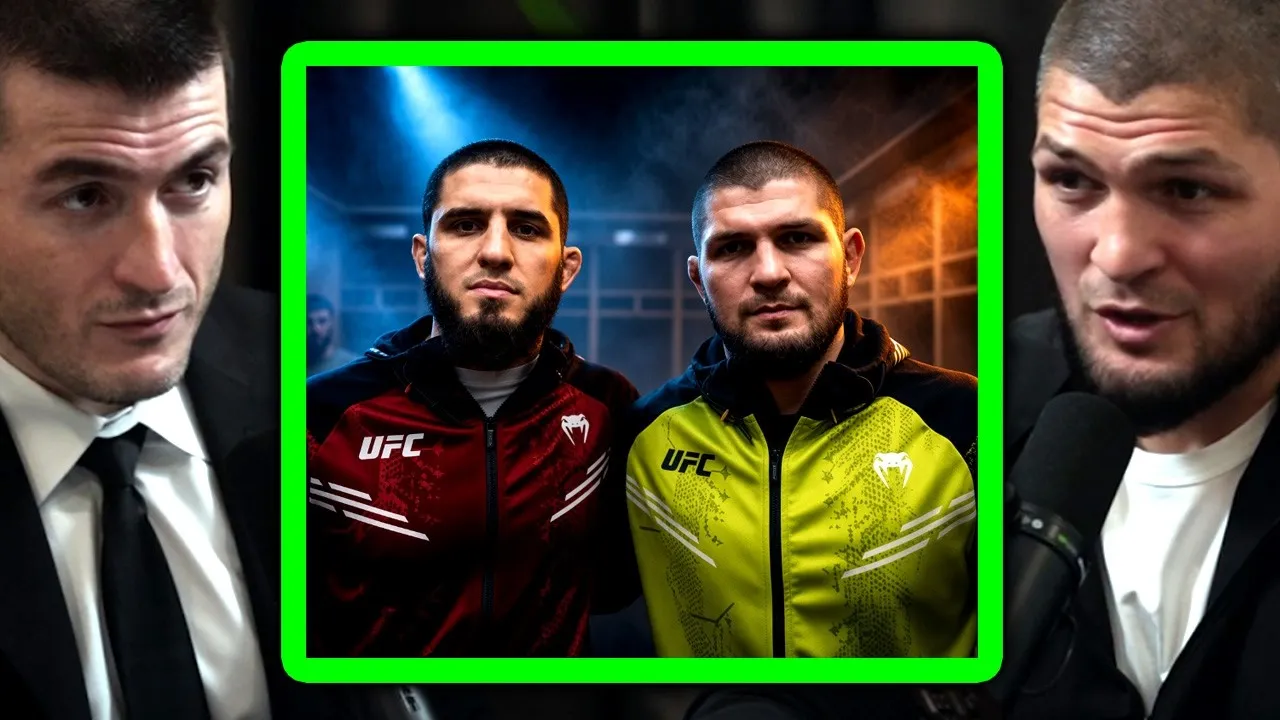 WATCH NOW↓
 The funniest thing about the Dagestani MMA superteam myth is that even the two most famous guys in it may need a linguistic bridge. Khabib Nurmagomedov says he and Islam Makhachev, longtime teammates and two of the defining lightweight fighters of their era, don’t actually understand each other’s native languages.
We have so many languages, more than 30 different languages and people just don’t understand each other.
That is the whole miniature world Khabib opens up in this clip from the Lex Fridman Podcast. To outsiders, especially fight fans, Dagestan can get reduced to one ominous noun: wrestling. The mountains, the beard, the smesh, the cage-side fathers and cousins and coaches. A brand. Khabib’s point is more interesting than the brand. Dagestan isn’t a single factory stamping out southpaw grapplers. It’s a dense historical region where two athletes from the same republic can share a gym, a religion, a sport, a public story, and still not share a first language.
Take Islam and me. We have different languages, come from different backgrounds.
The claim lands because it punctures a lazy fan shorthand. Khabib and Makhachev are often discussed as if they are basically one person spread across two UFC title reigns: same camp, same aura, same suffocating top pressure, same inevitability. But Khabib is drawing a harder line. This is not a cute regional accent problem. It’s not Brooklyn versus Boston. It is, in his telling, mutual incomprehension.
We don’t understand each other at all.
Dagestan is not a monolith, even in the Khabib Cinematic Universe
Khabib says Makhachev has picked up some of his language over the years because he has been around Khabib’s circle for nearly 25 years. That detail is better than any glossy tourism line. It makes the diversity practical. Friendship becomes translation. Training becomes immersion. A fight camp becomes, accidentally, a language school with cauliflower ears.
He also widens the frame beyond language. Islam, he says, is the primary religion in Dagestan, but the republic has absorbed many cultures and faiths. He talks about food the way people talk about old port cities, with Europe, Asia, the Caucasus, and local traditions all ending up on the plate. This is not Khabib doing a TED Talk with a map behind him. It’s more casual than that, which is why it works. He sounds like a man slightly amused that anyone could think the place is simple.
the last 1,500 years of history have left a huge mark.
Is the claim exaggerated? Not really. Dagestan is famously one of the most linguistically diverse places in the Russian Federation, and Khabib’s Avar background and Makhachev’s Lak background are not interchangeable labels. The surprise is not that Dagestan has many languages. The surprise is hearing Khabib make the point through the most famous possible example in MMA: him and Islam, the pairing fans treat as nearly seamless.
If you only know Dagestan as the place that sent the UFC a generation of men who appear to have been raised inside a single-leg takedown, Khabib is offering the corrective. The next time someone says “the Dagestanis” like it’s one village, one voice, one language, remember that its two biggest cage exports may need Russian, friendship, and 25 years of proximity to meet in the middle.
- How many languages does Khabib say are spoken in Dagestan?
- Khabib says Dagestan has more than 30 different languages, and that the differences are not merely accents or dialects. His example is personal: he and Islam Makhachev are longtime teammates from Dagestan, but he says they do not understand each other’s native languages.
- Why don’t Khabib and Islam Makhachev understand each other’s native languages?
- Khabib says they come from different backgrounds inside Dagestan, a region shaped by deep history and many distinct peoples. He frames the language difference as a product of geography and history rather than distance between them personally.
- What is Khabib’s bigger point about Dagestan?
- He is arguing that Dagestan cannot be reduced to one simple identity. Islam is the primary religion there, he says, but the region has absorbed many cultures, faiths, traditions, and cuisines over roughly 1,500 years.
Khabib Nurmagomedov says Islam Makhachev can overtake Jon Jones, Demetrious Johnson, and Georges St-Pierre, but time is running out
Khabib’s praise for Makhachev comes with the most Dagestani compliment possible: you can become the greatest ever, now hurry up because your body is betraying you.
Khabib Nurmagomedov says his father prepared him for Conor McGregor by making him lose judo matches at 15
On Lex Fridman’s podcast, Khabib turns his invincibility myth into something more annoying and more useful: repetition, discomfort, and losing early where nobody was watching.
Don Lincoln says Fermilab was two or three years from discovering the Higgs boson before CERN got there
The Fermilab physicist frames the Higgs discovery as a near miss, not a clean victory lap for CERN, and he has the machine numbers to make that sting.
Anthony Kaldellis says Rome’s three biggest disasters were the Arab conquests, the Seljuk conquest of Asia Minor, and the Fourth Crusade
The Byzantine historian’s Roman Empire is not a marble statue collapsing in 476, but a long-running state repeatedly injured by three fast, brutal shocks.
The circuit, read weekly. No noise.