Khabib Nurmagomedov says Islam Makhachev can overtake Jon Jones, Demetrious Johnson, and Georges St-Pierre, but time is running out
Khabib’s praise for Makhachev comes with the most Dagestani compliment possible: you can become the greatest ever, now hurry up because your body is betraying you.
Listen on YouTube · Spotify · Apple Podcasts
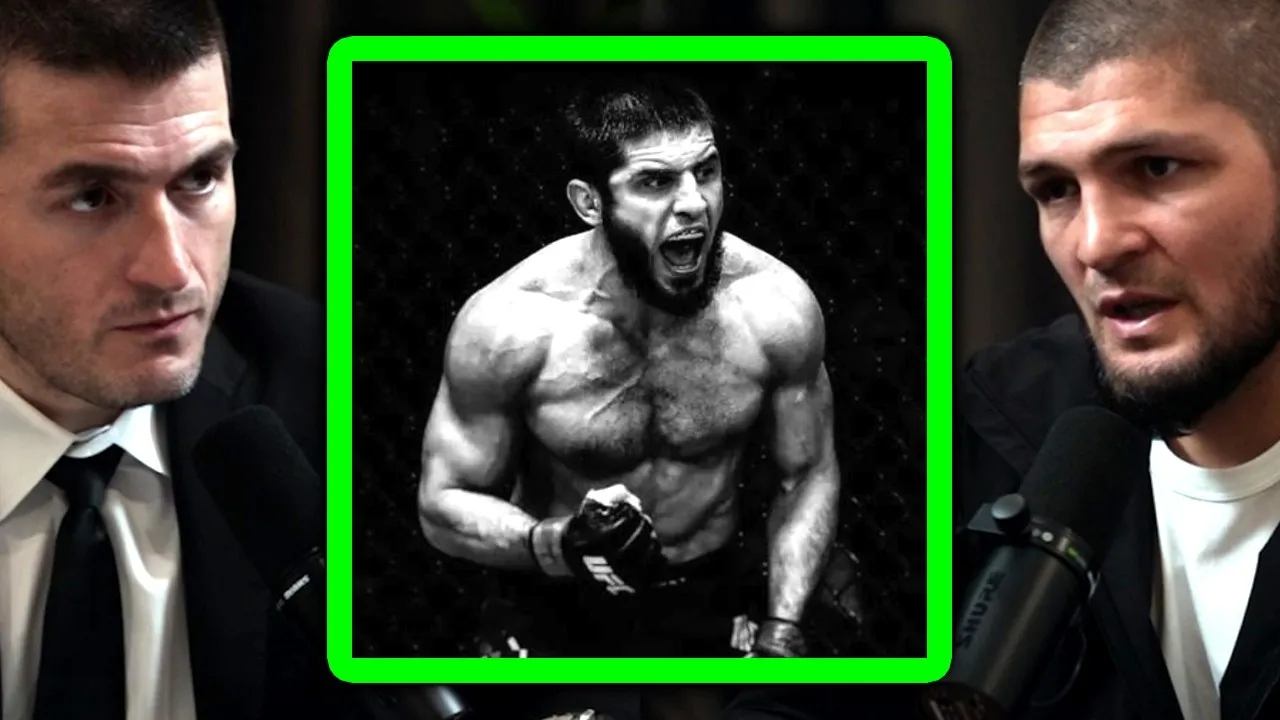 WATCH NOW↓
 Khabib Nurmagomedov’s hottest take on Islam Makhachev is also his most Khabib take: yes, Islam can pass Jon Jones, Demetrious Johnson, and Georges St-Pierre in the all-time MMA argument, but please notice the clock chewing through his prime. This is teammate hype with a stopwatch attached.
On Lex Fridman Podcast, Khabib Nurmagomedov does not do the normal cornerman thing where every training partner is secretly the best fighter ever and the record books are just waiting to be corrected. He gives Makhachev the full family blessing, then immediately starts talking like a man staring at an hourglass in a sauna. Makhachev can get there. He just cannot linger.
If Jon Jones is there, why can’t Islam be there? If Demetrious Johnson is there with 11 title defenses, why can’t Islam be there? It’s a good question. Why not?
That is the headline answer. Khabib believes Makhachev belongs in the same room as the giants. But the more revealing part is that he frames greatness not as aura, not as undefeated mysticism, not as a pound-for-pound graphic on a broadcast, but as a race against biology. Jon Jones gets time. Heavyweights get time. The 155 and 170-pound killers get a receipt.
I’d like him to break all those records, to overtake Jon Jones, Demetrious Johnson, and St-Pierre, no matter how much respect I have for them. Islam has a chance, but time is starting to run out a little.
The compliment is real. So is the warning.
Khabib’s case for Makhachev is not built on one night, one belt, or one highlight where a man realizes too late that his arm belongs to Islam now. It is built on what he calls a chain. Older fighters pulled Khabib up, Khabib pulled Makhachev up, and now Makhachev is the terrifying adult in the room making the next generation better. It is less Rocky montage, more conveyor belt of bad news.
This is a kind of chain that exists in a gym, in a training system, that produces the best fighters in the world.
That matters because GOAT arguments in MMA often flatten into résumé spreadsheets: title defenses, double-champ status, quality of opposition, failed drug tests, eye-poke discourse, everyone yelling at a phone in a bar. Khabib is making a different pitch. Makhachev’s greatness, to him, is the product of a 20-plus-year ecosystem, school, neighborhood, gym, father, sparring partner, sacrifice. Very Dagestan. Very unromantic. Very effective.
He also gives Makhachev the highest possible Abdulmanap-era stamp: Khabib says his father saw the potential early and considered Islam one of his favorite students. In Khabib’s universe, that is not sentimental garnish. That is canon.
My father saw in him this potential for greatness in how hard he trained.
Khabib’s aging theory is the part fans will fight over
The skeptical read: of course Khabib wants his close friend and teammate in the GOAT debate. This is the same gravitational pull that makes every retired legend discover that the next legend just happens to share his gym, his coaches, and his childhood memories. Nobody is immune to the home-team fog machine.
But Khabib’s warning about age is not empty flattery. It is the hard part of the claim, and it rings truer than the coronation. Lighter fighters depend on speed, timing, scrambles, reactions, and endless small explosions. A heavyweight can sometimes age into craft and still find one nuclear punch. A lightweight who loses half a step may suddenly find that every exchange has become customer service for younger violence.
But, when you compete in lighter weight classes, 155, 170, age really catches up.
That is why this lands better than a simple “Islam is the greatest” clip. Khabib is not pretending the UFC rankings exist outside time. He is saying Makhachev’s path is possible and narrow. To pass Jones, Demetrious Johnson, and St-Pierre, Islam does not just need wins. He needs the kind of wins that age well, and he needs them before the weight class starts charging interest.
The funny thing is that Khabib, six years retired, still talks like a man who hasn’t emotionally left the mat. He says he still wrestles, still grapples, still wants 40 minutes before he feels the real high. The retired guy is explaining aging while refusing to let go of the thing that made him immortal. That contradiction is not hypocrisy. It is the whole sport.
So the next Makhachev fight carries a very specific stake: not just whether he wins, but whether he adds enough historical weight before Khabib’s clock runs out on him.
- What did Khabib say about Islam Makhachev and the MMA GOAT debate?
- Khabib said Makhachev has a chance to enter the all-time conversation with Jon Jones, Demetrious Johnson, Georges St-Pierre, and Fedor Emelianenko. He did not crown him outright, but he did say he wants Makhachev to break those records and overtake those names.
- Why does Khabib think Islam Makhachev is running out of time?
- Khabib’s argument is that lighter fighters age differently. At 155 or 170 pounds, reaction speed, pace, and physical sharpness fade faster than they do at heavyweight or light heavyweight, where Jon Jones has been able to stretch his career.
- What makes Islam Makhachev special according to Khabib?
- Khabib points less to one magic skill than to the system around Makhachev: childhood training, years under Abdulmanap Nurmagomedov, constant sparring with better and older teammates, and a life stripped down to training, eating, sleeping, and repeating.
Khabib Nurmagomedov says his father prepared him for Conor McGregor by making him lose judo matches at 15
On Lex Fridman’s podcast, Khabib turns his invincibility myth into something more annoying and more useful: repetition, discomfort, and losing early where nobody was watching.
Don Lincoln says Fermilab was two or three years from discovering the Higgs boson before CERN got there
The Fermilab physicist frames the Higgs discovery as a near miss, not a clean victory lap for CERN, and he has the machine numbers to make that sting.
Anthony Kaldellis says Rome’s three biggest disasters were the Arab conquests, the Seljuk conquest of Asia Minor, and the Fourth Crusade
The Byzantine historian’s Roman Empire is not a marble statue collapsing in 476, but a long-running state repeatedly injured by three fast, brutal shocks.
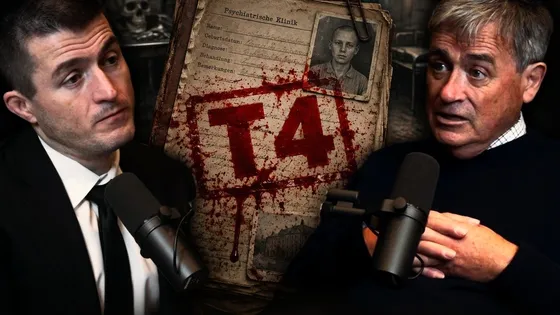
Andrew Scull says Nazi gas chambers were developed first to kill mental patients
The historian of psychiatry connects asylum overcrowding, American eugenics, California sterilization laws, Rockefeller-funded genetics research, and the Nazi T4 program into one grim family tree.
The circuit, read weekly. No noise.