Michael Lee says Sequence cut BankSouth consumer loan underwriting time by 94%
The Sequence Holdings CEO gave No Priors the cleanest kind of AI proof point, a boring bank workflow made wildly faster, but the bigger claim still needs a credit cycle.
Listen on YouTube
 WATCH NOW↓
 The rarest thing in AI is not a demo. It is a number you can understand without wearing a Patagonia vest in a Sand Hill Road conference room. On No Priors, Michael Lee said Sequence’s work at BankSouth cut average consumer loan underwriting time by 94%, then took commercial loan processing from 30 days to 11.
That is the claim worth taking seriously. Not because it proves that every sleepy incumbent is one agent workflow away from becoming Nvidia with tellers. It doesn’t. But because Lee is making the case that artificial intelligence will create its first boring miracles in places with clean rules, centralized processes, and lots of humans copying numbers from one box to another. Banks, in other words. The least sexy possible arena, which is usually where the money is hiding.
لقد بنينا اليوم نظاماً يمكنه تولي جميع قروض المستهلكين داخل المؤسسة. لذا، انخفض متوسط اكتتاب قروض المستهلكين اليوم بنسبة 94%منذ أن بدأنا في مارس.
The bank is the demo
Lee’s company, Sequence Holdings, is not pitching itself as another AI vendor hawking copilots to procurement. It is a permanent holding company that wants to buy or partner with incumbents, wire in engineers, and rebuild the operating system from inside the house. Its first test case was BankSouth, a Georgia bank connected through the family of an early contact. Lee says Sequence began as a services partner, then became an investor after federal approvals.
The result, according to Lee, was not a chatbot named Finley cheerfully explaining APRs. It was the plumbing. Consumer underwriting got automated enough that the bank could handle far more loan volume with the same, or even smaller, underwriting staff. The human workers, in Lee’s telling, moved toward harder exceptions and customer-facing work. This is AI as middle-office forklift, not AI as robot banker in a blazer.
قمنا عملياً بتقليص متوسط وقت معالجة القرض في البنك من 30 يوماً إلى 11 يوماً فقط من البداية إلى النهاية.
The verdict: credible as an operational speed claim, incomplete as a business transformation claim. Loan processing time is a real metric. So is underwriting headcount. But banking is not a Peloton onboarding flow. The harder questions are credit quality, compliance, exceptions, and whether faster underwriting means better loans or just faster yeses. Lee is careful enough to say the bank’s loan volume doubling from Q1 to Q2 was luck, not a trophy he wants to grab with both hands. Good. That restraint makes the rest of the pitch more believable.
Sequence wants to buy the boring kingdom
The BankSouth stat matters because it explains why Sequence just announced a much bigger swing, a $7.7 billion take-private deal for Baldwin alongside Michael Dell’s family office. Insurance brokerage is even more Sequence-coded than banking: huge market, relationship-driven distribution, high retention, and miserable startup attack surface. Lee’s argument is that startups struggle when the incumbent already owns trust, customers, compliance, and distribution. So don’t fight the castle. Buy the castle. Then give the castle engineers.
This is also where Lee gets a little grand, in the way finance people do when they discover that culture is not just a slide near the end of the deck. He says every company has a figure it celebrates. At Blackstone, the celebrated figure is the investor. At Sequence, he wants it to be the engineer. That sounds like a recruiting slogan because it is one. It is also a pretty direct shot at private equity, which has spent decades making gods of dealmakers and then wondering why the software people don’t want to sit at the kids’ table.
في عالم تؤمن فيه بأن العوائد المتميزة تأتي من الهندسة والذكاء الاصطناعي، تحتاج إلى خلق ثقافة تكون فيها الشخصية المحتفى بها هي المهندس.
His critique of traditional funds is simple and self-serving, which doesn’t make it wrong. Funds need to deploy capital. Funds need exits. Funds need to show marks and return money. Lee says Sequence can be pickier because it only wants to do about one deal a year, and because the holding-company structure lets it think in decades rather than auction timelines. If that sounds like Berkshire Hathaway got trapped in a WeWork phone booth with Palantir, congratulations, you understand the pitch.
نحن نحاول إتمام صفقة واحدة سنوياً. هذا كل شيء. ليس لدينا وتيرة محددة لتوزيع الاستثمارات.
The number is real. The revolution is pending.
Lee’s strongest idea is not that AI will make every company a tech company. That line should be retired and buried next to the metaverse office. His better point is that AI favors companies whose work can be mapped into rules, records, permissions, workflows, and exceptions. A regulated bank, weirdly, becomes a nice little racetrack for agents because the lanes are already painted.
The danger is extrapolation. A 94% reduction in consumer loan underwriting time at one bank is a serious proof point. It is not yet proof that Sequence can refound every incumbent it touches, or that Baldwin will become the AI-native insurance brokerage colossus of Lee’s investor dreams. But it is a much better claim than the usual AI fog machine. If the promise of enterprise AI is real, it may not arrive first as a glowing assistant that changes your life. It may arrive as the disappearance of 19 days from a loan file.
- What did Michael Lee say Sequence actually did at BankSouth?
- Lee said Sequence built a system that now handles all consumer loans inside the bank, cutting average consumer loan underwriting time by 94%. He also said commercial loan processing fell from 30 days to 11 days, which is the kind of metric AI companies dream of putting on a billboard.
- Does the BankSouth example prove AI is producing real ROI in finance?
- It proves something narrower and more useful: AI can attack a repetitive, centralized workflow when the data and rules are legible. It doesn't yet prove that credit outcomes are better, that the gains survive at larger scale, or that every bank can copy the result.
- Why does Lee think Sequence is different from normal private equity?
- Lee argues that private equity firms are built to celebrate investors and prepare assets for sale, while Sequence is built to celebrate engineers and hold companies long enough to rebuild them. That is a neat distinction, and also a very convenient pitch for a holding company trying to win deals.
Erik Allebest says poker players will care about ratings as much as money
The Chess.com CEO is taking the site's status machine to poker, where the chips are fake, the ego damage is real, and the rating may be the whole product.

Nate Soares says humanity would be lucky to have 10 years unless we stop building superintelligence
The AI safety researcher’s doomsday clock is blunt, but his stronger argument is that a global pause might actually be enforceable because frontier AI training is huge, scarce and visible.
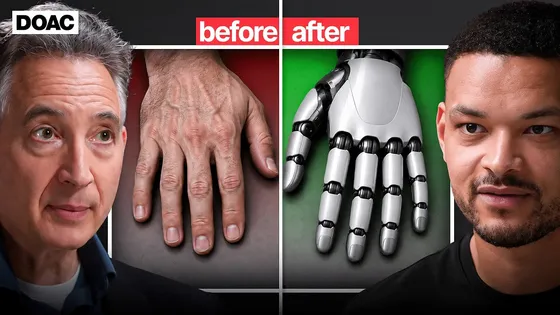
Brian Greene says by the time we see an AI intelligence explosion, it may be too late to stop it
The physicist is not buying every 2029 superintelligence prophecy, but he thinks the math of exponential growth is exactly what makes AI risk so nasty.

Matt Ehret says cosmic rays, not human CO2, are the real causes of climate change
On the Danny Jones Podcast, Ehret revives the Henrik Svensmark cosmic-ray theory and says the scientist was professionally punished for challenging the CO2 consensus.
The circuit, read weekly. No noise.